
Hain Celestial's Stock: A High-Risk Bet Amid Legal Storms and Governance Overhaul
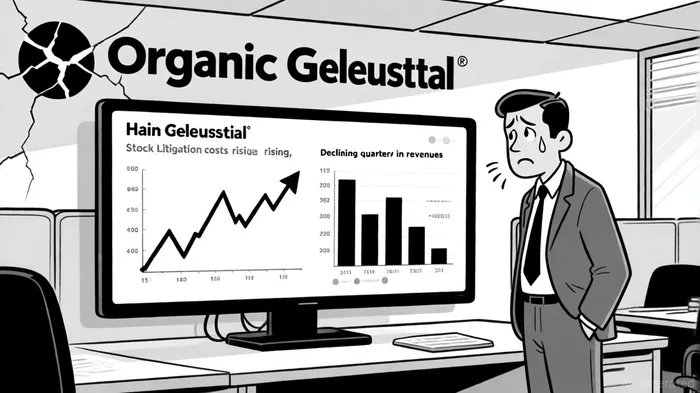
The natural and organic food sector, long celebrated for its growth potential and alignment with health-conscious consumer trends, has become a battleground for legal and operational risks. Nowhere is this more evident than in the case of Hain CelestialHAIN-- Group (HAIN), a once-dominant player now grappling with a perfect storm of litigation, governance upheaval, and financial underperformance. For investors, the question is no longer whether Hain Celestial is a viable long-term bet—but whether its survival hinges on navigating these crises or if its stock has become a cautionary tale.
Legal Challenges: From “Channel Stuffing” to Heavy Metal Controversies
Hain Celestial's legal woes in 2025 have escalated dramatically. A federal appeals court recently revived the lawsuit, alleging the company engaged in a “channel stuffing” scheme between 2014 and 2016, artificially inflating sales by pushing inventory onto distributors through incentives and side deals. Separately, the court ruled that executives disseminated “half-truths” to mask these practices, a decision that resurrects claims of securities fraud and threatens further reputational and financial damage.
Compounding these issues, the company faces over 210 lawsuits tied to its Earth's Best baby food line, accused of containing toxic heavy metals like lead and arsenic. Plaintiffs allege these contaminants contributed to developmental disorders such as autism and ADHD. Unlike labeling disputes—where peers like Chobani and Kashi settled for millions over “natural” claims—this case strikes at the core of consumer trust in organic products. The multidistrict litigation (MDL) could result in astronomical settlement costs, mirroring the $2.3 billion Baby Formula MDL involving other manufacturers.
Operational Decline: Sales Slumps and Strategic Overhauls
Hain's financial performance underscores its operational fragility. Q3 2025 results revealed an 11% year-over-year sales drop to $390 million, with North America's snacks and infant nutrition categories underperforming. The company reported a $135 million net loss, driven by $133 million in impairment charges and a 23% plunge in adjusted EBITDA, according to the earnings call transcript. Even as it pivots to “Hain Reimagined”—a strategy emphasizing cost cuts, digital transformation, and portfolio streamlining—its 5% organic sales decline suggests execution gaps, per a SWOT analysis.
Leadership changes, including Wendy Davidson's exit and Alison Lewis's appointment as interim CEO, signal a strategic reset, according to a company announcement. However, Lewis's outsider status and the company's reliance on Goldman Sachs for a portfolio review highlight deep-seated uncertainties. Analyst perspectives show an average price target of $3.69 (as of September 2025)—a 33% drop from prior estimates—reflecting diminished confidence in management's ability to stabilize operations.
Governance and Industry Comparisons: A Stark Contrast
Hain's governance risks stand out even in a sector prone to labeling disputes. While peers like Organic Avenue and Nature's Way have faced FTC scrutiny for “natural” claims, Hain's channel stuffing allegations and product safety crises represent a more systemic failure of corporate oversight. A 2025 market overview of the organic-food sector underscores how normative certification expectations raise the stakes for brand trust. The USDA organic standards further amplify the irony of Hain's current predicament.
The company's leverage ratio of 4.7x and -25% net margin (per Q1 earnings) paint a grim picture compared to industry averages. In contrast, rivals such as Whole Foods Market and Amy's Kitchen have maintained positive EBITDA margins, per Whole Foods' financials, underscoring Hain's operational inefficiencies.
Investor Implications: A Calculated Risk?
For risk-tolerant investors, Hain Celestial's stock offers a speculative play on a potential turnaround. Its strategic initiatives—$25 million in projected cost savings by mid-2026 (per the company's Q3 release) and a focus on digital capabilities—could stabilize cash flows. However, the legal and reputational headwinds are formidable. The channel stuffing case alone could trigger additional fines or shareholder settlements, while the Earth's Best litigation risks long-term brand erosion.
Analysts' Hold ratings reflect this duality. A September 2025 earnings miss sent shares plummeting 24.65% to $1.62, according to an investor alert. Yet, if Hain successfully executes its restructuring and resolves litigation without catastrophic penalties, the stock's 114% upside from current levels (per analyst targets) could materialize.
Conclusion: A Tenuous Path Forward
Hain Celestial's stock attractiveness in 2025 hinges on its ability to navigate a dual crisis: legal exposure and operational stagnation. While its governance overhaul and cost-cutting measures are steps in the right direction, the scale of its challenges—particularly the Earth's Best lawsuits—poses existential risks. For investors, the key will be monitoring litigation outcomes, the success of its strategic review, and whether the new leadership can restore credibility. Until then, Hain Celestial remains a high-risk proposition in an industry where trust is as vital as organic certification.
"""





Comentarios
Aún no hay comentarios