
Guyana's Essequibo Oil Wealth Amid U.S. Geopolitical Interventions in South America: Assessing the Geopolitical Security Premium and Long-Term Stability for Energy Investors
Guyana's Essequibo region has emerged as a pivotal frontier in South America's energy landscape, driven by its vast offshore oil reserves and the strategic interventions of the United States. As the U.S. recalibrates its influence in the Western Hemisphere following its 2026 military operation in Venezuela, Guyana's energy sector has become a focal point for global investors. However, the interplay of geopolitical risks, economic dependencies, and institutional frameworks demands a nuanced assessment of the geopolitical security premium and long-term stability for energy investors.
U.S. Geopolitical Interventions and Regional Stability
The U.S. intervention in Venezuela, which culminated in the arrest of President Nicolás Maduro in January 2026, has reshaped the regional energy dynamics. By dismantling Venezuela's oil infrastructure-a critical lifeline for China and Russia-the U.S. has not only weakened rival powers but also created a vacuum that Guyana is poised to fill. According to a report by , this intervention has prompted a "new scramble for Latin America," with the U.S. seeking to reassert dominance while regional actors like Brazil and Mexico navigate shifting allegiances.
For Guyana, the U.S. has provided military and diplomatic support to safeguard its territorial claims in the Essequibo region, a disputed area rich in oil. This backing has reduced immediate risks of conflict with Venezuela, which has historically asserted claims over the region. As stated by the U.S. Department of State, "Guyana's sovereignty and regional stability are aligned with U.S. strategic interests," a stance reinforced by Secretary of State Marco Rubio's 2025 visit. Such interventions have indirectly stabilized Guyana's energy sector, enabling ExxonMobilXOM-- and its partners to accelerate production in the Stabroek Block.
Economic Transformation and Investment Momentum
Guyana's oil-driven economic boom has been nothing short of extraordinary. With offshore production exceeding 650,000 barrels per day in 2024 and projected to reach 1.3 million barrels per day by 2027, the country's GDP surged by 43.6% in 2024, making it the fastest-growing economy globally. The Natural Resource Fund (NRF), which managed $3.6 billion in oil revenues by September 2025, has become a cornerstone of fiscal policy, funding infrastructure and social programs.
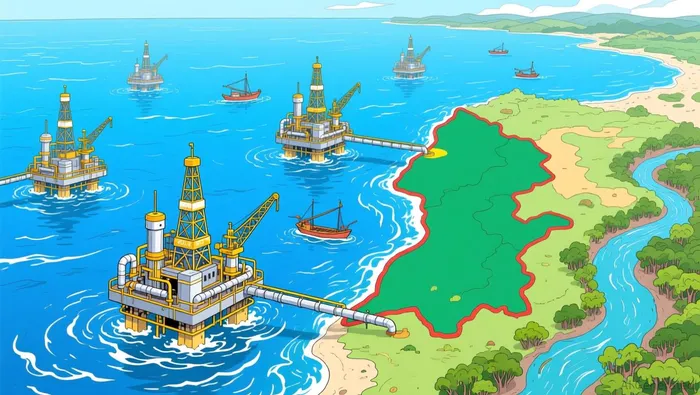 However, this rapid growth has raised concerns about the "oil curse"-a phenomenon where resource wealth leads to governance challenges and economic imbalances. Despite a GDP per capita that has soared, poverty persists with 48-58% of Guyanese still living below the poverty line. The government's efforts to diversify the economy, including the Gas-to-Energy project (set to generate 300 MW of electricity by 2026), aim to mitigate these risks.
Geopolitical Security Premium: Quantifying the Risks
The geopolitical security premium for Guyana's energy sector is shaped by both regional and global factors. While U.S. support has reduced immediate threats from Venezuela, the risk of gray zone operations-such as cyberattacks or maritime incursions-remains. A 2025 risk analysis by highlights that Venezuela's alignment with Russia, China, and Iran increases the likelihood of indirect threats to Guyana's offshore assets.
Financial institutions have begun factoring these risks into their assessments. For instance, the BlackRock Geopolitical Risk Indicator (BGRI) notes that regional conflicts and U.S.-China competition could elevate energy market volatility, indirectly affecting Guyana's export stability. Additionally, the 2025 U.S. imposition of a 15% tariff on Guyanese exports (though largely exempt for oil) underscores the sensitivity of trade relations.
Despite these challenges, Guyana's strategic partnerships have enhanced its resilience. The innovative agreement with U.S.-based Curlew Midstream-where Guyana trades crude oil for refined products-has reduced domestic energy costs and insulated the country from refinery-related risks. Similarly, the $6.8 billion Hammerhead Development project, the largest Final Investment Decision (FID) of 2025, reflects confidence in Guyana's project execution and geopolitical stability.
Institutional Frameworks and Investor Confidence
Guyana's regulatory environment has evolved to attract foreign direct investment (FDI). The 2025 Financial Institutions (Amendment) Act allows foreign banks to establish representative offices, while the Local Content Act of 2021 mandates local sourcing for energy projects. These reforms, coupled with streamlined business registration processes, have positioned Guyana as a high-growth destination.
Yet, institutional weaknesses persist. World Bank governance indicators reveal gaps in transparency and accountability, raising concerns about the equitable distribution of oil revenues. The 2025 elections, in which President Irfaan Ali secured a second term, have provided political continuity but also highlighted the need for robust checks and balances.
Conclusion: Balancing Opportunity and Risk
For energy investors, Guyana's Essequibo region represents a paradox: a high-growth, resource-rich economy underpinned by U.S. geopolitical support, yet vulnerable to regional tensions and institutional fragility. The geopolitical security premium-while not quantified explicitly in financial reports-can be inferred through factors like Venezuela's territorial disputes, global energy market volatility, and the U.S.-China rivalry.
Investors must weigh these risks against Guyana's strategic advantages: a transparent sovereign wealth fund, innovative energy partnerships, and a production-sharing agreement that ensures long-term revenue management. As the Stabroek Block's potential nears full realization, the key to sustained stability lies in diversifying the economy, strengthening institutions, and leveraging regional alliances. In this context, Guyana's energy sector remains a high-reward, high-risk proposition-one that demands both strategic foresight and geopolitical agility.







Comentarios
Aún no hay comentarios