
GSK's Bepirovirsen and the Path to a Hepatitis B Functional Cure: Strategic Pipeline Value and Revenue Potential in a High-Unmet-Need Market
The hepatitis B virus (HBV) remains a global health crisis, affecting over 250 million people worldwide. Despite decades of research, current treatments-primarily nucleos(t)ide analogues-offer limited efficacy, requiring lifelong administration and achieving functional cure rates of less than 1%. This unmet need has positioned the development of functional cure therapies as a high-stakes priority for pharmaceutical innovators. GlaxoSmithKline's (GSK) antisense oligonucleotide (ASO) candidate, bepirovirsen, has emerged as a transformative contender in this space. With robust Phase III trial results and a rapidly expanding market for HBV therapeutics, GSK's pipeline asset represents a compelling strategic and financial opportunity.
Clinical Efficacy: A Triple-Action Mechanism and Proven Outcomes
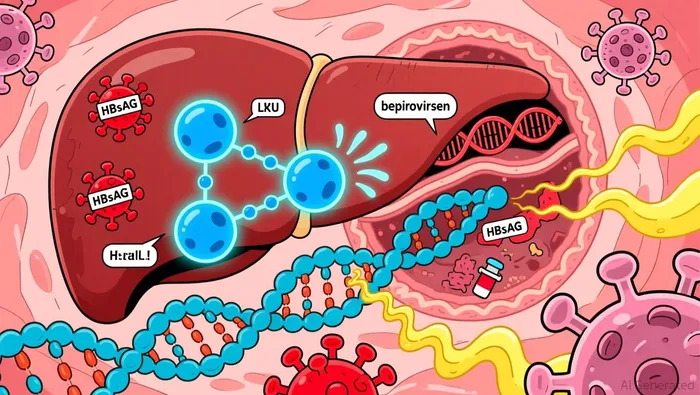
Bepirovirsen's mechanism of action distinguishes it from conventional therapies. As a triple-action ASO, it inhibits viral DNA replication, suppresses HBsAg levels, and activates the immune system via toll-like receptor 8 (TLR8) agonism. These combined effects aim to achieve a functional cure, defined as sustained HBsAg loss and undetectable HBV DNA for at least 24 weeks post-treatment.
Data from GSK's pivotal Phase III trials (B-Well 1 and B-Well 2) demonstrated statistically significant and clinically meaningful functional cure rates, far surpassing the 1% benchmark of existing therapies. A sub-analysis of the Phase II B-Sure study further highlighted the durability of these responses, with sustained HBsAg loss observed for up to 12 months after treatment cessation in patients receiving bepirovirsen combined with pegylated interferon (Peg-IFN). These results underscore the drug's potential to redefine treatment paradigms by offering a finite, curative regimen.
Market Dynamics: A High-Growth, High-Stakes Opportunity
The HBV therapeutics market is poised for exponential growth, driven by the transition from long-term antiviral therapies to functional cure approaches. According to market forecasts, the global HBV treatment market size is projected to expand from $2.48 billion in 2025 to $6.25 billion by 2032, growing at a compound annual growth rate (CAGR) of 14.1%. The seven major markets (7MM)-comprising the U.S., EU5, and Japan-are expected to see even more dramatic shifts, with the chronic HBV therapeutics market expanding from $1.5 billion in 2024 to $3.2 billion by 2034 at a CAGR of 7.9%.
Functional cure drugs are anticipated to dominate this growth, accounting for over 65% of the 7MM market by 2034. This transition is fueled by the limitations of nucleos(t)ide analogues and the rising demand for curative solutions. Bepirovirsen, alongside late-stage competitors like Gilead's selgantolimod and Aligos' ALG-000184, is positioned to capture a significant share of this expanding market.
Competitive Landscape: Bepirovirsen's Differentiators
Bepirovirsen's competitive edge lies in its clinical performance and regulatory momentum. The drug has demonstrated superior functional cure rates compared to standard of care, particularly in patients with baseline HBsAg levels below 1,000 IU/ml. Its safety profile, consistent with prior studies, further strengthens its appeal. Regulatory designations-including Fast Track in the U.S., Breakthrough Therapy in China, and SENKU in Japan-underscore its potential to address critical unmet needs and accelerate approval timelines.
While competitors such as Gilead and Bristol-Myers Squibb are also advancing functional cure candidates, bepirovirsen's triple-action mechanism and durable response data position it as a front-runner. The drug's anticipated approval in Q1 2026 aligns with a market window where demand for curative therapies is surging, particularly in high-prevalence regions like Asia-Pacific, which is forecasted to become the fastest-growing market for HBV therapeutics.
Revenue Projections and Strategic Implications
Analysts project that bepirovirsen could become a blockbuster asset. The global functional cure drugs market, valued at $783 million in 2024, is expected to grow to $1.15 billion by 2032 at a CAGR of 6.1%. Within this landscape, bepirovirsen is forecasted to capture a substantial market share, driven by its efficacy, regulatory advantages, and strategic partnerships.
In the 7MM, the U.S. currently dominates the HBV market, accounting for 47.5% of 2024 sales. By 2034, however, the market is expected to diversify as functional cure therapies gain traction in Europe and Asia-Pacific. Bepirovirsen's potential to command premium pricing- functional cures are projected to be more expensive than current therapies-further enhances its revenue potential.
Risks and Mitigants
Despite its promise, bepirovirsen faces challenges, including potential generic competition as patents for existing therapies like Gilead's Vemlidy expire. Additionally, a projected decline in diagnosed HBV cases due to improved screening and vaccination programs could temper market growth. However, the drug's robust clinical data, combined with GSK's expertise in liver disease innovation, positions it to mitigate these risks and maintain a leadership role in the functional cure era.
Conclusion: A Strategic Win for GSKGSK-- and Investors
GSK's bepirovirsen represents a rare convergence of clinical innovation and market demand. With Phase III success, regulatory tailwinds, and a rapidly expanding functional cure market, the drug is poised to deliver transformative value for both patients and shareholders. As the HBV therapeutics landscape evolves, bepirovirsen's role in redefining treatment standards and capturing a dominant market share makes it a cornerstone of GSK's pipeline-and a compelling investment opportunity.







Comentarios
Aún no hay comentarios