
GRVT's $19M Raise and the Battle for On-Chain Finance's Future
The on-chain trading landscape is undergoing a seismic shift as privacy, scalability, and institutional adoption become critical battlegrounds. GRVT's recent $19 million Series A raise—co-led by ZKsyncZK--, Further Ventures, EigenCloud, and 500 Global—has positioned it as a formidable challenger to Hyperliquid, the dominant player in the space. This funding round, described as a “watershed moment for privacy-first onchain finance” by CoinDesk[2], underscores GRVT's ambition to redefine the industry's infrastructure while addressing Hyperliquid's perceived limitations in security, transparency, and institutional readiness.
Strategic Foundations: ZKsync, EigenDA, and Institutional-Grade Infrastructure
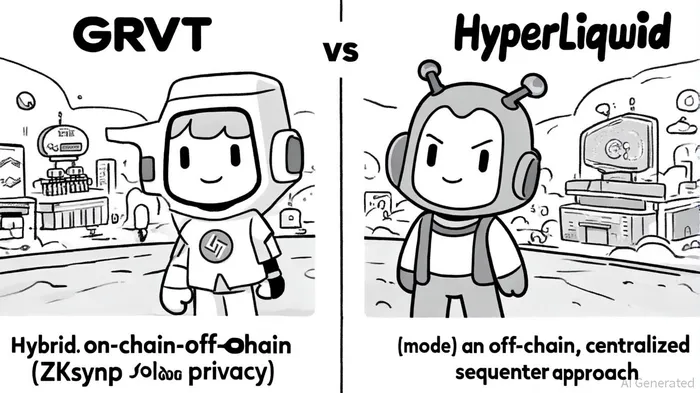
GRVT's infrastructure is built on a hybrid model that merges on-chain settlements with off-chain execution, a design explicitly tailored for institutional adoption. By leveraging ZKsync's Validium L2 blockchain, GRVT ensures Ethereum-level security while achieving low-latency trading—a critical requirement for high-frequency institutional participants[1]. This contrasts sharply with Hyperliquid's fully off-chain model, which relies on a centralized sequencer to prioritize speed but introduces counterparty risk[1].
The integration of EigenCloud's EigenDA further strengthens GRVT's scalability, enabling secure and cost-effective data availability for its privacy-focused transactions[1]. According to a report by ICO Holder, this infrastructure allows GRVT to process trades with “zero-knowledge proofs that obscure trade data, shielding large positions from front-running and liquidation sniping”[4]. Such features are increasingly attractive to institutions wary of the transparency risks inherent in Hyperliquid's fully public ledger[4].
Privacy as a Competitive Edge
Privacy has emerged as GRVT's most compelling differentiator. While Hyperliquid's open-book model—where all positions and order data are visible—has driven its $400 billion monthly volume, it also creates vulnerabilities for large traders[4]. GRVT's validium chain, by contrast, validates transactions without exposing underlying trade details, a feature that has already drawn interest from “large institutional players seeking regulatory clarity and operational secrecy”[2].
This privacy-first approach is not merely defensive. GRVT's use of zero-knowledge cryptography aligns with broader industry trends toward RegDeFi frameworks, which blend decentralized finance's transparency with regulatory compliance. As noted in a blog post by GRVT itself, this model “addresses the critical gap between Web3's trustless ethos and institutional requirements for auditability and compliance”[1].
Institutional Adoption: A War of Features and Trust
Hyperliquid's 70% market share[4] is a testament to its execution speed and user-friendly interface, but GRVT's institutional-grade security measures are designed to erode this advantage. The platform's hybrid account management system combines Web2 onboarding (email, OAuth) for KYC with SecureKey (MPC, biometrics) for self-custodial trading—a feature Hyperliquid lacks[1]. This dual-layer approach reduces onboarding friction while maintaining full control over funds, a critical factor for institutions navigating complex compliance regimes.
Security is another area where GRVT's strategy diverges. The platform emphasizes “rigorous verification processes, including MFAMFA--, HSMs, and secure enclaves,” according to a Publish0x analysis[3]. Hyperliquid, while adhering to standard Web3 practices, does not prioritize institutional-grade security to the same extent[3]. For investors, this distinction could determine which platform becomes the default choice for institutional capital inflows.
Yield-First Strategy: A New Paradigm for On-Chain Finance
GRVT's product roadmap includes fixed-yield generation flywheels, tokenized vaults managed by institutional partners, and real-world asset integrations—features that position it as a hybrid between a decentralized exchange and a yield-generating platform[2]. This dual-target approach—catering to both active traders and passive investors—is rare in the DeFi space and could disrupt Hyperliquid's ecosystem, which currently focuses narrowly on trading volume[2].
The $19 million raise will accelerate these initiatives, with funds allocated to infrastructure development, community building, and talent acquisition[1]. For context, ZKsync's involvement as a lead investor signals confidence in GRVT's ability to scale its privacy-centric model, a critical factor in an industry where network effects often dictate long-term success[1].
Conclusion: A Tipping Point for On-Chain Finance
GRVT's $19 million raise is more than a funding milestone—it represents a strategic pivot toward institutional-grade on-chain finance. By addressing privacy, scalability, and regulatory compliance, GRVT is positioning itself to challenge Hyperliquid's dominance in a market poised for explosive growth. For investors, the key question is whether the industry will prioritize speed and transparency (Hyperliquid's strengths) or security and privacy (GRVT's focus). Given the accelerating demand for RegDeFi solutions, the latter appears increasingly likely.
As the on-chain trading wars intensify, GRVT's ability to execute its hybrid model and attract institutional capital will be a defining narrative in 2026.






Comentarios
Aún no hay comentarios