
The Growth Potential of Prepared Meal Delivery Services: A Strategic Analysis of Factor Meals in 2025
The prepared meal delivery industry is undergoing a seismic shift, driven by the collision of health consciousness, urbanization, and the relentless demand for convenience. By 2025, the global prepared meal delivery market is projected to reach $12.23 billion, with a 12.0% CAGR through 2032, as consumers increasingly prioritize nutrition without sacrificing time. Within this landscape, the healthy meal delivery sector is accelerating faster still, with a 15% CAGR expected from 2024 to 2031, fueled by subscription-based models and dietary customization. At the forefront of this evolution is Factor Meals, a high-margin, high-growth player that has redefined the intersection of convenience and health.
Factor Meals: A Niche with Premium Pricing Power
Factor Meals distinguishes itself through a heat-and-eat model, offering pre-cooked, dietician-approved meals that eliminate the need for home preparation. This contrasts with competitors like HelloFresh, which rely on meal kits requiring assembly according to a 2025 review. Factor's value proposition is built on three pillars:
1. Nutritional Precision: Meals are tailored to keto, low-carb, plant-based, and high-protein diets, with strict ingredient vetting (banning over 160 additives) and portion control (400–800 calories per serving) according to a detailed analysis.
2. Convenience: No chopping, no cleanup-just heat and eat, appealing to time-constrained professionals and fitness enthusiasts.
3. Premium Branding: Factor's meals are free from hormones, antibiotics, gluten, and GMOs, with add-ons like steak and mahi mahi elevating perceived value according to product reviews.
This focus on health-first convenience has allowed Factor to command a premium price point ($10.99 per serving), significantly higher than traditional meal kits. Despite this, demand remains robust, with Factor's parent company reporting $65 million in November 2025 revenue-a 15–20% increase from October-and projecting 20–25% growth in 2025 compared to 2024.
Financials: High Margins in a Scalable Model
Factor's financials underscore its appeal as an investment. By 2025, it is projected to achieve adjusted EBITDA margins of 12–14%, outperforming the industry's median margin of 11.3%. This resilience stems from:
- Operational Efficiency: Pre-cooked meals reduce per-unit costs compared to raw-ingredient kits, while HelloFresh's global infrastructure lowers distribution expenses according to financial analysis.
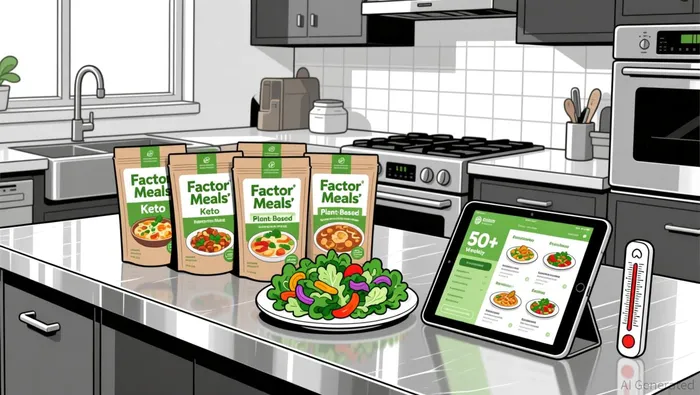
- Subscription Stickiness: Factor's rotating weekly menu (50+ entrées, 70+ add-ons) and personalized dietitian consultations enhance customer retention according to consumer insights.
- 
- Market Expansion: Factor's 2025 revenue of $480 million (up from $93 million in 2020) reflects its dominance in the U.S. healthy meal market, where it holds over 80% of the ready-to-eat sector's market share.
Critics argue that Factor's pricing and menu repetition could limit scalability, but its 12–14% EBITDA margins and 13.24% CAGR in the U.S. meal kit market suggest strong unit economics. Moreover, its recent retail launch and expansion into premium add-ons signal a strategy to diversify revenue streams.
Market Position: Leading in a $57 Billion Opportunity
The healthy meal delivery sector is a $24.77 billion market in 2024, projected to balloon to $57.45 billion by 2031. Factor's dominance in the U.S. ready-to-eat niche-where it holds over 80% market share-positions it to capitalize on this growth. Key tailwinds include:
- Urbanization and Digital Penetration: The U.S. meal kit market is growing at 13.1% CAGR, driven by urban populations seeking time-saving solutions.
- Health Trends: 63% of American consumers prioritize healthier options, avoiding processed foods according to market research. Factor's dietitian-approved meals align perfectly with this shift.
- Sustainability: Meal kits inherently reduce food waste, and Factor's eco-friendly packaging further appeals to environmentally conscious buyers according to industry analysis.
While competitors like Blue Apron and Freshly dominate the cook-and-eat segment (60.6% market share in 2022), Factor's heat-and-eat model is gaining traction, with a 15.7% CAGR from 2023–2030. This bifurcation of the market allows Factor to target a distinct demographic-individuals prioritizing convenience over customization-without directly competing with meal kit leaders.
Risks and Mitigants
Factor's success hinges on maintaining its premium brand while scaling. Challenges include:
- Price Sensitivity: At $10.99 per serving, Factor is 30–50% pricier than HelloFresh or Blue Apron according to market analysis. However, its focus on health-conscious, high-income consumers (36.1% of market share from households with rising disposable income) according to industry reports mitigates this risk.
- Menu Fatigue: Critics note repetitive protein-vegetable-carb structures according to user reviews, but Factor's 50+ weekly entrées and 70+ add-ons provide variety.
- Competition: The market is crowded, with HelloFresh and Blue Apron investing in health-focused lines. Factor's differentiation lies in its no-cook convenience and dietitian-backed branding, which competitors lack according to industry analysis.
Conclusion: A High-Margin Play in a Booming Sector
Factor Meals exemplifies the future of food delivery: health, convenience, and scalability. With a 12–14% EBITDA margin, 20–25% revenue growth in 2025, and over 80% U.S. market share in its niche, it is a compelling investment in the $57 billion healthy meal delivery sector according to financial analysis. As urbanization, digital adoption, and health trends converge, Factor's premium model is poised to outperform, making it a standout in a market growing at 13.96% CAGR through 2034 according to market projections.







Comentarios
Aún no hay comentarios