
The Growing Risks of Relying on Unverified Crypto KOLs and the Need for On-Chain Accountability
The Rise of Unverified KOLs and Their Risks
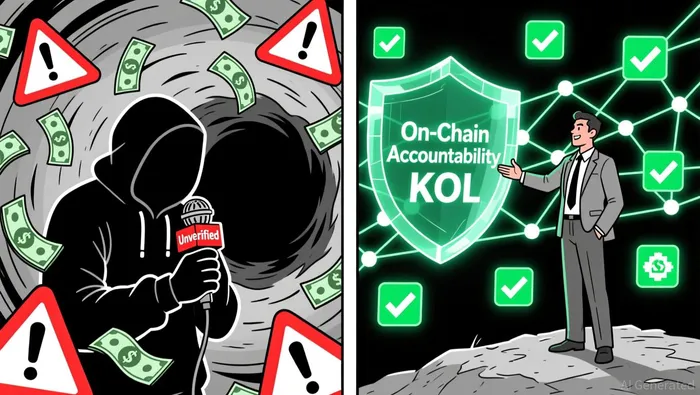
Unverified crypto KOLs operate in a gray space between education and exploitation. While some provide valuable insights, others leverage social media clout to promote fraudulent projects, often without disclosing conflicts of interest. A 2025 report by The Capital highlights how federal enforcement agencies have shifted focus toward investor victimization, prioritizing cases where KOLs directly facilitate fraud over mere regulatory non-compliance, according to a Capital analysis. This trend underscores a growing recognition of the harm caused by unverified influencers.
Case studies from 2024–2025 illustrate the scale of the problem. In one instance, a deepfake video of a prominent crypto YouTuber promoted a fake giveaway, siphoning over $500,000 in "entry fees," as detailed in a ConnectCU report. Another scheme involved a DeFi platform promising 30% weekly returns, which vanished with $12 million in investor funds, as described in the same ConnectCU report. These scams exploit the trust placed in KOLs and the lack of due diligence among retail investors.
Systemic Risks and the BalancerBAL-- Exploit
The interconnected nature of DeFi amplifies the risks posed by unverified KOLs. A 2023 exploit of the Balancer protocol, which exploited a rounding error in its smart contract logic, drained $120 million across multiple blockchains, as reported by a Coinotag analysis. This incident revealed how vulnerabilities in one protocol can cascade through the ecosystem, destabilizing stablecoins and liquidity pools. While technical flaws were the immediate cause, the broader context of unverified KOLs promoting unvetted protocols exacerbated the crisis.
The aftermath of the Balancer exploit highlights the need for robust on-chain accountability mechanisms. Protocols must adopt multi-signature approvals, rigorous smart contract audits, and transparency in incident reporting, as noted in the Coinotag analysis. Yet, these measures are often reactive rather than proactive. For investors, the lesson is clear: due diligence must extend beyond project fundamentals to include scrutiny of the KOLs endorsing them.
Investor Due Diligence: A Framework for Mitigation
Investor due diligence in DeFi requires a dual focus on technical and legal risks. Technically, tools like Cryptoworth and Delta enable real-time tracking of liquidity pools, staking activities, and cross-chain transactions, according to a Cryptoworth blog. These platforms automate data reconciliation and categorize tokens (e.g., LP tokens, wrapped assets) to ensure accurate financial reporting. For example, liquidity pool tokens must be tracked for impermanent loss, while wrapped tokens require careful logging of exchange rates and bridging events, as noted in the Cryptoworth blog.
Legally, the Propel Fuels, Inc. v. Phillips 66 Co. case serves as a cautionary tale. In this 2025 dispute, Phillips 66 was held liable for misappropriating trade secrets during due diligence, resulting in $800 million in damages, as reported in a Jax Daily Record article. While notNOT-- DeFi-specific, the case underscores the importance of structured NDAs, clean teams, and audit trails when handling sensitive information. For DeFi investors, this means implementing strict controls when engaging with KOLs or third-party promoters.
The Path Forward: Accountability and Regulation
Regulatory shifts in 2025, such as the IRS's mandate for DeFi brokers to report gross proceeds, signal a move toward greater transparency, according to the Cryptoworth blog. However, enforcement remains inconsistent, particularly with the disbandment of the National Cryptocurrency Enforcement Team, as noted in the Capital analysis. This vacuum has allowed unverified KOLs to operate with relative impunity, necessitating self-policing by institutions and individuals.
On-chain accountability tools are a critical defense. Platforms like Cryptoworth automate compliance across jurisdictions, logging every swap, stake, and yield farming activity, as described in the Cryptoworth blog. For investors, these tools provide a competitive edge by offering granular insights into risk exposure. Meanwhile, proactive measures-such as structured NDAs and audit trails-can mitigate legal risks associated with KOL-driven investments.
Conclusion
The DeFi ecosystem stands at a crossroads. While its potential for financial innovation is undeniable, the risks posed by unverified KOLs demand a paradigm shift in investor behavior. By adopting robust due diligence frameworks and leveraging on-chain accountability tools, investors can navigate the DeFi landscape with greater confidence. As regulatory clarity emerges, the onus will remain on market participants to prioritize transparency over hype-a lesson the Balancer exploit and 2025 scams have made painfully clear.







Comentarios
Aún no hay comentarios