
The Growing Risks and Opportunities in Stablecoins Amid Rising Money Laundering and Regulatory Scrutiny
The AML Crisis: Stablecoins as a Double-Edged Sword
Stablecoins' design-pegging value to fiat currencies while enabling fast, borderless transactions-has made them a preferred tool for illicit actors. According to an IMF report, stablecoins are increasingly exploited in the layering and integration stages of money laundering, where criminals obscure the origins of illicit funds by converting them into stablecoins and routing them through decentralized platforms. For instance, ransomware operators and darknet marketplaces now favor stablecoins over volatile assets like BitcoinBTC--, as they avoid price swings while retaining liquidity, according to the IMF report.
China's People's Bank of China (PBOC) has been particularly vocal, stating that stablecoins "can't meet the basic requirements like customer identification and anti-money laundering," warning of risks to global financial stability and monetary sovereignty, as noted in a Decrypt article. This sentiment is echoed by the Financial Action Task Force (FATF), which has urged nations to adopt stricter "travel rules" for stablecoin transfers to track cross-border flows, according to the IMF report.
Regulatory Tightrope: The U.S. GENIUS Act and Global Divergence
The U.S. regulatory landscape has shifted dramatically in 2025 with the passage of the GENIUS Act, which subjects stablecoin transactions to the same AML scrutiny as wire transfers, according to a Castellum AI insight. The law mandates enhanced due diligence for institutions facilitating stablecoin activity, requiring real-time monitoring of suspicious patterns and stricter reserve disclosures, as noted in the Castellum AI insight. For TetherUSDT--, this means adapting to quarterly attestations from auditors like BDO Italia and preparing for potential top-tier audits by firms such as Deloitte or PwC, as reported in a Coinotag article.
Meanwhile, the European Union's Markets in Crypto-Assets (MiCA) regulation has created a stark divide. Circle's USDCUSDC--, already MiCA-compliant, has gained a competitive edge over USDT, which has historically lagged in transparency, according to a Trakx insight. This regulatory divergence is reshaping market dynamics: USDC's market capitalization surged 72% in Q3 2025, outpacing USDT's 32% growth, as noted in a Yahoo Finance article.
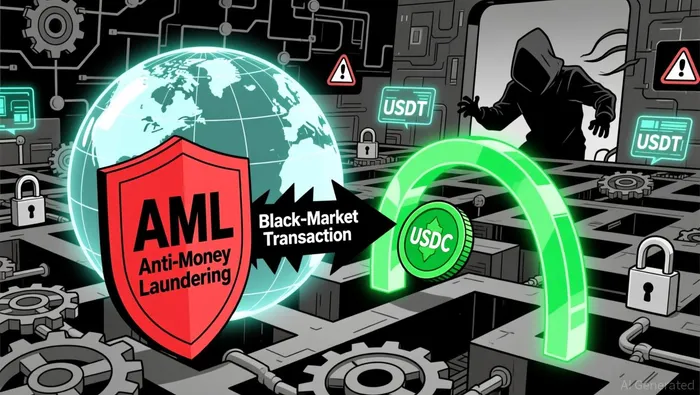
Opportunities in Compliance: Innovation and Institutional Adoption
Despite the risks, regulatory clarity is unlocking new opportunities. The GENIUS Act and MiCA have spurred innovation in interest-bearing stablecoins, such as Ethena's USDe, which saw a 13,750% surge in market cap in 2025 by offering yield-generating capabilities, according to a 99Bitcoins report. Tether itself is preparing to launch USAT, a stablecoin fully compliant with OECD standards, signaling its intent to compete in a regulated environment, as reported in the Yahoo Finance article.
For investors, the key lies in balancing compliance with utility. USDC's institutional adoption-bolstered by its transparent reserve management and enterprise-grade security-has made it a safer bet for risk-averse portfolios, according to the Trakx insight. Conversely, USDT's dominance in liquidity (it facilitated 60% of on-chain stablecoin transactions in Q3 2025, according to a CoinMetrics report) suggests it remains a critical infrastructure asset, albeit one requiring continuous adaptation to regulatory shifts.
Investor Confidence: Profitability vs. Regulatory Uncertainty
Tether's financial resilience is undeniable. With a projected $15 billion in 2025 profits and a market cap of $186 billion, according to the CoinMetrics report, USDT's user base now exceeds 500 million, as reported in the Coinotag article. However, investor confidence hinges on its ability to align with evolving standards. The PBOC's crackdown on stablecoin activity in mainland China, as noted in the Decrypt article, and the U.S. Treasury's emphasis on foreign issuer compliance, as noted in the Castellum AI insight, highlight the geopolitical risks of over-reliance on any single stablecoin.
Circle's USDC, meanwhile, benefits from its proactive compliance stance. Its 1:1 U.S. dollar backing and third-party audits have attracted institutional investors seeking regulatory resilience, according to the Trakx insight. As the stablecoin market expands beyond $300 billion, according to the 99Bitcoins report, the divide between "compliant" and "commoditized" stablecoins will likely widen, with implications for market share and investor trust.
Conclusion: Navigating the New Normal
The stablecoin landscape in 2025 is defined by a tension between innovation and oversight. While USDT's liquidity and network effects ensure its relevance, its long-term viability depends on its ability to meet global AML standards and compete with compliant alternatives like USDC. For investors, the path forward requires a nuanced approach: hedging against regulatory risks by diversifying stablecoin exposure while capitalizing on the infrastructure role these assets play in cross-border payments and DeFi.
As the OECD and FATF continue to refine stablecoin guidelines, one thing is clear: the era of unregulated digital dollars is over. The winners in this new paradigm will be those who adapt-not just to compliance, but to the evolving expectations of a world where stablecoins are no longer a niche experiment, but a cornerstone of global finance.





Comentarios
Aún no hay comentarios