
The Growing Risk of Misleading Crypto Compliance Narratives and Their Impact on Exchange Valuations
The cryptocurrency sector has long grappled with the tension between innovation and regulation. For investors, the credibility of compliance claims by major exchanges like Binance is not just a legal concern-it is a critical determinant of valuation stability and long-term trust. Recent developments surrounding Binance highlight a troubling pattern: selective reporting, regulatory backsliding, and the potential for data manipulation in compliance narratives. These dynamics could reshape risk profiles for crypto exchanges and erode investor confidence, particularly as global regulators recalibrate their enforcement priorities.
Binance's Compliance Overhaul and Regulatory Scrutiny
In 2023, Binance reached a landmark $4.3 billion settlement with the U.S. Department of Justice (DOJ) after pleading guilty to willful violations of anti-money laundering (AML) and sanctions laws. The settlement mandated a three-year independent compliance monitorship, a measure designed to ensure Binance strengthened its AML protocols. However, by 2025, Binance had reportedly entered negotiations with the DOJ to terminate the monitorship early, citing operational burdens and a shift in regulatory priorities under the Trump administration. This move raises questions about whether Binance's compliance reforms are sustainable or merely a temporary fix to avoid stricter oversight.
The U.S. Treasury Department, meanwhile, imposed a separate five-year monitorship under the Bank Secrecy Act (BSA), managed by Sullivan & Cromwell according to Casten. Yet Binance has pushed for its removal as well, arguing that the costs of compliance are stifling innovation. Such requests underscore a broader industry trend: exchanges seeking to minimize regulatory friction while maintaining the appearance of compliance.
Selective Reporting and Data Omissions in Binance's Narrative
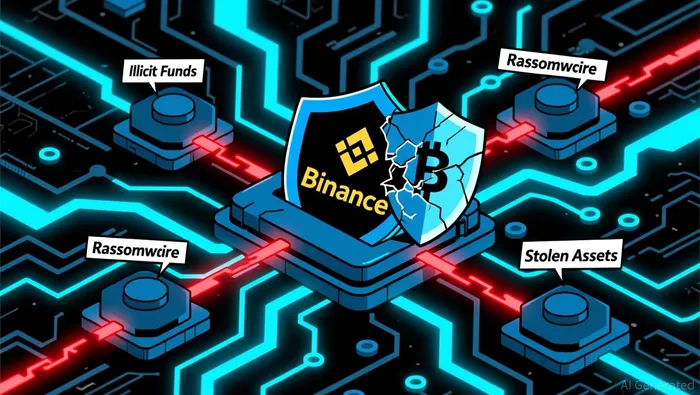
Binance has touted a 96–98% reduction in direct exposure to illicit funds since 2023, citing Chainalysis and TRM Labs data showing only 0.007% to 0.016% of its trading volume linked to illicit addresses. However, this narrative omits critical nuances. Chainalysis has pointed out that Binance's analysis excludes indirect flows, such as funds from ransomware attacks or stolen assets, which could still pass through the platform via intermediate wallets. By focusing narrowly on "direct exposure," Binance may be masking systemic vulnerabilities in its transaction-monitoring systems.
Further scrutiny emerged in May 2024, when Binance fired an internal investigator who uncovered $300 million in alleged wash trading by client DWF Labs according to Yahoo Finance. The company dismissed the claims as unsubstantiated, yet the incident highlights a pattern of selective enforcement. Binance's public emphasis on combating "policy violations" (e.g., offboarding 355,000 users) contrasts with its apparent tolerance for high-profile market manipulation, suggesting a compliance strategy more concerned with optics than substance as reported by Yahoo Finance.
Regulatory Shifts and the Risk of Eased Oversight
The DOJ's recent dismissal of its civil enforcement action against Binance-finalized with prejudice, meaning the SEC cannot refile the same claims- reflects a broader regulatory pivot. Under Chair Paul Atkins, the SEC has prioritized framework development over enforcement, signaling a potential retreat from aggressive litigation. While this shift may benefit Binance's short-term valuation by reducing legal uncertainty, it also creates a moral hazard: exchanges may interpret relaxed enforcement as a green light to scale operations without robust compliance safeguards.
This dynamic is further complicated by the DOJ's broader review of corporate monitorships. In 2025, the department acknowledged the "costs and disruptions" of compliance oversight and hinted at scaling back its use. If Binance succeeds in ending its monitorship, it could set a precedent for other exchanges to follow, potentially normalizing lax compliance standards.
Investor Sentiment and Market Reactions
The market's response to Binance's compliance challenges has been mixed. Following the 2023 DOJ settlement, Binance's native token, BNBBNB--, dropped 10% in the short term, while BitcoinBTC-- and EthereumETH-- remained resilient. However, by 2025, investor sentiment had shifted as Binance's negotiations with regulators suggested a path toward lighter oversight. Some analysts viewed this as a positive sign for regulatory clarity, while others warned of complacency as noted by Finance Feeds.
The recent civil lawsuit filed by families of Hamas attack victims-accusing Binance of facilitating $1 billion in transactions for terrorist groups-has reignited concerns according to The New York Times. If the case gains traction, it could force Binance to defend its compliance practices in court, potentially damaging its reputation and deterring institutional investors.
Broader Implications for Crypto Exchange Valuations
Binance's case illustrates a systemic risk in the crypto sector: the disconnect between compliance rhetoric and operational reality. For investors, this raises critical questions:
1. Are compliance improvements genuine or merely tactical? Binance's push to end monitorships suggests a focus on cost-cutting over long-term risk mitigation.
2. How do regulatory shifts impact valuation models? A move toward lighter oversight may temporarily boost valuations but could erode trust if enforcement gaps lead to future scandals.
3. What role does data transparency play in investor trust? Binance's selective reporting on illicit activity highlights the need for third-party audits and independent verification.
Exchanges that fail to align their compliance narratives with rigorous, transparent practices risk being outpaced by competitors who prioritize regulatory alignment. For instance, Binance.US has emphasized formal reviews by banking partners and state regulators according to its website, a contrast to the parent company's opaque approach.
Conclusion: A Call for Cautious, Compliance-Driven Investment
The crypto sector's future hinges on its ability to balance innovation with accountability. Binance's compliance journey-from the 2023 DOJ settlement to its current negotiations-reveals a company navigating regulatory turbulence with a mix of strategic concessions and selective disclosures. For investors, the lesson is clear: compliance claims must be scrutinized through the lens of independent audits, regulatory trends, and operational transparency.
As the industry evolves, a compliance-driven investment strategy will become increasingly vital. Exchanges that prioritize robust AML frameworks, transparent reporting, and proactive engagement with regulators are more likely to withstand scrutiny and maintain investor trust. In a sector where narratives can quickly shift from hype to crisis, credibility is not just a legal requirement-it is the foundation of sustainable value.






Comentarios
Aún no hay comentarios