
The Growing Risk of Exploiting Legacy DeFi Protocols and Its Impact on Smart Contract Security Investments
The decentralized finance (DeFi) ecosystem has long been a double-edged sword: a beacon of innovation and financial democratization, but also a honeypot for attackers exploiting outdated infrastructure. As the Truebit Protocol hack of 2026 starkly demonstrated, legacy DeFi protocols remain prime targets for sophisticated exploits, even years after deployment. This incident, which saw $26.5 million in ETH stolen through a vulnerability in a five-year-old unverified smart contract, underscores a critical truth: security is no longer optional in DeFi-it is existential. For investors, this reality signals a seismic shift in value creation, with blockchain security firms and auditing platforms emerging as linchpins of the industry's future.
The Truebit Hack: A Case Study in Legacy Vulnerabilities
In early 2026, the Truebit Protocol suffered a catastrophic breach when attackers exploited integer truncation flaws in an un-audited smart contract. By minting an excessive amount of TRUTRU-- tokens and selling them back to the protocol, the attacker drained 8,500 ETH-valued at $26.5 million at the time-before the market collapsed. The stolen funds were split between two addresses, a tactic designed to evade tracking, while the TRU token lost nearly all its value, wiping out its liquidity on decentralized exchanges.
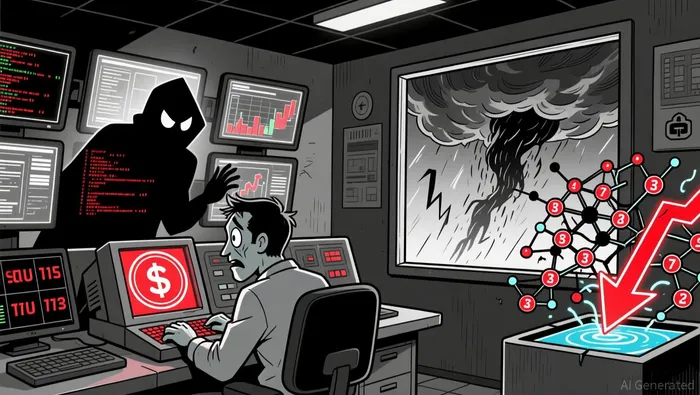
This attack was not an isolated incident. The same wallet linked to the Truebit exploit had previously targeted the Sparkle protocol, suggesting a pattern of calculated, high-impact attacks on aging DeFi infrastructure. The root cause? A failure to audit or update a contract deployed five years prior, despite well-documented risks like integer overflow vulnerabilities. For investors, the lesson is clear: legacy code is a liability, and protocols that neglect security updates are inviting disaster.
The 2025 Security Landscape: A Market Response to Rising Threats
The Truebit incident is part of a broader trend. By 2022, DeFi-related cybercrimes had already caused cumulative losses of $10 billion, prompting a surge in demand for blockchain security services. In 2025, this demand has crystallized into a robust market, with firms like Hacken, OpenZeppelin, and CertiK leading the charge. These companies now secure over $100 billion in assets collectively, leveraging AI-driven tools, real-time monitoring, and gamified audit frameworks to stay ahead of attackers.
Key innovations in 2025 include:
- Aderyn VS Code Extension: A tool developed by Cyfrin that enables real-time static analysis of Solidity code, detecting over 100 vulnerabilities during development.
- Safe Hash: A solution addressing multi-sig workflow flaws by allowing users to verify transaction hashes before signing.
- Financial Coverage Models: Firms like Sherlock now offer up to $2 million in compensation for uncovered vulnerabilities, aligning their incentives with project security.
These advancements reflect a maturing industry where security is no longer an afterthought but a foundational requirement. For investors, this shift creates a compelling case for allocating capital to firms that are redefining DeFi's risk profile.
Strategic Investment Opportunities in Blockchain Security
The growing urgency to secure DeFi infrastructure has created a fertile ground for strategic investments. Here are three key areas to consider:
- Smart Contract Audit Leaders: Firms like Hacken and OpenZeppelin have audited over 700 projects and $10 billion in assets, respectively. Their expertise in EthereumETH-- and cross-chain protocols positions them to benefit from the ongoing migration of DeFi to more secure environments.
- AI-Powered Security Platforms: Rapid Innovation and CertiK are pioneering AI-driven tools that automate vulnerability detection, reducing costs and increasing audit efficiency. These platforms are critical for scaling security in a rapidly expanding DeFi ecosystem.
- Post-Launch Security Ecosystems: Companies like Sherlock and TRM Labs are building end-to-end security solutions, including bug bounties and blockchain intelligence tools like TRM's Beacon Network, which helps intercept illicit funds before they are cashed out.
Investors should also monitor the rise of security-as-a-service (SaaS) models, where protocols pay recurring fees for continuous monitoring. This recurring revenue stream offers long-term stability for security firms, mirroring the subscription-based models of traditional cybersecurity providers.
The Long-Term Value of Security-First Infrastructure
The Truebit hack and similar incidents have exposed a critical weakness in DeFi: security is a continuous process, not a one-time checkbox. Protocols that prioritize regular audits, real-time monitoring, and community-driven bug bounties are better positioned to survive in a threat landscape that evolves daily. For investors, this means prioritizing firms that offer holistic, lifecycle security solutions rather than fragmented tools.
Moreover, regulatory pressures are amplifying the demand for robust security. As governments crack down on unsecured DeFi projects, protocols without verifiable audit trails will face existential risks. Security firms that can demonstrate compliance with emerging standards-such as ISO 27001 for information security-will gain a competitive edge.
Conclusion: A Call for Proactive Investment
The Truebit hack is a wake-up call for the DeFi industry. It highlights the catastrophic consequences of neglecting legacy code and the urgent need for proactive security measures. For investors, the path forward is clear: allocate capital to blockchain security firms and auditing platforms that are redefining the industry's risk profile. These firms are not just mitigating losses-they are enabling the next phase of DeFi's growth by building trust in decentralized systems.
As the market continues to mature, the winners will be those who recognize that in DeFi, security is not a cost-it is an investment in survival.






Comentarios
Aún no hay comentarios