
The Growing Risk of AI Deepfakes in Financial Markets and Investor Trust
Reputational Risks: When AI Investments Backfire
The reputational fallout from AI deepfakes is starkly illustrated by Rightmove, a UK-based property portal. In 2025, the company's decision to reallocate resources toward AI-driven platform upgrades led to a 25% stock price plunge as investors reacted to slashed 2026 profit forecasts, according to a Rightmove report. This case underscores a critical tension: while AI promises operational efficiency, its short-term costs-both financial and reputational-can alienate stakeholders. Conversely, PalantirPLTR-- Technologies has navigated AI integration successfully, leveraging strategic partnerships and robust financial performance to bolster investor confidence despite sector-wide volatility, according to a Market Minute. The contrast highlights how reputational resilience depends on aligning AI investments with clear value propositions.
Operational Vulnerabilities: The $200 Million Cost of Deception
Operationally, deepfakes are weaponized to exploit vulnerabilities in financial systems. In Q1 2025 alone, institutions reported over $200 million in losses from deepfake attacks, including fraudulent earnings calls and cloned executive voices, according to a market analytics report. A $25 million scam at Arup Engineering in Hong Kong, executed via a deepfake video conference, exemplifies the sophistication of these threats, as detailed in a GAFA case study. Such incidents not only drain capital but also compromise internal security protocols, forcing firms to adopt layered defenses like C2PA metadata and human oversight, as noted in the market analytics report. For long-term investors, the operational fragility exposed by these attacks raises questions about the sustainability of companies lacking robust cybersecurity infrastructure.
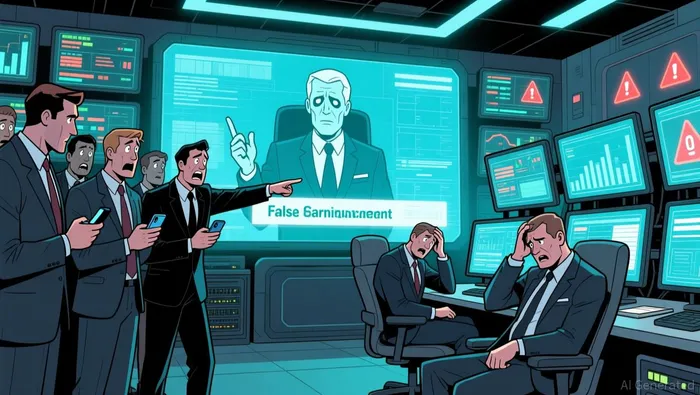
Investor Trust: The Fragile Foundation of Value Investing
Deepfakes are eroding the bedrock of investor trust, particularly in long-term value strategies that rely on stable, predictable markets. A 2025 report by RealityDefender notes that 60% of consumers have encountered deepfakes, with only 24.5% able to detect high-quality forgeries, according to a reality defender analysis. This lack of discernment amplifies market noise, as false information spreads rapidly and distorts asset valuations. For instance, a deepfake voice clone of Ferrari's CEO nearly succeeded in diverting $600,000 in funds before being intercepted, as detailed in the GAFA case study. Such incidents not only damage brand credibility but also create ripple effects across sectors, as seen in the 1,700% year-over-year surge in U.S. deepfake attacks, according to a Dow Jones analysis.
Regulatory and Mitigation Frameworks: A Path Forward
Regulators are beginning to address deepfake risks, with the EU AI Act and FinCEN guidance mandating synthetic media labeling and enhanced monitoring, as noted in the market analytics report. In the U.S., Fannie Mae's cybersecurity mandates now require incident reporting within 36 hours of detection, as reported in a mortgage lending update. However, these measures lag behind the pace of technological advancement. Financial institutions are increasingly adopting "trust infrastructure," combining AI-driven fraud detection with biometric authentication and continuous identity verification, as described in a Veriff report. For investors, supporting firms that prioritize such frameworks-like Palantir, which reported a 121% surge in U.S. commercial revenue-may offer a hedge against deepfake-related uncertainties, as noted in a Reality Defender analysis.
Conclusion: Navigating the Deepfake Era
For long-term value investors, the rise of AI deepfakes necessitates a dual focus: scrutinizing companies' AI integration strategies for reputational risks and evaluating their operational resilience against synthetic threats. While firms like Palantir demonstrate that AI can drive growth, the sector's volatility-exemplified by BigBear.ai's erratic stock performance-reveals the fragility of investor trust in unproven technologies, as noted in a KeepNet analysis. As deepfake detection lags with a 65% accuracy rate against advanced tools, according to the reality defender analysis, the imperative for proactive risk management has never been clearer.





Comentarios
Aún no hay comentarios