
The Growing Investment Case in Grid-Reliable Energy Infrastructure Amidst Soaring PJM Capacity Costs
The U.S. power grid is undergoing a seismic shift, driven by surging electricity demand, policy reforms, and the urgent need to modernize aging infrastructure. At the heart of this transformation lies the PJM Interconnection, which operates the largest electricity grid in the world, serving 67 million people across 13 states and the District of Columbia. Recent developments in PJM's capacity markets and transmission planning underscore a compelling investment case for firms positioned to address grid reliability challenges. With capacity prices hitting record highs and grid modernization projects accelerating, strategic allocations to power generation and transmission firms are poised to yield significant returns.
Soaring Capacity Costs Signal Systemic Strain
PJM's 2025 capacity auction results reveal a 22% year-over-year increase in capacity prices, reaching $329.17 per megawatt-day (MW-day). This surge reflects a tightening supply-demand balance, exacerbated by rapid data center expansion in Virginia's "data center alley" and broader economic growth. For context, the grid secured only 139 MW of surplus capacity for the 2026–2027 delivery year, raising alarms among operators about meeting future demand. These price pressures are already translating into higher electricity bills for consumers, with regional increases projected between 1.5% and 5%.
The root cause of this strain lies in the mismatch between infrastructure development and demand growth. 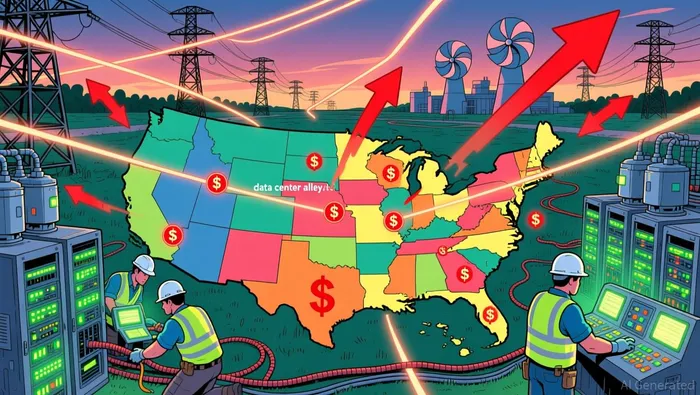 Data centers, electric vehicles, and industrial electrification are driving load increases of over 3,000 MW by 2026. Meanwhile, delays in offshore wind projects and the retirement of legacy generation assets have left gaps in supply. This perfect storm has created a tailwind for firms involved in grid modernization and capacity expansion.
Grid Modernization: A $11.6 Billion Opportunity
PJM's 2025 Regional Transmission Expansion Plan (RTEP) Window 1 has emerged as a focal point for investment. The initiative includes 134 proposals-57 greenfield projects and 77 upgrades-submitted by 19 entities, with a total estimated cost of $11.6 billion. Key projects include:
- A 525 kV High-Voltage Direct Current (HVDC) transmission link to bolster power transfer into northern Virginia.
- A 765 kV transmission line connecting central and eastern PJM to reinforce the west-to-east power corridor.
- A third 765 kV line in western PJM to accommodate load growth in Ohio and Pennsylvania (https://insidelines.pjm.com/pjm-reviews-preliminary-recommended-projects-for-2025-rtep-window-1/).
These projects are critical to addressing reliability risks and enabling the integration of renewable energy. For instance, the 525 kV HVDC link is designed to move large volumes of power over long distances, a necessity as data centers cluster in northern Virginia. The scale of these investments highlights the urgency of modernization and creates a fertile ground for firms with expertise in transmission development.
Key Players and Strategic Alliances
Dominion Energy, American Electric PowerAEP-- (AEP), and FirstEnergyFE-- dominate the landscape, but their partnerships with third-party developers and technology providers are equally noteworthy. The Valley Link Transmission Company, a joint venture between these three firms, is spearheading a $6.7 billion portfolio of 765 kV projects, including 260 miles of transmission lines and substations in Virginia and Maryland. AEPAEP-- alone is committing $1.1 billion to these efforts, leveraging its Transource Energy subsidiary to streamline project execution.
Beyond the majors, FirstEnergy Transmission LLC (FET) has secured $1.25 billion in investments through partnerships with Brookfield Super-Core Infrastructure Partners. FET's projects include rebuilding 59 miles of 138-kV lines in Ohio and reconfiguring substations in Pennsylvania. Similarly, Pearl Street and Nira Energy are gaining traction as automation software providers, helping expedite interconnection studies under PJM's new "first-ready, first-served" queue model (https://www.zeroemissiongrid.com/insights-press-zeg-blog/grid-modernization-2025/).
The U.S. Department of Energy (DOE) is also amplifying investment momentum. A $1.6 billion loan guarantee to AEP Transmission for reconductoring and rebuilding 5,000 miles of lines will increase grid capacity by 70% while reducing debt costs for ratepayers. Such public-private collaborations are reducing financial barriers and accelerating project timelines.
Policy Reforms: A Catalyst for Efficiency
PJM's shift to a "first-ready, first-served" interconnection queue is a game-changer. By prioritizing projects that meet readiness criteria, the model reduces speculative entries and shortens study times to 1–2 years for mature projects. This reform, mirrored by regional operators like MISO and CAISO, is streamlining grid access and enhancing reliability. For investors, it means reduced regulatory uncertainty and faster returns on capital deployed.
Investment Implications and Risks
The confluence of soaring capacity costs, grid modernization, and policy alignment creates a robust investment case. Firms directly involved in transmission development-such as Dominion EnergyD--, AEP, and FirstEnergy-and their subcontractors (e.g., Brookfield, Pearl Street) are well-positioned to capitalize on the $11.6 billion RTEP pipeline. Additionally, technology providers enabling automation and efficiency gains in interconnection processes represent high-conviction opportunities.
However, risks persist. Higher electricity bills could dampen consumer demand, and regulatory delays remain a wildcard. Yet, the scale of the infrastructure gap and the urgency of decarbonization efforts suggest these risks are manageable. For strategic investors, the key is to overweight firms with strong project pipelines, cost management expertise, and partnerships with public entities.
Conclusion
The PJM grid's capacity crisis is not merely a regional issue-it is a harbinger of the broader challenges facing U.S. energy infrastructure. As capacity prices climb and modernization projects gain momentum, the sector offers a rare combination of defensive and growth characteristics. For investors seeking to align with long-term energy transitions, the time to act is now.





Comentarios
Aún no hay comentarios