
The Growing Institutional Appetite for Bitcoin and ETF Dynamics: Assessing the Long-Term Implications on Price Action and Institutional Adoption
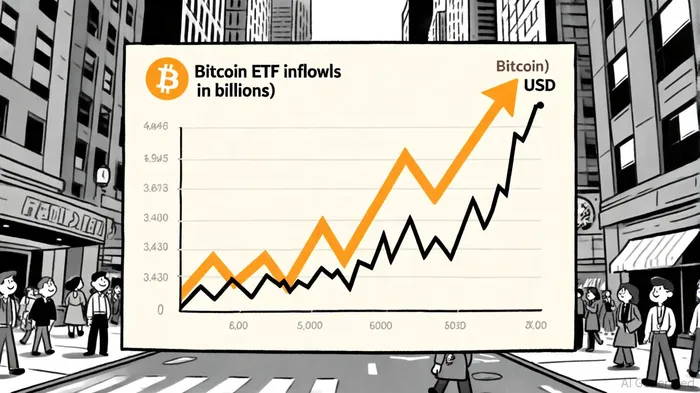
The institutional investment landscape for BitcoinBTC-- has undergone a seismic shift in 2024–2025, driven by the explosive growth of U.S. spot Bitcoin ETFs. These vehicles have notNOT-- only democratized access to Bitcoin for traditional investors but also redefined its role as a strategic asset class. With over $144.5 billion in assets under management (AUM) as of August 28, 2025, spot Bitcoin ETFs have become a cornerstone of institutional portfolios, with BlackRock's iShares Bitcoin Trust (IBIT) and Fidelity's Wise Origin Bitcoin Trust (FBTC) dominating the market [2]. This surge in capital inflows—exceeding $50 billion from institutional investors in Q1 2025 alone—has directly influenced Bitcoin's price trajectory, pushing it to record highs and reshaping market dynamics [3].
The ETF-Driven Supply-Demand Imbalance
Bitcoin's price action in 2025 has been inextricably linked to the supply-demand mechanics created by ETF inflows. With a fixed supply cap of 21 million coins, Bitcoin's scarcity is amplified when ETFs absorb significant quantities of the asset from the open market. For instance, on July 10 and 11, 2025, U.S. spot Bitcoin ETFs recorded inflows of $1.18 billion and $1.03 billion, respectively, coinciding with Bitcoin's price nearing $120,000 [2]. This pattern underscores how ETFs act as a “marginal buyer,” reducing available liquidity and creating upward price pressure.
The impact is further magnified by the sheer scale of inflows. Data from April 22, 2025, revealed a $912 million influx into U.S. spot Bitcoin ETFs—over 500 times the 2025 daily average—triggered by Bitcoin's six-week price high [4]. Such surges highlight the self-reinforcing cycle: rising prices attract institutional capital, which in turn drives further price appreciation. This dynamic has transformed Bitcoin from a speculative asset into a core component of diversified portfolios, with 59% of institutional investors allocating at least 10% of their holdings to Bitcoin by early 2025 [1].
Institutional Adoption and Market Maturity
The approval of spot Bitcoin and EthereumETH-- ETFs by the U.S. SEC in early 2024 marked a pivotal inflection pointIPCX--. Major asset managers like BlackRockBLK--, Fidelity, and Grayscale capitalized on this regulatory clarity, with IBIT alone accumulating $83.46 billion in AUM by August 2025 [2]. This dominance is not accidental: low expense ratios and regulatory compliance have made ETFs the preferred vehicle for institutional capital. In contrast, Grayscale's Bitcoin Trust (GBTC) has faced outflows due to its higher fees, illustrating the market's preference for cost-efficient solutions [1].
Ethereum ETFs have also gained traction, with $19.6 billion in cumulative inflows as of July 29, 2025 [5]. While Bitcoin remains the primary focus, the broader crypto ETF ecosystem is signaling a maturation of institutional adoption. These funds provide a regulated, liquid, and familiar interface for investors who previously shunned crypto due to volatility and regulatory uncertainty.
Long-Term Price Implications and Volatility Reduction
The sustained inflows into Bitcoin ETFs have not only driven price appreciation but also reduced Bitcoin's volatility. Realized volatility has dropped by up to 75% compared to earlier cycles, attributed to deeper liquidity and sustained institutional demand [1]. This stabilization is critical for Bitcoin's adoption as a store of value and hedge against macroeconomic risks.
Looking ahead, the trajectory is bullish. Bitcoin's price has already surged from $45,000 in early 2025 to over $120,000 by July 2025, with analysts projecting targets of $200,000 to $210,000 within 12–18 months [1]. These projections are underpinned by the continued absorption of Bitcoin supply by ETFs, which reduces circulating liquidity and creates a scarcity premium.
Conclusion: A New Era for Bitcoin
The institutional appetite for Bitcoin, channeled through ETFs, has ushered in a new era of legitimacy and scalability. These vehicles have bridged the gap between traditional finance and crypto, enabling institutional investors to allocate capital with confidence. As ETF inflows continue to outpace outflows and Bitcoin's supply remains fixed, the long-term implications for price action are clear: sustained upward momentum driven by structural demand. For investors, this represents a paradigm shift—a transition from speculative trading to strategic, long-term asset allocation.





Comentarios
Aún no hay comentarios