
The Growing Disconnect Between Main Street and Wall Street in 2025: Contrarian Investing in a Fractured Market
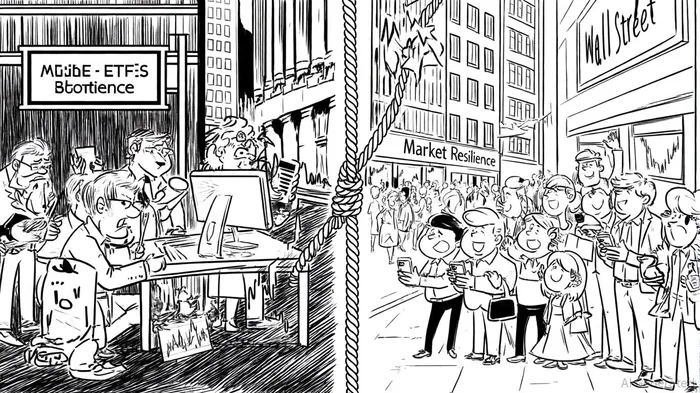
The U.S. stock market in 2025 has become a battleground of clashing narratives. On one side, institutional investors are hedging against a potential recession with record shorting of ETFs, while on the other, retail traders are flooding equity markets with $40 billion in April 2025 alone[1]. This stark divergence between Wall Street and Main Street is not merely a temporary anomaly—it is a structural shift with profound implications for contrarian investors.
Institutional Bearishness: A Hedge Against Macro Risks
Hedge funds and institutional investors have adopted a deeply bearish stance, shorting broad-market ETFs like SPY and QQQ to unprecedented levels in April 2025[1]. Their caution stems from a cocktail of macroeconomic headwinds: rising interest rates, stubborn inflation, and geopolitical tensions, including China's slowing growth and trade restrictions[1]. According to a report by TAM Asset Management, these institutions are prioritizing cyclical hedges in sectors like financials and industrials, anticipating a mild recession in the second half of 2025[3].
This institutional bearishness is not irrational. With the U.S. Federal Reserve signaling a prolonged high-rate environment and global trade dynamics growing increasingly volatile[4], hedge funds are positioning for a market correction. Yet their strategies have created a paradox: while they short the market, they simultaneously maintain long-term exposure to U.S. equities, betting on the resilience of the tech sector and AI-driven productivity gains[4].
Retail Bullishness: The AI-Driven "Reopening" Rally
Contrast this with Main Street, where retail investors have embraced a relentless optimism. Commission-free trading apps, zero-interest margin loans, and social media hype have fueled a surge into AI-driven stocks and momentum plays[1]. The "reopening" rally in travel and financial sectors has further amplified this bullish sentiment, with retail traders treating the market as a high-stakes game of speculation[1].
However, this enthusiasm is increasingly disconnected from reality. Data from Bloomberg indicates that 49% of U.S. consumers in April 2025 expect stock prices to fall over the next 12 months—a doubling of pessimism in just three months[1]. This disconnect between retail inflows and consumer sentiment highlights a fragile market psychology, where retail investors are buying on hype rather than fundamentals.
The Magnificent 7: A Double-Edged Sword
The S&P 500's performance in 2025 is largely driven by the "Magnificent 7" tech firms—Alphabet, Amazon, Apple, Meta, Microsoft, NVIDIA, and Broadcom—which account for 34% of the index[3]. These companies have sustained their dominance through aggressive AI infrastructure spending, even as the broader economy grapples with inflation and slower job growth[3].
While this concentration has created a "tech bubble" narrative, it also underscores a critical opportunity for contrarian investors. The Magnificent 7's success is not a fluke; it reflects a structural shift toward AI-driven productivity. Yet their dominance has left the rest of the market vulnerable to corrections, particularly in sectors like industrials and financials where hedge funds are heavily hedged[1].
Contrarian Investing: Navigating the Divergence
For investors seeking to exploit this fractured landscape, the key lies in balancing bearish and bullish signals. Contrarian strategies could focus on:
1. Shorting Overhyped Sectors: Targeting AI-driven stocks with stretched valuations while hedging against tech sector resilience[1].
2. Longing Cyclical Hedges: Positioning in sectors like industrials and financials, which hedge funds are shorting but could rebound if the economy avoids a recession[3].
3. Leveraging AI Tools: Using automated trading agents to capitalize on intraday volatility caused by the clash between institutional shorting and retail buying[1].
Market resilience, however, remains a wildcard. As noted in a 2025 investment outlook by Liberrated Stock Trader, the U.S. market's ability to outperform other developed economies hinges on its tech sector's adaptability and the potential for AI to drive productivity gains[5]. This resilience suggests that while the current divergence is extreme, the market may ultimately reconcile these opposing forces through a correction or a new equilibrium.
Conclusion: A Market at a Crossroads
The 2025 divergence between Wall Street and Main Street is a testament to the market's complexity. Institutional bearishness and retail bullishness have created a volatile, fragmented landscape where traditional indicators often fail. For contrarian investors, this is both a challenge and an opportunity. By aligning strategies with macroeconomic realities while exploiting short-term imbalances, investors can navigate this crossroads with resilience—and potentially emerge stronger on the other side.







Comentarios
Aún no hay comentarios