
The Growing Disconnect Between U.S. Financial Markets and Economic Fundamentals
The U.S. financial markets have long been a barometer of economic health, but recent trends suggest a widening chasm between asset valuations and underlying fundamentals. As consumer and commercial credit health deteriorates, the risks of a speculative bubble loom larger, driven by inflated asset prices, structural weaknesses in high-risk sectors, and a credit system struggling to adapt to macroeconomic headwinds. This analysis examines the evidence of this disconnect and its implications for investors.
Deteriorating Consumer Credit Health
Consumer credit delinquency rates have shown troubling signs of strain, particularly in auto loans and credit cards. As of Q3 2025, the delinquency rate on consumer loans reached 2.72%, a marginal decline from Q1 but still elevated compared to pre-pandemic levels. Auto loan delinquencies have spiked in Q3 2025, disproportionately affecting lower-income households and renters, as rising monthly payments and high vehicle prices erode financial resilience. Meanwhile, credit card delinquency rates have stabilized, but this masks deeper vulnerabilities: households are increasingly relying on revolving credit to service fixed obligations, a trend that could reverse if interest rates remain elevated or incomes stagnate according to the Federal Reserve's analysis.
Commercial Credit and the CRE Refinancing Crisis
The commercial real estate (CRE) sector faces a perfect storm of maturing debt, structural demand shifts, and tightened credit conditions. Over $1.4 trillion in CRE loans is set to mature between 2023 and 2025, with $957 billion maturing in 2025 alone-nearly triple the 20-year average. This "maturity wall" has been exacerbated by high interest rates, with the federal funds rate at 4.25-4.50% as of July 2025, and structural issues like 19.4% national office vacancy rates. 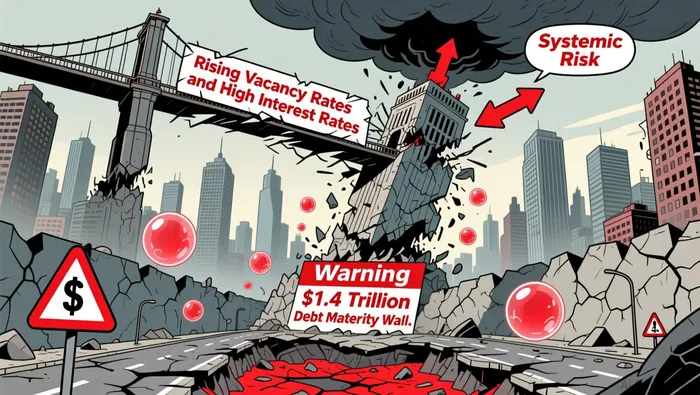 Banks have responded by increasing modified loan volumes by 66% between 2024 and 2025, but this flexibility is not a long-term solution. Sectors like retail and hospitality face heightened risks, with Trepp's bank consortium reporting 7% office delinquencies by late 2024.
Asset Price Inflation and Stretched Valuations
Asset prices across equities and real estate remain inflated relative to fundamentals. The forward P/E ratio for U.S. stocks is well above historical averages, while commercial real estate prices also exceed long-term benchmarks despite some stabilization in industrial and multifamily sectors according to the Federal Reserve's report. This inflation is fueled by low interest rates (historically, but temporarily), speculative investment, and policy-driven distortions like 90-year-high U.S. tariff rates according to Fidelity's analysis. For example, industrial and logistics properties benefit from e-commerce growth, but office and retail markets remain overleveraged, with 23% office vacancy rates. The result is a bifurcated recovery: resilient sectors mask vulnerabilities in cyclical ones.
The Speculative Bubble Risk
The interplay of deteriorating credit health and inflated asset prices raises concerns about a speculative bubble. Consumer delinquencies signal household fragility, while CRE's refinancing crisis highlights systemic risks in commercial lending. Meanwhile, asset valuations are increasingly disconnected from earnings and cash flow, relying instead on low borrowing costs and speculative demand. For instance, the Fed's April 2025 Financial Stability Report notes that equity and real estate valuations are "stretched", with equity prices high relative to fundamentals despite market volatility.
Investors must also consider the role of alternative lenders. As traditional banks tighten underwriting standards, private credit funds and non-bank lenders have filled the void, offering financing for high-quality assets but potentially extending credit to riskier ventures. This shift could delay necessary corrections in overleveraged sectors, prolonging the illusion of stability.
Conclusion
The U.S. financial system is at a crossroads. While industrial and multifamily real estate show resilience, the broader economy faces structural challenges in consumer credit, CRE refinancing, and asset valuations. The risks of a speculative bubble are not hypothetical but embedded in current trends. Investors must adopt a cautious approach, prioritizing defensive sectors and stress-testing portfolios against potential corrections. As the Fed and market participants navigate this fragile landscape, the disconnect between markets and fundamentals will likely remain a critical focal point for risk management.







Comentarios
Aún no hay comentarios