
The Growing Dangers of Leverage in Crypto Futures Markets
The crypto futures market has long been a double-edged sword for investors, offering unparalleled upside potential alongside existential risks. Over the past two years, the sector has seen explosive growth in leveraged trading, with leverage ratios and systemic risk metrics reaching levels that demand urgent scrutiny. Recent events and academic analyses underscore a troubling reality: the interplay between extreme leverage, volatility feedback loops, and systemic risk is creating a fragile ecosystem where cascading failures could ripple far beyond crypto's borders.
A Perfect Storm: The October 2025 Liquidation Event
The most alarming example of this fragility emerged on October 10, 2025, when the crypto futures market experienced its largest liquidation event in history. According to a report by Galaxy, over $19 billion in perpetual positions were liquidated within a single day, triggered by sharp price declines that activated auto-deleveraging mechanisms across major exchanges. 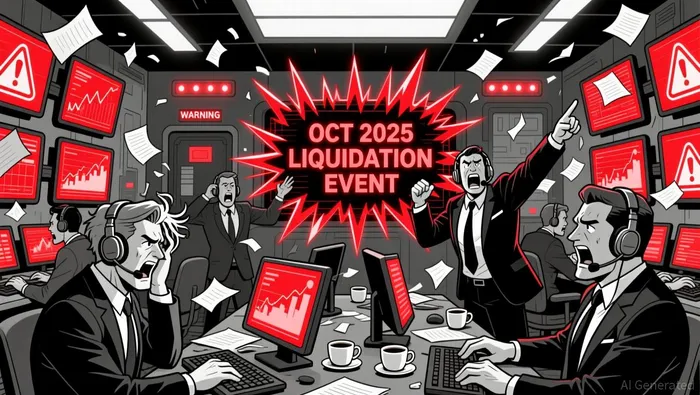 Notably, even positions with relatively modest leverage (e.g., 5x–10x) were not immune to liquidation, highlighting how mechanical exchange design-rather than individual risk-taking-can amplify systemic shocks. This event exposed a critical flaw: the lack of circuit breakers or dynamic safeguards to prevent cascading failures in leveraged markets.
Systemic Risk: From Crypto to Traditional Markets
The interconnectedness of crypto futures with traditional financial systems has also intensified concerns. A study published in on dynamic connectedness and systemic risk revealed that BitcoinBTC-- and EthereumETH-- futures now exhibit significant volatility spillovers into traditional futures markets. For instance, sharp corrections in crypto derivatives have been shown to trigger correlated sell-offs in equity and commodity futures, particularly during periods of macroeconomic stress. This integration, while a sign of maturation, also raises the stakes for regulators and institutional investors. The paper emphasizes the need for advanced methodologies like wavelet coherence and TVP-VAR frequency connectedness to model these risks-a call to action for policymakers to adopt more granular tools.
Volatility Feedback Loops and Speculative Overreach
The speculative nature of crypto derivatives exacerbates volatility feedback loops. Data from Amina Group indicates that 81% of derivatives positions in Q3 2025 were closed within 24 hours, reflecting a market dominated by short-term speculation.
Exchange Responses: Progress, But Not Enough
In the wake of the October 2025 crisis, exchanges have begun to adapt. Galaxy notes that platforms like Binance and Bybit introduced dynamic funding rate adjustments and stricter liquidation thresholds to mitigate future shocks. While these measures are a step forward, they remain reactive rather than proactive. For instance, dynamic funding mechanisms can only dampen volatility if implemented in real time, which requires robust monitoring systems. Moreover, the absence of cross-exchange coordination means that a shock on one platform could still trigger a domino effect elsewhere.
Conclusion: A Call for Prudent Innovation
The crypto futures market stands at a crossroads. Leverage, while a catalyst for innovation and liquidity, has also become a systemic liability. The October 2025 liquidation event and growing volatility spillovers into traditional markets underscore the need for a paradigm shift: from unbridled speculation to structured risk management. Regulators, exchanges, and investors must collaborate to implement circuit breakers, cross-market stress tests, and transparent leverage caps. Without such measures, the next shock-inevitable in a market defined by extremes-could test the resilience of not just crypto, but global finance itself.







Comentarios
Aún no hay comentarios