
The Growing Bearish Overhang in Crypto Markets: Whale Moves, Miner Capitulation, and Implications for Bitcoin and Ethereum
The crypto markets in 2025 are increasingly shadowed by a bearish overhang, driven by a confluence of whale accumulation patterns, miner financial stress, and systemic risks from leveraged short positioning. These factors, when analyzed through the lens of on-chain data and market sentiment metrics, paint a picture of fragility and potential volatility for both BitcoinBTC-- and EthereumETH--.
Bitcoin: Whale Accumulation and Miner Capitulation as Systemic Risk Indicators
Bitcoin's market dynamics in 2025 reveal a stark divergence between long-term holders (LTHs) and short-term holders (STHs). Entities holding 10–10,000 BTCBTC-- acquired 269,822 BTC ($23 billion) over 30 days, signaling aggressive whale accumulation. This behavior, while often interpreted as bullish, contrasts sharply with the financial strain on miners. Despite rising mining difficulty, miner revenues have declined, pushing the sector into a "second and historically final phase of a bear market." This phase is marked by capitulation, as miners face margin compression and forced sales to cover operational costs.
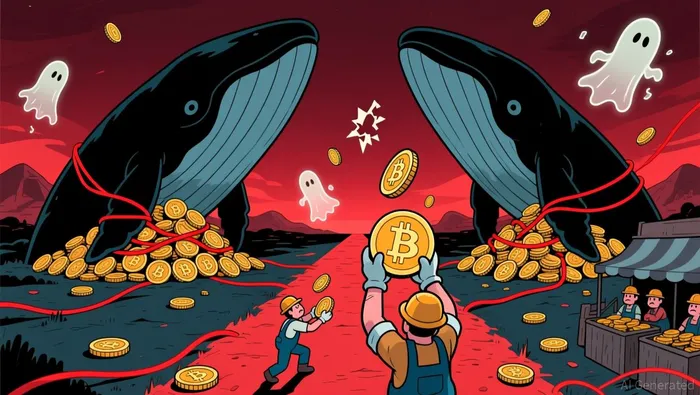 The imbalance in profit distribution further underscores systemic risk: 58% of Bitcoin's circulating supply is in profit, but STHs hold only 2.2% of their supply in profit. This suggests that LTHs are absorbing the majority of unrealized losses, a pattern historically associated with prolonged bear cycles. If miner capitulation accelerates, it could trigger cascading sell pressure, exacerbating downward momentum.
Ethereum: Staking Stress and Institutional Exit Signals
Ethereum's post-merge ecosystem has shifted the focus from miner capitulation to staking stress. In 2025, institutional staking provider Kiln initiated an "orderly exit" of all its Ethereum validators, citing security concerns following the SwissBorg exploit-a $41.5 million loss from a compromised API. This move, while defensive, highlighted vulnerabilities in Ethereum's staking infrastructure and eroded confidence among institutional participants.
Compounding this, Ethereum's validator exit queue reached a historic bottleneck, with 2.5 million ETH ($11.25 billion) waiting to leave the network. Exit wait times stretched to 46 days, the longest in Ethereum's history, driven by protocol-imposed churn limits and profit-taking by stakers. This gridlock not only reflects liquidity constraints but also signals a loss of trust in the staking model's resilience during systemic shocks.
Leveraged Short Positioning: A Double-Edged Sword
Leveraged short positioning in 2025 has become a critical barometer of market sentiment. In late December 2025, over $110 million in Bitcoin short positions were liquidated as BTC surged to $90,000, exposing the fragility of bearish bets. Conversely, a deleveraging event in early December saw $584 million in crypto positions liquidated, with 87% of losses attributed to longs. These events underscore the precarious balance between bullish and bearish leverage, where sudden price swings can trigger cascading liquidations.
Derivatives metrics further amplify concerns. Negative global funding rates in late 2025 indicated that shorts were paying longs to maintain positions-a pattern historically linked to market bottoms. However, the record $73.6 billion in crypto-collateralized borrowing by Q3 2025, coupled with a $19 billion liquidation cascade in October, highlights the systemic risks of concentrated leverage. Advanced tools like Glassnode's Leverage Position Openings and Closures (LPOC) reveal that leveraged positioning often precedes market turning points, suggesting heightened volatility ahead.
Implications for Investors
The interplay of whale accumulation, miner/staking stress, and leveraged positioning creates a volatile cocktail for 2025. For Bitcoin, miner capitulation and LTH dominance in losses could prolong bearish pressure until cost basis realignment occurs. Ethereum's staking gridlock and institutional exits signal a reevaluation of PoS's scalability and security, potentially deterring new entrants. Meanwhile, leveraged short positioning remains a wildcard-capable of both accelerating declines and triggering short squeezes if bullish fundamentals resurface.
Investors must remain vigilant to these systemic risks. Diversification, hedging against liquidity crunches, and monitoring on-chain metrics like whale activity and validator exits will be critical. As the market navigates this bearish overhang, the line between capitulation and opportunity grows increasingly blurred.







Comentarios
Aún no hay comentarios