
C&C Group's Strategic Challenges and Capital Reallocation Potential: Evaluating the CFO's Exit Strategy Amid Declining H1 Sales
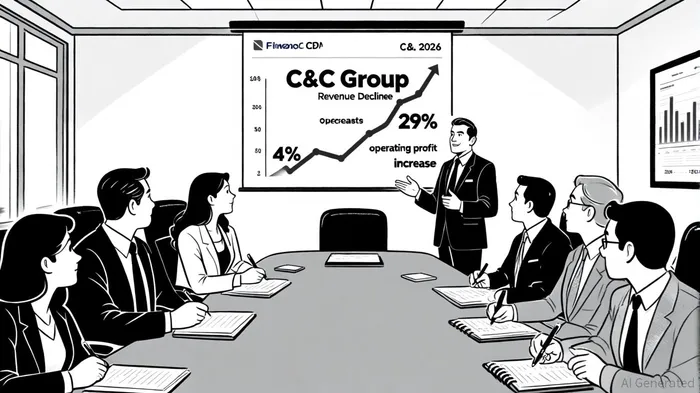
C&C Group, the Irish beverage giant behind brands like Bulmers and Tennent's, is navigating a pivotal juncture as it grapples with declining first-half revenues and a strategic leadership shift. The company's H1 2025 results revealed a 4% revenue drop on a constant-currency basis, driven by the transfer of AB InBev's off-trade beer distribution in Ireland and the planned exit from lower-margin segments[2]. While this decline raises immediate concerns, the 29% year-over-year increase in underlying operating profit before exceptional items—reaching €40.3m—suggests a deliberate pivot toward margin preservation and operational efficiency[2].
The CFO's impending exit, announced in October 2024, adds another layer of complexity to this strategic recalibration. Andrew Andrea, who also served as Chief Financial and Transformation Officer, is set to step down in March 2026, with CEO Roger White acknowledging his role in “stabilizing and improving the business” during a period of transformation. Andrea's departure follows a broader restructuring effort, including the disposal of non-core assets like the Irish soft drinks business and reduced contract brewing volumes[2]. These moves, while painful in the short term, align with a long-term vision of focusing on high-margin core brands and streamlining operations.
Capital Reallocation and Strategic Priorities
C&C Group's capital reallocation strategy is centered on two pillars: exiting underperforming segments and doubling down on core brands. The 3% net revenue decline in H1 2025—from €886.9m to €861.4m—was partially offset by cost efficiencies and improved margins, with the company projecting full-year operating profit of €80m and a 2027 target of €100m[2]. This trajectory hinges on the successful execution of its transformation plan, which includes exiting lower-margin cider volumes in the UK and refocusing on premium offerings.
The CFO's exit strategy appears to mirror this operational focus. Andrea's tenure coincided with a period of aggressive cost-cutting and asset divestitures, and his successor will inherit a business poised to capitalize on these changes. As noted by CEO Roger White, Andrea's leadership was critical in navigating the “challenging period” of declining revenues, but the next phase will require sustained discipline in capital allocation.
Implications for Shareholder Value
For investors, the interplay between C&C Group's strategic challenges and its capital reallocation efforts presents both risks and opportunities. The short-term revenue decline and CFO transition could test market confidence, particularly if the new leadership fails to maintain momentum in margin expansion. However, the company's ability to boost operating profit despite these headwinds—coupled with its long-term €100m operating profit target—signals a commitment to value creation through operational rigor[2].
A key question remains: Can C&C Group sustain its profitability while scaling its core brands? The performance of Tennent's and Bulmers in H1 2025, which delivered “solid revenue growth,” suggests that the company's premiumization strategy is resonating[2]. If this trend continues, the exit from lower-margin segments could free up capital for innovation and market expansion, further enhancing shareholder returns.
Conclusion
C&C Group's H1 2025 results and CFO transition underscore a broader narrative of strategic reinvention. While the near-term revenue decline is a red flag, the company's focus on margin expansion, core brand growth, and operational efficiency positions it to weather the transition. The success of this strategy will depend on the incoming CFO's ability to maintain the momentum Andrea helped build—and on the market's willingness to reward long-term transformation over short-term volatility.







Comentarios
Aún no hay comentarios