
Grocery Outlet Holds Steady Amid Headwinds: Q1 Earnings Offer a Glimmer of Resilience
Grocery Outlet Holding Corp (NASDAQ: GO) has delivered a mixed but cautiously optimistic Q1 2025 earnings report, balancing top-line growth with tempered expectations for same-store sales. While the company’s adjusted EPS of $0.13 comfortably beat the $0.07 consensus, its revised guidance underscores the persistent challenges of an uncertain economic environment. Let’s dissect the numbers to determine whether this value-driven grocer remains a compelling investment.
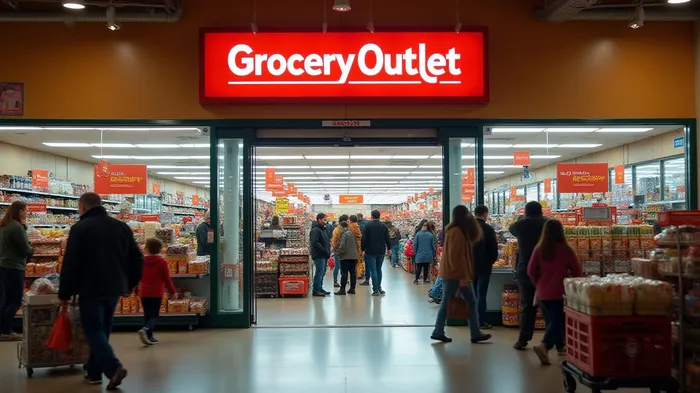
Key Financial Metrics: Growth Amid Volatility
Grocery Outlet reported a 8.5% year-over-year jump in net sales to $1.13 billion, fueled by aggressive store expansion. The company now operates 413 locations, up from 383 at the same time last year—a testament to its “fast-growth” strategy. However, comparable store sales rose a mere 0.3%, marking a slowdown from prior quarters and prompting the downward revision of full-year guidance.
The quarter’s net loss of $23.3 million stemmed primarily from $33.9 million in restructuring charges tied to its cost-cutting initiatives. Stripping out these one-time expenses, adjusted net income rose to $13.0 million, or $0.13 per share, driven by a 31.7% surge in adjusted EBITDA to $51.9 million. This operational efficiency, coupled with a 650% year-over-year increase in operating cash flow to $58.9 million, signals underlying health in its core business.
Guidance Adjustments: Pragmatism Over Optimism
The company’s decision to lower its full-year comparable store sales guidance to 1%–2% (from 2%–3%) reflects cautious realism. Management cited macroeconomic pressures, including reduced average transaction sizes and shifting consumer spending habits. Notably, however, Grocery Outlet reaffirmed its $4.7–$4.8 billion full-year net sales target—a figure achievable even if same-store sales fall short due to its relentless store-opening pace.
The plan to open 33–35 new stores in 2025 remains intact, with 16 already operational year-to-date. At its current trajectory, this expansion could contribute ~$300 million to annualized sales by year-end, assuming average store sales of $4.5 million. Meanwhile, the Q2 outlook of 1% comparable sales growth and a gross margin of 30.0%–30.5% suggests stabilization—albeit modest—after a slow start to the year.
Operational Levers to Watch
- Inventory Management: The rollout of its real-time order guide system aims to reduce out-of-stock issues and improve inventory turnover, which could lift sales and margins.
- Cost Discipline: The Restructuring Plan, which targets $30–$40 million in annual savings by 2027, is already yielding results. Operating cash flow surged to $58.9 million, up from $7.8 million a year ago.
- Customer Engagement: The company’s focus on “price-driven traffic” through daily markdowns and rotating door promotions remains its key differentiator. This model has historically thrived in recessions, as lower-income households prioritize discounts.
Risks on the Horizon
- Economic Sensitivity: The 0.3% same-store sales increase in Q1 hints at soft consumer demand. If inflation remains sticky or unemployment rises, transaction counts could weaken further.
- Competitor Pressure: Discount grocers like Lidl and Aldi continue to expand, potentially siphoning traffic.
- Execution Risks: The restructuring charges highlight the complexity of scaling operations while cutting costs.
Conclusion: A Buy with a Long-Term Lens
Grocery Outlet’s Q1 results paint a company navigating choppy waters but still steering toward its fiscal 2025 targets. The reaffirmed $4.8 billion sales ceiling, supported by 35 new stores and improving EBITDA, suggests management has the levers to deliver. While same-store sales remain a near-term concern, the company’s value-oriented model and disciplined expansion strategy position it well to capitalize on macroeconomic recoveries.
Investors should prioritize Grocery Outlet’s operational metrics over short-term sales fluctuations. With adjusted EBITDA up 31.7% year-over-year and a net debt-to-EBITDA ratio of just 0.4x, the balance sheet is robust. Should same-store sales rebound to 2% in H2 (as management hints), the stock could outperform. For now, this remains a hold—ideal for those willing to bet on its “discount darling” playbook enduring the test of time.





Comentarios
Aún no hay comentarios