
Grocery-Anchored Resilience: Why Phillips Edison & Company's Q2 2025 Earnings Signal Retail Real Estate Strength
As the retail landscape continues to evolve, one sector has proven its staying power: grocery-anchored neighborhood shopping centers. Phillips EdisonPECO-- & Company (PECO), a leading owner and operator of such properties, is poised to demonstrate this resilience in its upcoming Q2 2025 earnings call. With record occupancy rates, fortress-like tenant retention, and a strategic focus on necessity-based retail, PECO's performance could offer investors a compelling thesis in an uncertain economic environment.
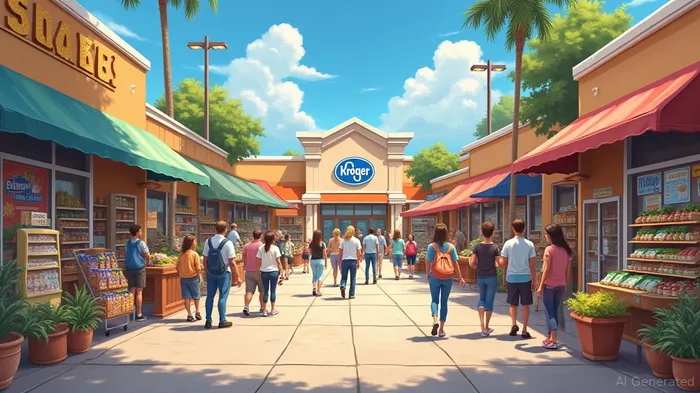
The Case for Grocery-Anchored Resilience
PECO's portfolio of 321 grocery-anchored centers is a masterclass in defensive real estate. Over 70% of its rental income comes from necessity-based tenants—grocery stores, pharmacies, and service providers—whose demand remains stable even during economic turbulence. This model proved its worth during the 2020 pandemic, when occupancy dipped just 70 basis points before rebounding fully by mid-2021. Today, PECO's 97.5% overall occupancy (as of Q1 2025) highlights the enduring appeal of its strategy. Anchors like KrogerKR--, Publix, and AlbertsonsACI-- drive foot traffic, while inline tenants benefit from their “last-mile” convenience.
The 95% tenant retention rate in Q1 2023—a record high—underscores the stability of this ecosystem. Tenants stay because PECO's centers are irreplaceable hubs for essential services. Even in a high-interest-rate environment, PECO's balance sheet shines: net debt to EBITDA of 5.3x (as of Q1 2025) leaves ample room to weather volatility.
Key Metrics to Watch in Q2 2025
The earnings call on July 25 will test whether this resilience persists. Investors should scrutinize three metrics:
- Occupancy Rates: Sustained high occupancy (target: 97%+) signals demand for necessity-driven retail.
- Leasing Spreads: New leases at +27% and renewals at +16% (Q1 2023 levels) reflect pricing power.
- Same-Center NOI Growth: A 3.25% annual target hinges on rental hikes and tenant retention.
Navigating Evolving Consumer Trends
While PECO's model is robust, it's not immune to challenges. E-commerce growth and shifting consumer preferences require adaptability. Here's how PECOPECO-- is responding:
- Omni-Channel Integration: Grocery anchors are now hubs for delivery and pickup, boosting foot traffic.
- Redevelopment Projects: Ground-up outparcel developments and repositioning (yielding 9–12% returns) ensure centers stay modern.
- Strategic Acquisitions: PECO targets $200–300 million in 2025 acquisitions, focusing on Sunbelt markets with population growth.
The proposed Kroger-Albertsons merger could also be a tailwind. As PECO's largest landlord for Kroger and second-largest for Publix, consolidation in the grocery sector could stabilize anchor occupancy further.
Risks and Considerations
Despite its strengths, PECO faces headwinds:
- Institutional Sentiment: Notable investors like CenterSquare have reduced stakes, signaling mixed confidence.
- Economic Sensitivity: While necessity-based tenants buffer downturns, high inflation or a recession could strain smaller inline tenants.
- Lack of Q2 Guidance: The absence of preliminary metrics in the press release leaves investors reliant on the earnings call for clarity.
Investment Thesis: Defensive Real Estate with Growth Potential
PECO's grocery-anchored model checks all the boxes for investors seeking stability and yield. With 8.5% dividend growth annually and a 4.4% dividend yield, it offers both income and capital appreciation. The stock's 52-week trading range of $30–$36 suggests it's undervalued relative to its peers.
Recommendation: Buy PECO for a diversified portfolio. Hold through the Q2 call, prioritizing occupancy and NOI data. Investors with a long-term horizon can consider dollar-cost averaging, especially if the stock dips pre-earnings.
Final Take
In an era of retail disruption, PECO's focus on grocery-anchored centers is a vote of confidence in the enduring power of necessity-based real estate. The Q2 earnings will test whether this model can outpace macroeconomic headwinds—and if so, PECO could emerge as a top defensive play in the REIT sector.
Stay tuned to the July 25 earnings call. The data will speak volumes.







Comentarios
Aún no hay comentarios