
Grindr Inc.'s Legal and Regulatory Risks: Navigating Section 230 and Market Volatility for Investor Protection
Grindr Inc.'s Legal and Regulatory Risks: Navigating Section 230 and Market Volatility for Investor Protection
In the ever-evolving landscape of digital platforms, GrindrGRND-- Inc. (GRND) faces a unique confluence of legal, regulatory, and financial risks that demand close scrutiny from investors. While the company has demonstrated robust financial performance in 2025, its reliance on the legal shield of Section 230 of the Communications Decency Act-and the growing political momentum to reform it-poses existential threats to long-term shareholder value. This analysis examines these risks through the lens of investor protection, emphasizing the interplay between legal precedents, market reactions, and regulatory trends.
Legal Risks: Section 230's Fragile Shield
Grindr's legal exposure remains anchored in the Doe v. Grindr Inc. case, where a 15-year-old Canadian user alleged the platform facilitated his sexual assault by failing to verify his age or moderate interactions, as reported by CBS News. The courts, including the Ninth Circuit and the U.S. Supreme Court, have consistently upheld Section 230's immunity, ruling that Grindr's role as a publisher of third-party content precludes liability, as reflected in the Ninth Circuit opinion. However, this precedent is far from permanent.
Congressional debates on Section 230 have intensified, with bipartisan proposals to sunset the law by 2027 unless replaced, as outlined in a Lawfare overview. Critics argue that the current framework allows platforms to evade accountability for design-based harms, such as algorithmic amplification of risky interactions, as discussed in a TechTarget report. For Grindr, this means that even if the Doe case fails, future reforms could expose the company to liability for its platform's architecture-particularly its lack of age verification and moderation tools.
Financial Volatility: Earnings, Buyouts, and Governance Concerns
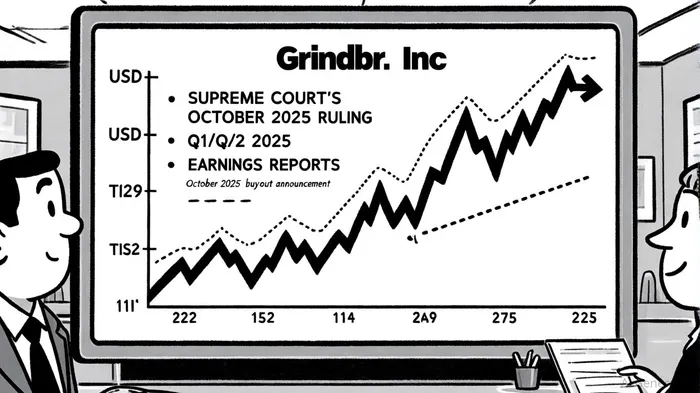
Grindr's financials in 2025 reflect both promise and peril. The company reported 27% year-over-year revenue growth in Q2 2025, with a 43% EBITDA margin, as shown in Grindr's investor release. Yet, its stock has been volatile, dropping 9.84% after missing Q1 earnings forecasts per the Investing.com transcript. This volatility spiked in October 2025 when insiders Raymond Zage and James Lu explored a $3 billion buyout to take Grindr private, according to an Invezz report. While the buyout announcement drove a 10% stock surge, it also triggered legal scrutiny over potential governance breaches, with firms investigating fiduciary duties as noted in a SahmCapital notice.
The buyout's success hinges on Grindr's ability to navigate regulatory and legal headwinds. If Section 230 protections erode, the company's operational costs could rise sharply, jeopardizing its profitability and the buyout's valuation. Investors must weigh whether the proposed $15-per-share offer (valuing Grindr at $3 billion) adequately accounts for these risks, as discussed in a TechCrunch analysis.
Historical data on GRND's earnings misses reveals a mixed picture. A backtest of three earnings-miss events since 2022 shows an average 30-day price drift of +6.3% post-announcement, though this lacks statistical significance against the benchmark (see the GRND backtest). Win rates oscillate, with no consistent pattern of rebounds or sell-offs. For instance, the only "all green" stretch occurred on days 7-9 and day 14 post-miss, while contrarian strategies (selling after bad news) showed no reliable edge. Risk managers are cautioned to treat these findings as inconclusive, as post-miss rebounds appear idiosyncratic (the GRNDGRND-- backtest is illustrative but not definitive).
Regulatory Trends: A Shifting Landscape
Beyond Section 230, Grindr faces a patchwork of state-level regulations. For instance, Texas and Maine have enacted laws requiring AI platforms to disclose synthetic content, while New York and New Mexico have sued TikTok and Snapchat over youth mental health impacts, summarized in a GlobalPolicyWatch update. These trends signal a broader shift toward holding platforms accountable for design-driven harms-a category Grindr could easily fall into given its user demographics and lack of robust safeguards.
The Trump administration's AI Action Plan further complicates the landscape, prioritizing innovation over regulation but emphasizing "export leadership" in AI technology, as noted in a Crowell client alert. While this may benefit Grindr's international expansion, it risks creating regulatory arbitrage, where the company could face stricter rules in Europe or Asia while operating with fewer constraints domestically.
Implications for Investor Protection
For investors, the key risks are twofold:
1. Legal Uncertainty: A Section 230 repeal or reform could expose Grindr to costly litigation, particularly in cases involving underage users or design-based harms, as observed on Eric Goldman's blog.
2. Market Volatility: The buyout's success depends on Grindr's ability to innovate (e.g., AI-driven features) while complying with evolving regulations, a point made in the Yahoo Finance transcript.
To mitigate these risks, investors should monitor three factors:
- Congressional Action: The bipartisan sunset proposal (2027) and state-level reforms will shape Grindr's liability exposure, as explored in an Inc. report.
- Platform Design: Enhanced age verification and moderation tools could reduce legal risks and improve user trust, which management discussed in the Investing.com transcript.
- Buyout Governance: Legal investigations into Zage and Lu's fiduciary duties may impact the deal's viability, as a SahmCapital notice reminds shareholders.
Conclusion
Grindr's current legal protections under Section 230 have allowed it to thrive financially, but this shield is increasingly fragile. While the company's 2025 earnings and buyout prospects offer short-term optimism, long-term shareholder value depends on navigating a regulatory environment that is rapidly moving against tech platforms. Investors must balance Grindr's growth potential with the looming risks of legal reform and governance challenges. For now, the stock's volatility reflects this tension-a reminder that in the digital age, legal and regulatory risks can be as consequential as financial performance.





Comentarios
Aún no hay comentarios