
The Grid-to-Chip Super-Cycle: Industrial Titans Powering the AI Era
The AI revolution is reshaping global markets, but the beneficiaries are no longer confined to traditional tech giants. In 2026, a seismic shift is underway: "New School" Industrials are outpacing the Technology sector, driven by their foundational role in enabling AI infrastructure. This transition reflects a broader reallocation of capital toward sectors with tangible execution and scalable margins, as investors increasingly favor companies that power the AI ecosystem over those merely riding the hype.
The Infrastructure Imperative: From Hype to Hard Assets
AI's exponential growth hinges on a robust physical and operational backbone. According to CNBC, the AI infrastructure sector-encompassing semiconductors, data centers, and power solutions-is projected to outperform industrials in 2026, fueled by hyperscalers like AmazonAMZN--, MicrosoftMSFT--, and MetaMETA-- pouring capital into AI deployment. These infrastructure providers are not just suppliers; they are the enablers of AI's commercialization. For instance, NVIDIA and AMD have seen surging demand for their AI chips, with NVIDIANVDA-- projected to reach $120 billion in revenue for FY2026.
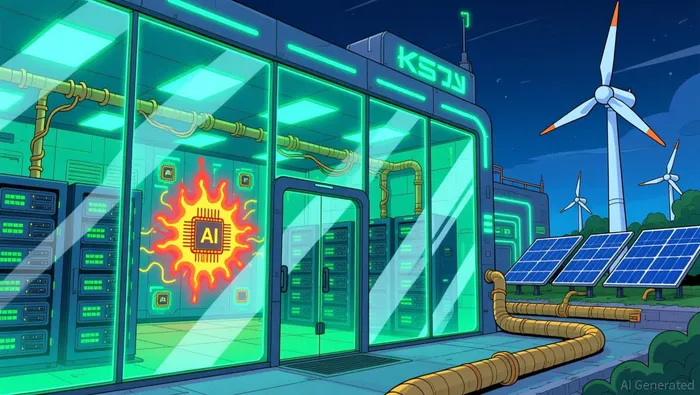 Meanwhile, industrials are redefining their role in this ecosystem. Companies like GE VernovaGEV-- (GEV) and Vertiv (VRTX) are leading the "Grid-to-Chip" super-cycle, addressing critical bottlenecks in power generation and data-center cooling. GE Vernova's stock has surged over 300% since its 2024 spinoff, supported by a $200 billion backlog extending through 2028. This performance underscores a key insight: as AI demand escalates, the ability to deliver reliable, scalable infrastructure becomes a competitive moat.
Tech's Valuation Woes and the Capital Rotation
The Technology sector, which surged 300% from 2023 to 2025, now faces valuation headwinds. Wall Street analysts warn that stretched multiples for the "Magnificent Seven" are prompting a rotation into more economically cyclical sectors like industrials and energy. As Bank of America and Morgan Stanley note, investors are shifting capital toward sectors with clearer earnings visibility and pricing power. This trend is amplified by the "One Big Beautiful Bill Act", which incentivizes domestic manufacturing and infrastructure development, further boosting industrials.
While tech firms remain critical to AI innovation, their ability to sustain growth is increasingly tied to execution. A Goldman Sachs analysis highlights that AI spending by hyperscalers is likely to prioritize "picks and shovels" like GPUs and high-speed memory over broader IT services. This shift pressures tech companies to demonstrate tangible ROI on AI investments-a challenge that industrials, with their capital-efficient models, are better positioned to meet.
New School Industrials: Innovation Beyond Traditional Boundaries
The "New School" Industrials are not merely adapting to AI-they are reinventing their industries. AST SpaceMobile is commercializing satellite-based cellular technology, with revenue expected to rise 342.6% in 2026. Similarly, Rivian Automotive's planned R2 electric vehicle line could unlock mass-market adoption and profitability. These companies exemplify how industrials are leveraging AI to disrupt traditional sectors, from space to mobility.
Legislative tailwinds further bolster this momentum. Tax incentives for reshoring and infrastructure development have accelerated adoption of advanced technologies, creating a favorable environment for long-term growth. For investors, this translates to a focus on firms with strong organic growth, margin expansion, and AI integration-traits that define the "New School" Industrials.
Broader Market Dynamics and Global Implications
The 2026 market landscape is marked by a broadening of returns across sectors and geographies. Franklin Templeton's Global Investment Outlook predicts that easing monetary policy and a weaker U.S. dollar will enhance returns for international and emerging market equities. This environment favors industrials and financials, which are more sensitive to economic cycles. Meanwhile, energy and power companies are gaining from the electricity demand driven by AI data centers.
However, challenges persist. The industrial sector must address a "workforce skills gap", while tech firms must prove the value of their AI investments. For now, though, the execution-driven returns of industrials-coupled with their critical role in the AI infrastructure boom-position them as the clear outperformers in 2026.
Conclusion: The New Titans of Capital Allocation
As the AI era matures, the market is rewarding companies that build the rails for innovation rather than merely riding the wave. The "New School" Industrials, with their focus on scalable infrastructure, legislative support, and operational excellence, are capturing the lion's share of capital flows. While the Technology sector remains vital, its growth is increasingly constrained by valuation risks and execution pressures. For investors, the lesson is clear: in 2026, the real winners are those powering the AI revolution from the grid to the chip.







Comentarios
Aún no hay comentarios