
Greenland's Strategic and Resource Potential Amid U.S.-Danish Tensions
The Arctic has long been a theater of geopolitical maneuvering, but in 2025, Greenland has emerged as a focal point of unprecedented strategic competition. With its vast untapped natural resources, strategic location, and the escalating tensions between the United States and Denmark over its sovereignty, Greenland is reshaping the calculus of Arctic investments. For investors, the interplay of geopolitical risk and resource potential presents both challenges and opportunities, particularly as global powers vie for influence in a rapidly changing region.
Geopolitical Risk as a Catalyst for Investment
The U.S. has intensified its focus on Greenland under President Donald Trump, who has repeatedly asserted that the island must be "owned" by the U.S. to counter Russian and Chinese ambitions in the Arctic according to a joint statement. This rhetoric, coupled with Trump's refusal to accept leasing agreements or diplomatic solutions, has elevated Greenland to a symbol of Arctic strategic competition as reported. While Denmark and Greenlandic authorities have firmly rejected U.S. overtures-emphasizing that the territory is not for sale and that any annexation would violate international law according to analysis-the resulting geopolitical friction has drawn global attention to Greenland's economic and military value.
This tension has directly influenced investment trends. For instance, the U.S. Export-Import Bank's $120 million loan proposal for the Tanbreez rare earth mine in Greenland, announced in June 2025, reflects a strategic push to secure critical mineral supply chains according to CSIS analysis. The move underscores how geopolitical risk is not merely a deterrent but a driver of investment, as nations and corporations seek to preemptively secure assets in contested regions.
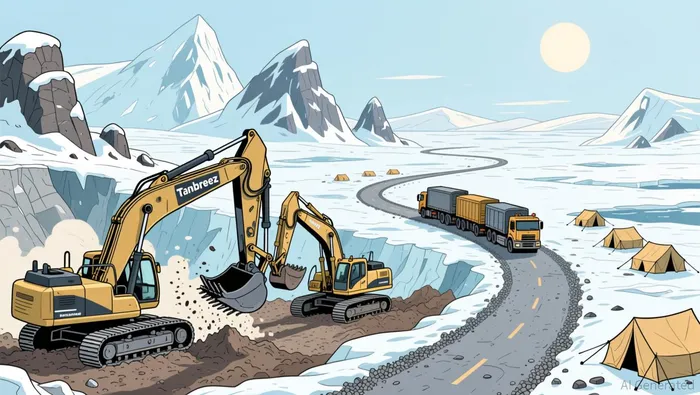
Greenland's Resource Potential: A Double-Edged Sword
Greenland's natural resources, particularly its rare earth elements (REEs), are central to its strategic appeal. The island ranks eighth globally in REE reserves, with deposits at Kvanefjeld and Tanbreez totaling 1.5 million tons according to CSIS analysis. These minerals are indispensable for defense technologies, renewable energy systems, and advanced electronics. However, the path to monetizing these resources is fraught with challenges.
Infrastructure limitations, environmental concerns, and the Arctic's harsh climate have delayed mining operations as CSIS reports. For example, China's Shenghe Resources, which holds a 12.5% stake in the Kvanefjeld mine, has faced setbacks due to regulatory hurdles and U.S. pressure on Greenland to prioritize Western partners according to analysis. Meanwhile, the U.S. has sought to counter Chinese dominance in rare earth processing-currently controlled by 90% of the global market-by fostering alliances with Japan, Australia, and Saudi Arabia as CSIS notes. This competition has turned Greenland into a microcosm of broader supply chain struggles, where resource access is inextricably linked to geopolitical alignment.
Strategic Location and Emerging Shipping Routes
Beyond its mineral wealth, Greenland's geographic position between North America and Eurasia amplifies its strategic significance. As Arctic ice recedes, new shipping routes are opening, potentially reducing transit times between Europe and Asia according to economic analysis. This development has drawn interest from nations seeking to dominate Arctic trade corridors. The U.S. military's existing presence at the Pituffik base, combined with the 1951 agreement allowing expanded deployments, highlights how Greenland's infrastructure could serve as a linchpin for Arctic security as reported.
However, the militarization of Greenland also raises risks. Danish Prime Minister Mette Frederiksen has warned that any U.S. attempt to annex the island would destabilize NATO and the post-World War II global order according to analysis. Such rhetoric underscores the fragility of the current status quo and the potential for conflict to disrupt investment flows.
The Role of Greenland's Self-Determination
Greenland's political aspirations further complicate the investment landscape. As a self-governing territory within the Kingdom of Denmark, Greenland has expressed a desire for full independence, with its leaders insisting that the island's future must be decided by its own people according to a joint statement. This stance has been reinforced by the Greenlandic government's openness to global mining partnerships, even as it navigates the pressures of U.S. and Chinese interests according to SP Global. For investors, this dynamic creates uncertainty: while Greenland's resources are abundant, its political trajectory remains fluid, influenced by both internal governance and external pressures.
Conclusion: Navigating Risk and Opportunity
The Arctic's geopolitical risks are no longer abstract-they are tangible forces shaping investment decisions in Greenland. The U.S.-Danish tensions, China's contested role, and the strategic value of rare earth elements have converged to make Greenland a high-stakes arena for global competition. For investors, the key lies in balancing the potential rewards of Arctic resources with the volatility of geopolitical dynamics.
As the Trump administration continues to prioritize Greenland's acquisition or influence, and as China seeks to expand its Arctic footprint, the island's future will hinge on a delicate interplay of diplomacy, economics, and security. Those who can navigate these complexities-while respecting Greenland's sovereignty and environmental constraints-may find themselves at the forefront of a new era in Arctic investment.







Comentarios
Aún no hay comentarios