
Greenland's Strategic Value and the Implications of U.S.-Danish Tensions for Arctic Resource Markets
The Arctic has long been a theater of geopolitical competition, but in 2025, Greenland has emerged as a focal point of global attention due to its strategic location, critical mineral resources, and the escalating tensions between the United States and Denmark. As the Trump administration reiterates its fixation on acquiring Greenland, investors and policymakers must grapple with the implications of this volatile dynamic for Arctic resource markets. This analysis explores Greenland's strategic value, the geopolitical risks posed by U.S.-Danish tensions, and the emerging investment opportunities in the region.
Greenland's Strategic and Economic Potential
Greenland's vast reserves of rare earth elements (REEs), lithium, and other critical minerals position it as a linchpin in the global energy transition and defense industries. According to a report, the island holds significant deposits of heavy rare earth elements like and , essential for permanent magnets used in wind turbines, electric vehicles, and advanced military systems. These resources are critical for reducing Western reliance on China, .
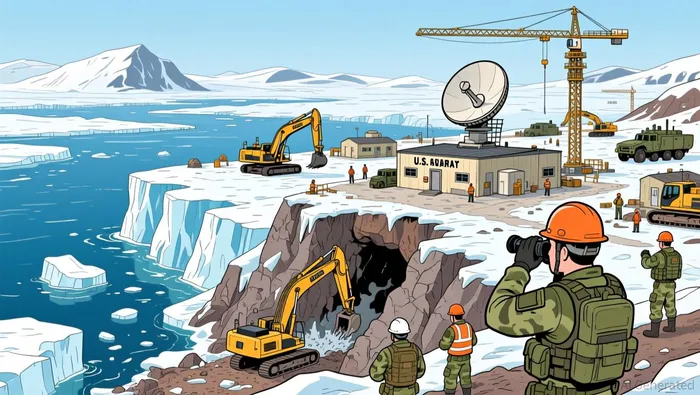
The Trump administration has framed Greenland's acquisition as a national security imperative, citing its strategic location between the Arctic and North Atlantic as a bulwark against Russian and Chinese influence. However, experts question the necessity of full annexation, noting that existing U.S. military infrastructure, such as the , already provides critical surveillance and missile defense capabilities. Despite this, the administration has explored equity stakes in Greenland-based projects, such as 's Tanbreez rare earths project, .
Geopolitical Risks and Diplomatic Fallout
The U.S. push for Greenland has strained transatlantic relations. Danish Prime Minister Mette Frederiksen has warned that Trump's threats could "spell the end of NATO," emphasizing that Greenland is not for sale and that Denmark and Greenland alone hold sovereignty over the territory. Greenland's government has echoed this stance, with Prime Minister Jens-Frederik Nielsen calling U.S. rhetoric "completely and utterly unacceptable."
These tensions have disrupted investment flows. uncertainty over U.S. policy has led to cautious capital deployment. Meanwhile, Denmark has increased its Arctic defense spending and sought to strengthen partnerships with European allies, including joint resource development agreements with Greenland. This shift reflects a broader European strategy to counter U.S. overreach while securing access to Greenland's resources.
Emerging Investment Opportunities Amid Uncertainty
Despite the risks, Greenland's resource potential is attracting strategic investors. The European Union, for instance, has prioritized a critical raw materials strategy, with Greenland serving as a key supplier of molybdenum and other defense-critical minerals. The Malmbjerg project, operated by , , underscoring the region's economic significance.
Middle Eastern nations, leveraging their energy cost advantages, are also emerging as key players in Arctic mineral processing. Partnerships with Saudi Arabia and the UAE could diversify supply chains and reduce Western dependence on Chinese processing. Additionally, Greenland's 2023 draft constitution, which emphasizes self-determination and Inuit heritage, may attract ethically conscious investors seeking to align with sustainable development frameworks.
Challenges and the Path Forward
Investors must navigate significant challenges, including high operational costs, environmental risks, and geopolitical volatility. The Arctic's harsh climate and limited infrastructure inflate capital expenditures, while recycling and substitution technologies threaten the economic viability of new projects. Furthermore, the Trump administration's military posturing-ranging from appointing a special envoy to Greenland to suggesting unilateral action- has created an unpredictable regulatory environment.
For Greenland, the path forward hinges on balancing sovereignty with economic development. Strengthening partnerships with Denmark and European allies, while pursuing independent resource projects, could mitigate U.S. pressure. For investors, the key lies in hedging against geopolitical risks while capitalizing on Greenland's unique position in the global supply chain.
Conclusion
Greenland's strategic value is undeniable, but its future remains entangled in the web of U.S.-Danish tensions and Arctic geopolitics. While the Trump administration's aggressive stance has raised alarms, it has also accelerated efforts to diversify critical mineral supply chains and bolster European Arctic partnerships. For investors, the Arctic presents both risks and rewards-a region where geopolitical dynamics and resource potential collide, demanding careful navigation and long-term vision.





Comentarios
Aún no hay comentarios