
Greenland's Strategic Gambit: Assessing the Rare Earth Supply Chain and Market Implications
President Trump's recent rhetoric has framed Greenland as a critical national security asset, a narrative driven by a desire to counter Russian and Chinese Arctic activity. The stated goal is clear: to secure control over the territory's vast mineral wealth, particularly rare earth elements (REEs), to break China's supply dominance. As the administration has reiterated, this is about resource security as national security. Greenland is rich in natural resources... but the resources attracting the most attention... are rare earth elements (REEs).
The president has made his position unequivocal. He has stated that if we don't take Greenland, Russia or China will, and I'm not letting that happen, and that we'll have to defend Greenland... the easy way or the hard way. His specific remarks underscore the perceived urgency and the dismissive attitude toward current defenses. He mocked Greenland's military posture, telling reporters their defense is two dog sleds, while warning of Russian and Chinese naval presence. This national security framing is the core of his gambit.
Yet the immediate feasibility of this gambit is severely limited by political reality. The response from key stakeholders has been a unified rejection. Greenland's self-governing leadership, including opposition party leaders, has issued a clear statement: We do not want to be Americans, we do not want to be Danes, we want to be Greenlanders. They insist the future must be decided by the Greenlandic people. Denmark, the sovereign state, has issued a stark warning: military action would spell the end of the trans-Atlantic defence alliance. European allies have echoed this alarm, with French and German leaders accusing the U.S. of undermining international rules and risking a return to a "den of robbers."
The bottom line is a stark tension between a bold geopolitical narrative and entrenched political resistance. The U.S. may frame Greenland as a strategic necessity, but the island's leaders and its Danish parent state see it as a sovereign territory not for sale. The rhetoric of national security may set the agenda, but the limits of international law, alliance cohesion, and local autonomy present formidable barriers to any coercive action.
The Mineral Reality: Assessing Supply Chain Impact and Strategic Complementarity
The strategic narrative hinges on a critical question: can Greenland's resources materially alter the global rare earth supply chain? The answer requires separating geological promise from commercial reality. Greenland hosts one of the world's largest undeveloped heavy rare earth deposits, exemplified by Critical MetalsCRML-- Corp.'s Tanbreez project. Recent drilling has yielded exceptional results, with a surface channel returning 65 metres grading 0.55% total rare earth oxides (TREO) and a 25.5% heavy rare earth oxides (HREO) component. These high-grade, bulk-tonnage results underscore the project's potential to supply the critical heavy elements that are in short supply and vital for advanced defense and clean energy technologies.
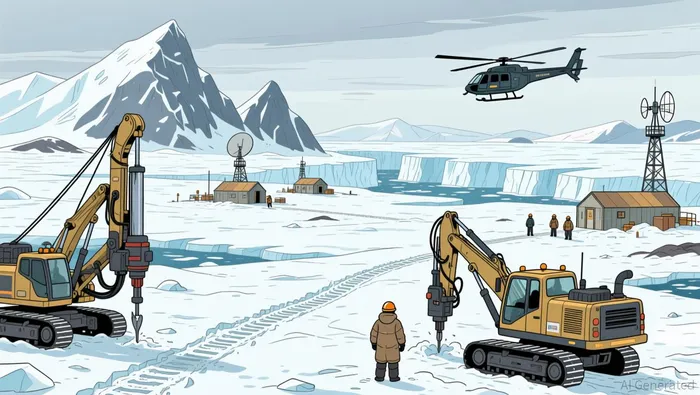
Yet the path from assay to market is obstructed by formidable physical and infrastructural challenges. The island's harsh environment, lack of key infrastructure, and difficult geology have so far prevented any commercial-scale mining. The complex eudialyte rock hosting these deposits requires specialized processing, and the absence of roads, ports, and power grids for remote operations creates a massive upfront cost and timeline barrier. As one expert noted, the hype far outstrips the hard science and economics behind these critical minerals. No rare earth mining has taken place to date, and even if political hurdles were cleared, commercial production is likely years away.
In this context, U.S.-based producers like MP MaterialsMP-- provide a crucial strategic complement. While Greenland represents a long-term, high-risk diversification play, MP offers a near-term, domestic supply chain anchor. The company operates the Mountain Pass mine in California and, critically, owns a domestic processing facility. Its strategic partnership with the U.S. Department of Defense, which made the Pentagon the largest shareholder, sets a price floor of $110 per kilogram for neodymium-praseodymium (NdPr) materials. This government-backed commitment provides stability and de-risks the domestic supply chain. As of early January, MP Materials stock was trading around $62.77, reflecting its established production and strategic value.
The bottom line is one of strategic complementarity, not substitution. Greenland's Tanbreez deposit represents a potential future source of critical heavy rare earths, but its development is a multi-decade endeavor fraught with physical and political uncertainty. MP Materials, by contrast, is a functioning, government-supported producer that provides immediate, tangible diversification from China. For the U.S. critical minerals strategy, the ideal path likely involves both: leveraging the domestic production and partnership of a company like MP today, while maintaining a long-term investment in the exploration and eventual development of strategic resources like those in Greenland.
Market Reaction and Valuation: Separating Speculation from Fundamentals
The geopolitical narrative has ignited a dramatic market reaction, but the moves reveal a clear split between speculative frenzy and fundamental valuation. For companies directly tied to the Greenland story, the response has been extreme volatility and a parabolic price surge. Critical Metals Corp.CRML-- (CRML) exemplifies this dynamic. In just the past five trading days, the stock has rallied 84.42%. Over the longer term, the run has been even more explosive, with the share price up 283% over the last 120 days. This frenzy is matched by staggering trading activity, with a turnover rate of 57.06% and a daily volatility of 20.44%. The stock's recent intraday swing of nearly 20% underscores the speculative positioning, where price moves are driven by narrative momentum rather than near-term financials.
Contrast this with the market's treatment of a company with tangible, existing production: MP Materials. As of early January, its stock was trading around $62.77, reflecting a more measured 5.77% gain over the recent period. Its valuation is grounded in its established domestic supply chain, including the Mountain Pass mine and a processing facility. The strategic partnership with the U.S. Department of Defense, which provides a price floor for critical materials, offers a fundamental de-risking that is absent from the Greenland play. Here, the market is pricing in production, government support, and a clear path to cash flow, not distant potential.
The market's interpretation is now clear. The CRMLCRML-- surge appears to be a classic speculative bet on the geopolitical narrative, a bet that Greenland's resources will eventually materialize into a commercial reality. The high turnover and volatility signal a crowded trade, where sentiment can drive sharp reversals. MP Materials, by contrast, is valued for its fundamentals-its existing operations and strategic government backing. This divergence highlights a key investment lesson: in the critical minerals sector, the market is willing to pay a premium for narrative, but it demands proof for price. For now, the speculative firestorm around Greenland has lifted one stock, while the other trades on the solid ground of what it already produces.
Catalysts, Scenarios, and Key Risks
The investment thesis for both Critical Metals and MP Materials now hinges on a series of forward-looking catalysts and risks that will determine whether the current market narratives hold water. For CRML, the path is defined by geopolitical execution and project advancement. For MP Materials, it is about sustaining its strategic advantage in a potentially shifting policy landscape.
The primary positive catalyst for CRML is a concrete, negotiated agreement that unlocks its Tanbreez project. A deal between the U.S. and Denmark/Greenland that includes clear pathways for project development-such as a long-term lease with guaranteed infrastructure support or a joint venture with defined milestones-would directly de-risk the company's premium valuation. This would transform the speculative narrative into a tangible development plan, validating the market's bet on Greenland's resource potential. Without such an agreement, the stock remains a pure play on geopolitical outcome.
The key political risk is a prolonged stalemate. If the current impasse continues, with Greenland's leadership and Denmark firmly rejecting any U.S. acquisition or lease, the company's entire investment case unravels. The stock's speculative premium is built on the assumption that U.S. control is achievable. A legal or diplomatic deadlock that prevents any operational control would render CRML's high valuation unsustainable, as its assets remain undeveloped and its strategic narrative loses credibility.
Beyond politics, there is a significant operational risk: failure to advance Tanbreez past the exploration phase. Even with U.S. control, the project faces the island's harsh environment, lack of key infrastructure, and difficult geology. Technical hurdles in processing the complex eudialyte rock or the inability to secure the massive upfront capital needed for remote mining could stall development for years. Financial constraints could also derail the timeline. This risk is independent of geopolitics; it is the fundamental challenge of turning a high-grade deposit into a commercial mine.
Finally, a strategic shift in U.S. policy poses a distinct risk. If the administration pivots away from the Greenland acquisition narrative toward bolstering existing domestic producers like MP Materials, the investment thesis for CRML could be re-evaluated. The market may decide that the near-term, government-backed production and processing capabilities of a company like MP offer a more reliable path to supply chain diversification than a distant, high-risk Greenland play. This would likely lead to a capital re-allocation, pressuring CRML's valuation while reinforcing MP's fundamentals.
The bottom line is a bifurcated risk-reward profile. CRML's future is a binary bet on geopolitical success and operational execution, both of which face steep odds. MP Materials offers a more stable, albeit less glamorous, path anchored in existing production and strategic partnership. Investors must monitor the diplomatic front for any breakthrough or breakdown, while also assessing the technical and financial progress of Greenland's deposits. The catalysts are clear, but the risks are equally defined.





Comentarios
Aún no hay comentarios