
Green Mobility in Nigerian Tertiary Education: Assessing the TETFund E-Tricycle Initiative as a Catalyst for Sustainable Infrastructure Investment
The global shift toward sustainable infrastructure is gaining momentum, and Nigeria's tertiary education sector is emerging as a critical battleground for green tech adoption. At the heart of this transformation lies the Tertiary Education Trust Fund (TETFund) E-Tricycle Initiative, a program that not only addresses campus mobility challenges but also aligns with national carbon reduction targets and youth empowerment goals. As Nigeria's government and private sector increasingly prioritize climate action, the initiative offers a compelling case study for investors seeking to evaluate the intersection of public policy, technological innovation, and scalable infrastructure investment.
TETFund E-Tricycle Initiative: A Dual-Pronged Approach to Green Mobility
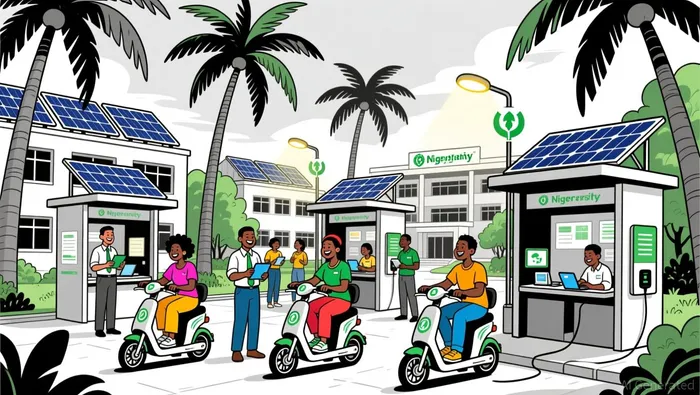
The TETFund E-Tricycle Initiative, launched in 2023 and expanded across institutions like Bayero University, Kano (BUK), and Ahmadu Bello University (ABU), represents a strategic pivot toward electrification and renewable energy. By deploying solar-powered tricycles equipped with lithium-ion batteries and solar panels, the program aims to reduce carbon emissions while cutting transportation costs for students and staff. At BUK, 20 solar-powered tricycles were commissioned in October 2025, enabling 130–150 km of travel per charge and complementing existing CNG-powered fleets. Similarly, ABU's adoption of the same technology underscores the initiative's scalability, with charging stations now integrated into campus infrastructure.
This initiative is not merely a pilot project but a deliberate step toward institutionalizing green mobility. According to a report by the Federal Ministry of Youth Development, the program aligns with President Bola Tinubu's "Renewed Hope Agenda," which seeks to reduce transportation costs by 40% and create 1.2 million jobs for youth through electric vehicle (EV) ecosystems. The dual focus on environmental sustainability and economic empowerment positions the E-Tricycle Initiative as a linchpin for Nigeria's energy transition.
Public-Private Partnerships: Bridging the Infrastructure Gap
The success of the E-Tricycle Initiative hinges on robust public-private partnerships (PPPs). While TETFund provides the initial capital and oversight, private entities like House of Destiny Global Services Ltd. and NATOMORAS (National Commercial Tricycle and Motorcycle Owners and Riders Association) play pivotal roles in scaling the program. For instance, the Youth-Focused Electric Tricycle Empowerment Initiative, launched in collaboration with these partners, has distributed over 4,000 electric tricycles and motorcycles to youth beneficiaries, creating a decentralized network of green mobility solutions.
These partnerships reflect a broader trend in Nigeria's infrastructure landscape. As noted in a 2025 study on PPP models, such collaborations leverage private-sector expertise in technology deployment and operational efficiency while reducing fiscal burdens on the government. The E-Tricycle Initiative exemplifies this model: TETFund funds the procurement of vehicles and charging infrastructure, while private partners manage distribution, maintenance, and workforce training. This division of labor ensures sustainability and scalability, critical factors for attracting long-term investment.
Alignment with National Green Mobility Goals
The E-Tricycle Initiative is explicitly tied to Nigeria's national carbon reduction targets. By replacing fossil-fuel-dependent tricycles with solar-powered alternatives, the program contributes to the country's Nationally Determined Contributions (NDCs) under the Paris Agreement. According to data from the Federal Ministry of Environment, transportation accounts for 28% of Nigeria's greenhouse gas emissions, making electrification a high-impact lever for decarbonization.
Moreover, the Federal Government's Energy Transformation Programme aims to transition 30% of public transportation to electric vehicles by 2030. TETFund's N70 billion Mini-Grid Solar Power Project, which extends renewable energy access to 18 tertiary institutions, further reinforces this alignment. These coordinated efforts signal a coherent policy framework, reducing regulatory and operational risks for investors.
Investment Implications: A Model for Scalable Green Infrastructure
For investors, the E-Tricycle Initiative highlights the potential of Nigeria's tertiary education sector as a high-impact arena for sustainable infrastructure. The program's reliance on PPPs and its alignment with national climate goals create a favorable environment for private capital. For example, the involvement of House of Destiny Global Services Ltd. demonstrates how private firms can monetize green tech adoption through service contracts, battery leasing, and data analytics from EV usage.
However, challenges remain. The lack of detailed funding ratios and technology contribution breakdowns in the initiative's current structure suggests room for improvement in transparency and stakeholder engagement. Investors seeking clarity may need to advocate for more granular reporting on cost-sharing mechanisms and performance metrics. Nonetheless, the initiative's early success-evidenced by its rapid expansion to institutions like the University of Jos (UNIJOS)-underscores its replicability and long-term viability.
Conclusion: A Catalyst for Systemic Change
The TETFund E-Tricycle Initiative is more than a campus mobility solution; it is a blueprint for integrating green tech into Nigeria's infrastructure DNA. By combining public funding with private-sector innovation, the program addresses both environmental and socioeconomic challenges, offering a scalable model for other sectors. For investors, the initiative's alignment with national policy, its demonstrated impact on carbon reduction, and its potential for job creation make it a compelling opportunity in the green economy. As Nigeria's energy transition gains momentum, the E-Tricycle Initiative stands as a testament to the power of collaborative, mission-driven investment.







Comentarios
Aún no hay comentarios