
The Great Unwinding: A Structural Shift in Global Capital Flows
The October numbers present a clear, if complex, signal. The U.S. recorded a net capital outflow of $37.3 billion, a sharp reversal from the $184.3 billion inflow in September. This shift is the headline, but the real story lies in the details beneath it. The outflow was driven by official sales, not a broad retreat from U.S. assets. Foreign official institutions sold $10.1 billion in long-term securities, while private foreign investors were net buyers of $49.0 billion.
The most telling data point is the trend in Treasury holdings. Foreign ownership of U.S. Treasuries fell to $9.243 trillion in October, marking a second consecutive monthly decline. This drop was led by China, whose holdings fell to $688.7 billion, the lowest since October 2008. The broader picture shows a systematic diversification, with Japan's holdings rising to a near-three-year high and the UK increasing its custodial stock.
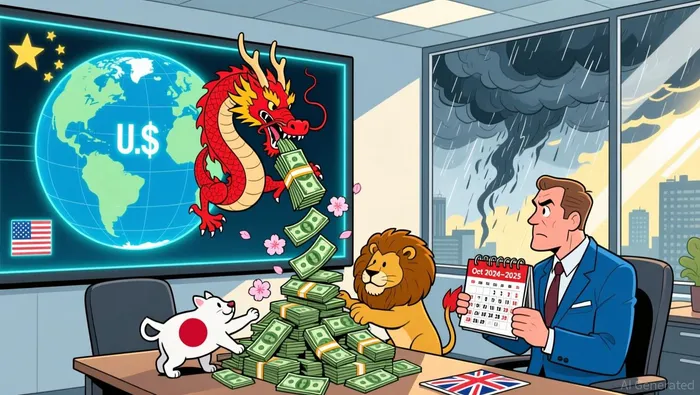
The puzzle is resolved by separating the flows. The net outflow is a function of official sales, while private demand remains robust. This divergence points to a structural shift. Central banks and sovereign wealth funds are actively reducing dollar exposure, a trend amplified by geopolitical tensions and the recent U.S. government shutdown. Yet, the underlying economic and financial appeal of U.S. assets persists for private capital. The October data does not signal a sudden flight, but rather a deliberate, ongoing unwinding of official dollar reserves.
The Drivers: Policy, Geopolitics, and the Dollar's Role
The October outflow is not a random fluctuation. It is the visible symptom of deeper, structural forces reshaping the global financial order. The immediate catalyst was a sharp spike in geopolitical risk, exemplified by the Justice Department's subpoena of the Federal Reserve. When that news broke, it rekindled fears about the central bank's independence, triggering a "Sell America" market reaction. Yields on U.S. Treasuries surged to multi-month highs, and the dollar weakened. While the panic faded, the underlying anxiety about policy stability and institutional integrity had already been planted.
This tactical shock interacts with a powerful long-term trend: the dollar's own depreciation. The currency fell about 11% in the first half of 2025, marking the end of a 15-year bull cycle. This significant devaluation creates a direct incentive for foreign investors to hedge their dollar exposure. As Morgan StanleyMS-- notes, the delayed impact of tariffs and policy uncertainty is likely to keep negative pressure on the dollar, a dynamic that encourages foreign capital to manage its currency risk by reducing net dollar holdings.
The most profound driver, however, is a fundamental reset in U.S. economic relationships. The administration's new National Security Strategy reflects a decisive break from the post-Cold War order, actively reshaping trade, industrial policy, and alliances. This strategic pivot, particularly the intensifying competition with China over AI and technology, creates a powerful incentive for U.S. allies and partners to diversify their asset holdings away from dollar-denominated instruments. The goal is to reduce systemic vulnerability to U.S. policy shifts and to build more resilient, multi-polar financial networks.
The bottom line is a convergence of pressures. A period of heightened political risk has amplified existing structural vulnerabilities in the dollar's dominance. The currency's own weakness, driven by a shift in growth expectations, makes it less compelling for foreign investors seeking stable returns. At the same time, U.S. strategic realignment is encouraging a global response of financial diversification. The capital flows we see are the market's verdict on this new, more uncertain landscape.
Financial and Market Implications
The unwinding of official dollar holdings carries tangible costs and reshapes the investment landscape. The most direct fiscal implication is the potential for higher U.S. borrowing costs. As foreign ownership of Treasuries has fallen to about 30% of publicly held debt, down from nearly 50% in the early 2010s, the market's ability to absorb new issuance is being tested. While the U.S. government can still fund its deficits, a sustained decline in foreign demand means it may have to offer higher yields to attract buyers. This dynamic threatens to undermine the low-cost financing that has underpinned decades of fiscal expansion and could eventually feed through to higher rates for consumers and businesses.
On the asset side, the market is digesting this volatility through a clear rotation in risk appetite. Recent flows show a decisive pivot away from fixed income and toward equities. On a single day last week, there was a massive rotation into broad equity exposure, with InvescoIVZ-- alone capturing $2.16 billion in inflows. This indicates that despite geopolitical jitters, private capital is seeking growth and income in corporate earnings rather than government debt. The S&P 500's 2026 YTD return of 1.97% suggests the market has largely shrugged off the recent turbulence, but its sensitivity remains high. The index's modest gain underscores a market that has stabilized but remains tethered to the policy and geopolitical narrative driving the capital flows.
The bottom line is a market recalibrating to a new reality. The structural reduction in foreign Treasury demand introduces a persistent upward pressure on U.S. fiscal costs, a cost that will eventually be borne by taxpayers and borrowers. At the same time, the private capital that remains is aggressively reallocating, fueling equity markets while leaving a gap in the fixed-income sector. This bifurcation-officials selling, private investors buying-defines the current investment landscape, one where the dollar's dominance is being quietly, but steadily, challenged.
Catalysts and Scenarios: What to Watch
The October data set the stage, but the coming weeks will reveal whether this is a sustained structural shift or a temporary adjustment. Three key catalysts will determine the path forward.
First, the next official data point is already on the calendar. The Treasury's TIC release for November 2025 is scheduled for January 15. This report will show if the divergence between official sales and private buying persisted. A continuation of the pattern-official institutions selling while private capital remains net buyer-would confirm the unwinding is structural. Any acceleration in official outflows, or a reversal where private investors also start selling, would signal a broader loss of confidence and could trigger a sharper market reaction.
Second, geopolitical risk remains the overlying narrative. The BlackRock Geopolitical Risk Indicator captures market attention to these pressures, and any new escalation in U.S.-China competition or other global flashpoints could reignite hedging flows. Equally important are domestic policy signals. The administration's new National Security Strategy is a blueprint for a more confrontational economic order. Any concrete announcements on trade, industrial subsidies, or sanctions will test the market's tolerance for policy uncertainty and could either reinforce or disrupt the current capital flow dynamics.
Finally, the financial markets themselves are the ultimate barometer. Watch the U.S. dollar index and Treasury yields for signs of sustained pressure. The dollar's 11% decline in the first half of 2025 was a major catalyst for diversification. If the index shows renewed weakness, it would validate the hedging behavior of foreign investors and pressure U.S. fiscal costs. Conversely, a sharp rebound could signal that the dollar's appeal is stabilizing. Meanwhile, Treasury yields must be monitored for any persistent upward drift, which would indicate that reduced foreign demand is forcing higher borrowing costs-a key fiscal implication of the unwinding.
The setup is clear. The coming data and policy events will test the resilience of the private capital that has so far offset official selling. The market's reaction to these catalysts will determine whether the structural shift in capital flows accelerates or stalls.





Comentarios
Aún no hay comentarios