
The Great Uncoupling: How LNG Exports Are Reshaping U.S. Natural Gas Markets
The U.S. natural gas market is undergoing a seismic transformation driven by the rapid expansion of liquefied natural gas (LNG) export capacity. What was once a domestically insulated commodity is now inextricably linked to global price dynamics, geopolitical tensions, and infrastructure bottlenecks. This shift-what I call the great uncoupling-is redefining strategic positioning for investors, as the U.S. ascends to become the world's largest LNG exporter while grappling with the unintended consequences of its newfound global role.
The Surge in U.S. LNG Export Capacity
North America's LNG export capacity is set to more than double from 15.4 to 28.7 billion cubic feet per day (Bcf/d) by 2029, fueled by projects along the Gulf Coast and cross-border developments in Canada and Mexico. This expansion is not merely a function of infrastructure but a strategic response to surging global demand, particularly in Europe and Asia, where LNG has become a critical pillar of energy security post-2022's Russian-Ukrainian conflict. By 2025, the U.S. had already solidified its position as the leading LNG exporter, surpassing traditional suppliers like Qatar and Australia.
However, this growth comes with a caveat: domestic price pressures. As gas is diverted to LNG facilities, competition with the power sector has intensified, driving up electricity costs for consumers. A report by the Institute for Energy Economics and Financial Analysis (IEEFA) highlights that LNG exports could exacerbate these pressures, particularly during periods of high domestic demand.
Global Integration and Price Volatility
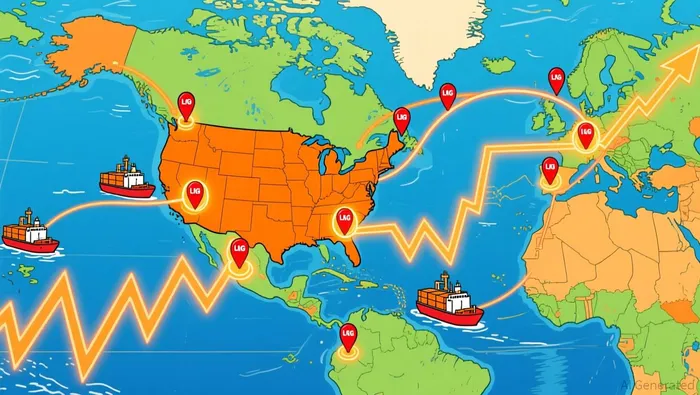
The U.S. natural gas market's historical insulation from global price swings is eroding. As stated by The Chronicle Journal, the construction of large-scale liquefaction facilities-operated by firms like Cheniere EnergyLNG-- and Sempra Energy-has forced domestic prices to align with global benchmarks. This alignment is driven by arbitrage opportunities and geopolitical events, such as the Red Sea shipping crisis, which have disrupted traditional trade routes and amplified price volatility.
Price volatility is further compounded by infrastructure constraints. For instance, Atlantic basin freight rates surged in late 2025, directly squeezing LNG export margins. Meanwhile, Henry Hub prices-a key U.S. benchmark-reached $5.06/MMBtu in December 2025, the highest level in years, compressing profit margins for exporters.
To mitigate these risks, operators have increasingly turned to long-term contracts structured as 115% of Henry Hub prices plus a fixed liquefaction fee, a model designed to stabilize cash flows amid uncertainty.
Strategic Positioning Amid Regional Demand Dynamics
The flexibility of LNG as a transportable commodity has de-regionalized global gas markets. Unlike compressed natural gas (CNG), which is constrained by fixed pipelines, LNG can be rerouted to meet demand in Europe, Asia, or Latin America, enabling dynamic price discovery. This has created a more interconnected market, where U.S. producers can capitalize on global price premiums while consumers in energy-starved regions benefit from diversified supply chains.
However, this integration has winners and losers. While LNG exporters thrive, domestic industries reliant on low-cost gas-such as chemical and fertilizer manufacturers-face rising input costs, threatening their global competitiveness. J.P. Morgan Research forecasts that global LNG supply will expand by ~350 Bcm by 2030, with North America and Qatar leading the charge. For investors, this underscores the importance of hedging strategies and sector diversification to balance exposure to both export-driven growth and domestic affordability risks.
The Path Forward: Opportunities and Risks
The U.S. LNG sector is at a crossroads. On one hand, it is a linchpin of global energy security, with the ability to pivot supply to meet urgent demand in Europe or Asia. On the other, it must navigate the delicate balance between export ambitions and domestic economic stability. For investors, the key lies in understanding the interplay between infrastructure bottlenecks, geopolitical risks, and pricing mechanisms.
Long-term contracts and flexible pricing models will remain critical for margin stability, but they are not foolproof. As the IEA notes in its Q3 2025 Gas Market Report, global demand growth is expected to accelerate in 2026, particularly in Asia, as LNG supply increases ease market fundamentals. This presents a window of opportunity for U.S. exporters to lock in favorable terms, but it also heightens competition from emerging suppliers in Africa and Southeast Asia.
Conclusion
The great uncoupling is more than a market shift-it is a redefinition of how energy is traded, priced, and consumed. For investors, the U.S. LNG sector offers a compelling mix of growth potential and strategic complexity. Yet, success will require a nuanced understanding of global integration, price volatility, and the evolving role of natural gas in the energy transition. As the world's largest LNG exporter, the U.S. is not just reshaping its own markets; it is setting the terms for a new era of global energy dynamics.







Comentarios
Aún no hay comentarios