
The Great Tokenization Shift: How Institutions Are Rewiring Finance for the Digital Age
The financial world is undergoing a quiet revolution. By 2025, asset tokenization has evolved from a speculative experiment to a foundational pillar of institutional investing. What began as a niche experiment in private equity and real estate is now accelerating across asset classes, driven by a confluence of regulatory clarity, technological infrastructure, and institutional demand for efficiency.
Institutional Adoption: From Skepticism to Strategic Commitment
Institutional investors are no longer watching from the sidelines. According to State Street's 2025 Digital Assets Outlook, over half of institutional investors expect 10–24% of their portfolios to be tokenized by 2030[1]. This shift is notNOT-- merely about chasing yield-it's about reengineering the very architecture of capital markets.
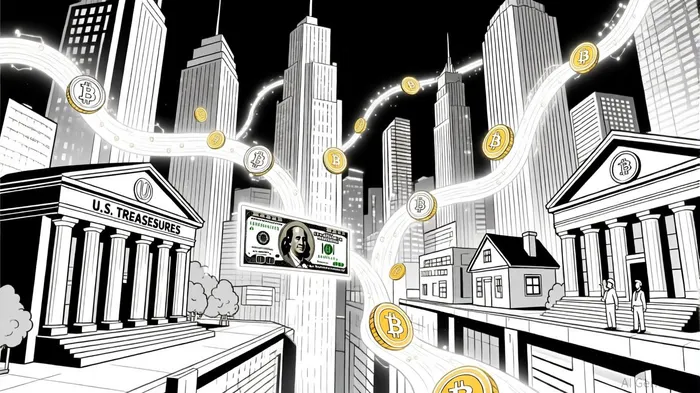
Tokenized U.S. Treasuries, for instance, have become a linchpin of this transformation. Platforms like BlackRock's BUIDL fund and Franklin Templeton's BENJI fund have demonstrated the viability of tokenized fixed income, with over $7.5 billion in tokenized Treasury products by mid-2025[2]. These instruments address critical pain points: reducing settlement times from days to minutes, slashing intermediation costs, and enabling real-time collateral management.
Private credit has followed suit. On-chain credit platforms like Maple FinanceSYRUP-- and ApolloAPO-- have attracted $16.8 billion in tokenized assets, offering institutional investors programmable access to high-yield loans[3]. Meanwhile, real estate tokenization is unlocking liquidity in traditionally illiquid markets. Siemens' €300 million corporate bond issued on distributed ledger technology (DLT) and HSBC's digital bond infrastructure are emblematic of a broader trend[3].
Market Infrastructure: Building the Rails for a Tokenized Future
The rise of tokenized assets is inseparable from the maturation of market infrastructure. Platforms now offer jurisdiction-specific KYC onboarding, tokenized cap tables, and fiat-crypto rails, enabling seamless compliance and operational efficiency[2]. For example, Siemens' €60 million digital bond on a public chain showcased how tokenization can streamline corporate financing[5].
Collateral management is another frontier. DBS Bank and Binance have pioneered off-exchange settlements using tokenized Treasuries, reducing counterparty risk and enabling dynamic collateral reuse[4]. These innovations are not just incremental-they're rewriting the rules of asset utility.
Regulatory Clarity: From Wild West to Framework
Regulatory ambiguity once stifled tokenization. But 2025 marks a turning point. The EU's MiCA framework, the UK's Digital Securities Sandbox, and Singapore's Project Guardian have created guardrails for experimentation[4]. In the U.S., initiatives like Project Crypto and the GENIUS Act are aligning federal oversight with industry innovation[4].
This clarity has been a game-changer. As one industry insider notes, "Regulation isn't slowing down tokenization-it's accelerating it by reducing uncertainty for institutional players"[2].
The Road Ahead: A $18.9 Trillion Future
The numbers tell a compelling story. Tokenized real-world assets (RWAs) have already surpassed $30 billion in market size, led by private credit ($17 billion), U.S. Treasuries ($7.3 billion), and commodities ($2 billion)[4]. Projections from BCG and Ripple suggest this could balloon to $18.9 trillion by 2033[2].
Conclusion: The New Operating System of Finance
Asset tokenization is not a passing fad-it's a paradigm shift. Institutions are not just adopting tokens; they're rewiring their operating models to leverage programmable money, real-time settlements, and global liquidity. For investors, the lesson is clear: the future of finance is digital, and those who tokenize today will lead tomorrow.





Comentarios
Aún no hay comentarios