
The Great Rotation of 2025: Small Caps Steal the Spotlight as Big Tech's AI Fever Cools
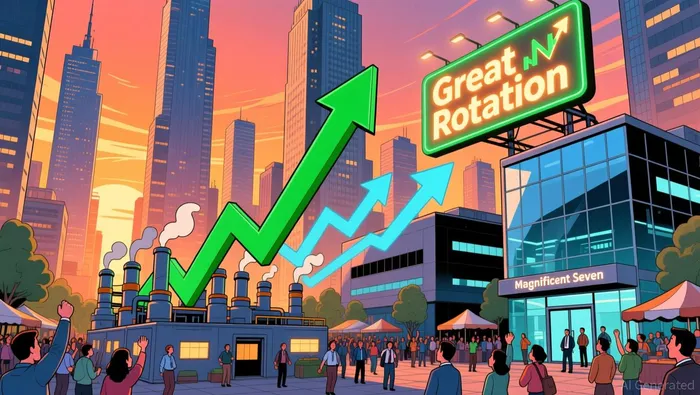
The U.S. stock market is undergoing a seismic shift. For much of 2025, the "Magnificent Seven" tech giants-Meta, AppleAAPL--, AmazonAMZN--, Alphabet, MicrosoftMSFT--, NVIDIANVDA--, and Tesla-dominated investor attention and capital flows. But in recent months, a dramatic reversal has taken hold. Small-cap stocks, long sidelined by the AI-driven frenzy, have surged to the forefront, with the Russell 2000 index breaking records and outperforming even the S&P 500 for four consecutive weeks. This "Great Rotation" reflects a broader re-balancing of risk, valuation, and economic expectations.
The Drivers of the Rotation
The shift from Big Tech to small-caps is not a random market quirk-it is the result of converging macroeconomic and structural forces. First, the Federal Reserve's dovish pivot has been a tailwind for small-cap stocks, which are more sensitive to interest rate changes. After a year of aggressive rate hikes, the Fed's December 2025 cuts have reduced borrowing costs, making smaller, growth-oriented companies more attractive. Second, skepticism about the sustainability of Big Tech's AI-driven valuations has grown. While the "Magnificent Seven" remain dominant, their earnings have failed to justify their lofty multiples. For instance, Oracle and Broadcom recently reported results that fell short of expectations, raising questions about the durability of AI-driven revenue streams.
Third, investors are seeking diversification. Sectors like industrials, healthcare, and financials have gained traction as capital flows away from the concentrated leadership of tech. This shift is not just about risk management-it's a recognition that the broader economy, not just a handful of AI darlings, is the foundation of long-term growth according to market analysts.
Valuation Metrics: A Tale of Two Markets
The valuation gap between small and large caps has reached historic extremes. The Russell 2000, which tracks small-cap stocks, now trades at a discount to its large-cap counterparts, with the S&P 500 commanding a 36% premium to its 25-year average. Meanwhile, the Nasdaq 100, heavily weighted toward tech, has underperformed despite the sector's fundamental strengths. This divergence is striking: small-cap ETFs like IWM and IJR have seen fresh inflows in late November, while tech-focused funds face outflows according to market data.
The disconnect is even more pronounced when examining price-to-earnings (P/E) ratios. The S&P 500's forward P/E of 23 contrasts sharply with AI startups trading at 30-50 times revenue. For investors, this suggests that small-cap stocks offer a more compelling risk-reward profile. While they carry higher volatility, their undervaluation and exposure to sectors like industrials and consumer discretionary make them attractive in a low-rate environment according to institutional analysts.
Sustainability of the Rotation: What Experts Say
The question on every investor's mind is whether this rotation will endure. Wall Street strategists are cautiously optimistic. Morgan Stanley's Michael Wilson argues that the market is entering an early-cycle phase, where small- and mid-cap stocks-along with cyclical sectors-will outperform. He notes that earnings growth for the S&P 493 (excluding the Magnificent Seven) is projected to accelerate to 9% in 2026, up from 7% in 2025 according to Morgan Stanley's outlook.
Charles Schwab's Liz Ann Sonders and Kevin Gordon echo this sentiment, emphasizing that the rotation is part of a broader "K-shaped" economic environment. While AI will remain a focal point, its capital-intensive nature-exemplified by Oracle's $50 billion AI-related capex plans-has pushed investors toward more economically sensitive assets according to Schwab analysts.
However, skeptics caution against over-optimism. Small-cap stocks are historically prone to volatility, and their recent gains have not erased long-term underperformance relative to large caps. Regulatory scrutiny of AI infrastructure and potential rate hikes in 2026 could also disrupt the momentum according to market analysts.
The Road Ahead
The Great Rotation of 2025 is more than a temporary trend-it signals a re-balancing of the market's priorities. As investors move away from speculative growth and toward value and earnings-driven growth, small-cap stocks are positioned to benefit. But this shift requires careful navigation. The key lies in identifying small-cap companies with durable business models and avoiding speculative plays in AI infrastructure or quantum computing according to investment insights.
For now, the data suggests that the rotation is here to stay. With the Fed's support, a more diversified economic backdrop, and widening valuation gaps, small-cap stocks are no longer an afterthought-they're the new frontier of opportunity.







Comentarios
Aún no hay comentarios