
The Great Credit Reset: A Structural Shift from Banks to Fintech
President Trump's proposal for a one-year 10% cap on credit card interest rates is not a mere political sideshow. It is a deliberate policy shock aimed at the core profitability of the traditional banking model. The immediate market reaction was a clear signal: shares of major banks and card issuers fell sharply, with Citigroup and Capital One down over 3% and Capital One sinking 7% in premarket trading. This sell-off reflects a deep-seated fear that the proposal, if enacted, would fundamentally break the economics of bank credit card operations.
The threat is structural because it directly attacks the high-margin revenue stream that has long funded broader bank ecosystems. Credit card balances, particularly those with higher interest rates, are a critical profit center. As Wells FargoWFC-- analysts noted, a 10% cap would hit large bank earnings before tax by an estimated 5%-18% and could wipe out earnings for lenders like Capital OneCOF-- and Synchrony FinancialSYF-- that are exclusively focused on this business. This isn't just about lower fees; it's about making large swaths of the current credit card portfolio unprofitable, especially for riskier borrowers. The policy, in effect, seeks to nationalize the risk-adjusted return on a key asset class.
The industry's warning underscores the systemic risk of the current model. Trade groups argue that such a cap would reduce credit availability and drive consumers toward less regulated, more costly alternatives like payday loans. This creates a perverse incentive: by making bank credit artificially expensive to offer, the policy could accelerate the very shift toward fintech and alternative lenders that banks are already struggling to contain. The proposal, therefore, acts as a catalyst, accelerating a pre-existing trend by forcing a reallocation of lending activity away from the traditional, regulated banking sector. The market is pricing in a new reality where the bank's role as the primary credit card provider is under direct, structural threat.
The Fintech Counter-Narrative: Embedded Growth and Scale
While the policy shock targets the bank model, the fintech counter-narrative is built on undeniable, structural growth. This isn't speculative hype; it's a measurable expansion of lending activity into new corners of the consumer economy, demonstrating both scale and deepening consumer integration.
The most visible expansion is in the buy-now-pay-later (BNPL) market. Spending through this channel reached $10.1 billion in November, marking a 9% year-over-year jump. This isn't a niche trend. On Cyber Monday alone, BNPL accounted for about $1.03 billion in spending, making it the biggest single day for the payment method in U.S. history. The growth is expected to accelerate, with user numbers projected to jump 34.5% in 2025. This rapid adoption is pulling in a broader demographic, moving beyond discretionary purchases to finance essentials. A stark indicator of this shift: 25% of BNPL users are financing groceries. This deep embedding into daily cash flow management signals a fundamental change in how consumers, particularly those under financial pressure, approach spending.
This user growth translates directly into massive scale. The total outstanding balance of loans originated by fintech platforms has now surpassed $500 billion. That figure represents a critical threshold of trust and operational maturity. It shows that digital lending is no longer a fringe activity but a mainstream financial channel, capable of handling a volume of credit that rivals, and in some segments exceeds, traditional bank portfolios. The convenience and accessibility of these platforms, fueled by e-commerce adoption and digital wallet integration, are driving this expansion. As one industry observer noted, the BNPL market is expanding due to consumer preference for flexible payment options and the rise of digital wallets, creating a powerful feedback loop of availability and usage.
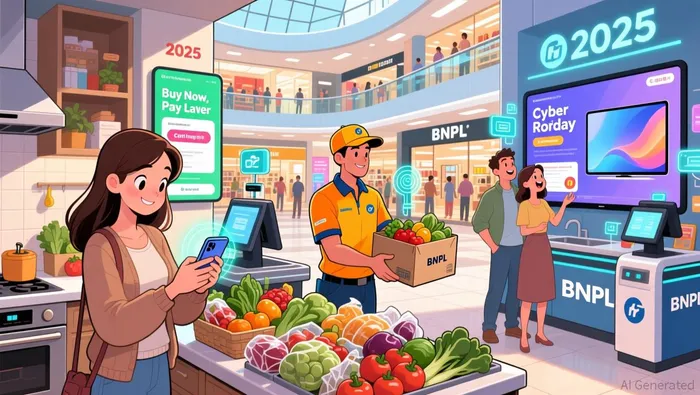
The bottom line is a clear reallocation of credit activity. As banks face a structural threat to their high-margin credit card business, fintech platforms are capturing the displaced demand. They are doing so not by competing on the same terms, but by embedding themselves into the shopping experience and offering flexible, accessible solutions that resonate with a cost-conscious consumer base. The scale of fintech lending and the depth of its integration into everyday spending paint a picture of a financial ecosystem in transition, where the center of gravity for consumer credit is visibly shifting.
Financial Impact and Valuation Scenarios
The policy shock and market shifts now converge on a stark financial reality: the traditional bank model faces a direct threat to its profit engine, while the fintech alternative carries emerging credit risks of its own. This creates a bifurcated valuation landscape, where the risks and opportunities are becoming increasingly clear.
For banks, the threat extends far beyond a simple reduction in interest income. The proposed 10% cap would undermine the entire credit card business model, which funds a significant portion of their broader retail and investment banking operations. As industry trade groups warned, the cap would reduce credit availability and drive consumers toward less regulated alternatives. This isn't just a revenue hit; it's a systemic risk to the bank's funding and ecosystem. The valuation implication is severe: if the cap is enacted, the market's current pricing of bank earnings may prove wildly optimistic, particularly for lenders whose profitability is heavily concentrated in credit cards. The risk is a permanent de-rating of bank valuations, as the high-margin asset class that has supported their business model for decades becomes structurally impaired.
For fintech, the growth narrative is tempered by rising credit quality concerns. The explosive user adoption is translating into tangible financial strain. Nearly 24% of BNPL users have missed payments, a rate that is rising and signals potential portfolio deterioration. More critically, over 25% of Americans regret using buy now, pay later due to unexpected costs, a figure that underscores consumer financial fragility and the risk of higher default rates down the line. This introduces a new layer of risk for fintech lenders, who must now build robust credit underwriting and risk management frameworks to support their scale. Valuation models that have priced in perpetual low default rates may need significant revision.
The regulatory landscape is also evolving, adding another variable. Some BNPL providers are beginning to report payment data to credit bureaus, a move that could increase their long-term credit risk and cost of capital. Affirm's recent announcement to report all pay-over-time transactions to Experian and TransUnion is a pivotal step. While framed as consumer empowerment, it effectively brings these loans into the formal credit system. This could force fintech lenders to adopt more conservative lending standards, potentially slowing growth, but it also provides a clearer, more transparent view of their credit risk profile for investors. The bottom line is a transition from a largely unregulated, high-growth phase to one with greater financial and regulatory scrutiny.
The financial impact is a direct trade-off. The bank's high-margin model is under threat, while the fintech's low-cost, embedded model faces rising credit costs and regulatory overhead. For investors, the valuation scenarios are now clearer: banks face a potential structural de-rating if the policy passes, while fintech valuations must account for the material credit quality risks that are now emerging. The reset is not just a market shift; it's a fundamental re-pricing of risk and return across the entire credit ecosystem.
Catalysts, Risks, and Strategic Positioning
The path forward is now defined by a handful of decisive events and metrics. For investors, the key is to monitor the catalysts that will determine whether the bank threat materializes and the signals that will reveal the sustainability of the fintech boom.
The primary catalyst remains legislative action. The framework is set: S.381, the 10 Percent Credit Card Interest Rate Cap Act, provides a clear path for a 10% rate cap, though its passage is far from certain. The bill, introduced in February 2025, faces an uphill battle with strong industry opposition and significant legal hurdles. As Wall Street analysts have noted, such a measure would require an Act of Congress and would likely face immediate legal challenges if enacted. The recent market volatility, with U.S. financial stocks falling on Monday following the President's call, shows the market is pricing in this risk. The decisive takeaway is that the threat is real but not imminent; the next 6-12 months will be a period of political and legal uncertainty, not an immediate policy shock.
For banks, the immediate watchpoint is earnings. Investors must monitor for signs of margin compression specifically in the credit card segment, which is the most exposed. A sustained drop in net interest margin or a strategic pivot away from high-rate lending toward alternative fee-based services would be a clear signal of the business model under stress. While broader lending recovery is underway, as evidenced by analysts raising 2025 loan growth forecasts for central U.S. banks, the credit card business remains the structural vulnerability. Any bank that fails to diversify its revenue streams away from this asset class will be left exposed.
For the fintech sector, the critical metrics are those that reveal the health of its growth engine. Watch for two key indicators: user growth and credit quality. The explosive user adoption is clear, with BNPL spending rising 9% year-over-year and user numbers projected to jump 34.5% in 2025. Yet the sustainability of this growth is tied to rising delinquency. The nearly 24% of BNPL users who have missed payments is a red flag that must be tracked. More broadly, the 25% of users financing groceries signals deep consumer financial strain, which could accelerate default rates. Regulatory scrutiny is also a growing risk, as seen with Affirm's move to report to credit bureaus. This transparency is a double-edged sword, potentially increasing the cost of capital but also providing a clearer picture of risk.
The bottom line for investors is a bifurcated watchlist. On one side, monitor the political and legal progress of the rate cap bill and bank earnings for margin pressure. On the other, track fintech delinquency rates and regulatory developments for signs of a consumer debt bubble forming. The reset is not a single event but a process, and the decisive takeaway is that the market is now pricing in a high-stakes gamble on both policy and credit quality.





Comentarios
Aún no hay comentarios