
The Great Bitcoin Reckoning: Wall Street's Embrace and the Battle for Decentralization
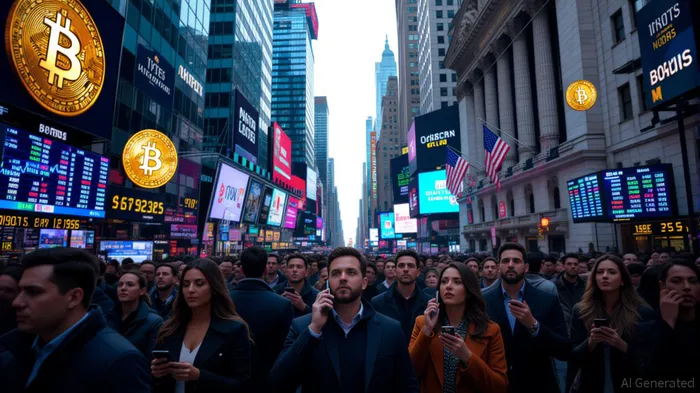
The past year has been a seismic shift for BitcoinBTC--. What was once a niche asset, dismissed as a speculative fad, has now become a $2 trillion market cap juggernaut, with institutional investors pouring billions into spot ETFs and corporate treasuries. But as Wall Street's grip tightens, a critical question emerges: Does this institutional adoption undermine Bitcoin's core thesis as a decentralized safe-haven asset?
Let's break it down.
The Institutional Takeover: A Double-Edged Sword
By Q1 2025, institutional holdings of Bitcoin ETFs had grown to $21.2 billion, with investment advisors capturing 50% of 13F filings. BlackRock's iShares Bitcoin Trust (IBIT) alone held $12.7 billion in institutional assets, while Fidelity's FBTC and Grayscale's GBTCGBTC-- followed closely. These figures reflect a seismic shift in capital allocation, with institutions viewing Bitcoin not as a speculative bet but as a strategic diversifier.
The Trump administration's August 2025 executive order allowing 401(k) accounts to include Bitcoin unlocked $8.9 trillion in retirement capital, with even a 1% allocation translating to $89 billion in potential inflows. This regulatory clarity has transformed Bitcoin from a “wild west” asset into a mainstream portfolio staple.
But here's the rub: Institutional dominance now accounts for 15% of Bitcoin's total supply, with corporate entities like MicroStrategy (now “Strategy”) and sovereign funds like Mubadala hoarding over 1.98 million BTC. While this concentration doesn't equate to control (no single entity holds a majority), it does raise red flags.
Decentralization at Risk?
Bitcoin's original allure was its decentralized nature—a digital asset immune to central bank manipulation. Yet, as institutions accumulate large stakes, critics argue that the “decentralized” narrative is eroding.
Consider the top five Bitcoin holders, who collectively control 771,551 BTC (nearly 4% of total supply). If these entities coordinated their actions, they could influence price discovery and liquidity. Meanwhile, mining pools like Foundry USA and AntPool now control over 51% of the network's hashrate, sparking fears of centralization.
Yet, Bitcoin's technical safeguards remain robust. The network's hash rate hit 1 zettahash in April 2025, and mining difficulty reached all-time highs. These metrics suggest that even with institutional participation, the network's security remains intact. The real threat isn't technical—it's perception.
Public Sentiment: Fear vs. Faith
Retail investors and crypto purists are split. On one hand, they acknowledge Bitcoin's newfound legitimacy. On the other, they fear that Wall Street's embrace has diluted its revolutionary spirit.
Social media sentiment indices show “extreme fear” readings even as Bitcoin trades near $100,000. This disconnect stems from the fact that institutions operate with long-term strategies, while retail investors remain emotionally driven. For example, the Wisconsin Board's $323 million divestment from Bitcoin in Q1 2025 sent shockwaves through retail circles, despite being a strategic rebalancing rather than a rejection of the asset.
Meanwhile, the U.S. government's Strategic Bitcoin Reserve—established in March 2025—has been hailed as a validation of Bitcoin's value. Yet, critics argue that treating Bitcoin as a state asset risks centralizing its narrative.
The Investment Playbook: Balancing Risk and Reward
So, where does this leave investors? The answer lies in strategic allocation.
- ETFs as a Gateway: For those wary of direct crypto exposure, spot Bitcoin ETFs like IBITIBIT-- and FBTC offer a regulated, liquid vehicle. These products have attracted $92.3 billion in AUM, with institutions accounting for 22.9% of holdings.
- Diversification is Key: While Bitcoin's 21 million supply cap makes it a hedge against inflation, it's still volatile. Pair it with gold, treasuries, or dividend-paying stocks like AppleAAPL-- (AAPL) to balance risk.
- Monitor Regulatory Shifts: The CLARITY Act and MiCAR regulations are reshaping the landscape. Favor jurisdictions with crypto-friendly policies, such as Singapore or the UAE.
- Long-Term Mindset: Bitcoin's volatility is a feature, not a bug. Institutions are buying for the long haul—retail investors should follow suit.
Final Take: The Future is Hybrid
Bitcoin's cultural integrity isn't dead—it's evolving. The asset's decentralized roots remain intact, but its integration with traditional finance is inevitable. The challenge for investors is to navigate this duality: leveraging Bitcoin's institutional credibility while preserving its decentralized ethos.
For now, the data tells a compelling story. Bitcoin's price correlation with gold has strengthened, and its role as a safe-haven asset is gaining traction. But as the old adage goes: “Don't fight the Fed, but don't blindly follow Wall Street either.”
In the end, Bitcoin's value lies in its ability to adapt. And if history has taught us anything, it's that the most resilient assets are those that can straddle the line between innovation and tradition.





Comentarios
Aún no hay comentarios