
The Great Auto Reset: How GM's $6 Billion Charge Signals the End of a Policy-Driven Boom
The $6 billion writedown announced by General MotorsGM-- on January 8 is not an isolated accounting adjustment. It is the latest, and one of the largest, in a series of massive charges that are now collectively unraveling a decade-long, policy-driven boom. This move, stemming from canceled supplier contracts and reduced production, marks the industry's painful retreat from a strategy built on government mandates and subsidies. The shock came from a sudden reversal in policy direction, creating a perfect storm of weak demand and stranded investments.
The policy context is clear and decisive. In the United States, the expiration of the $7,500 federal tax credit for EV buyers at the end of September was a critical blow. This was followed by the Trump administration's rolling back of Biden-era fuel economy standards in early December. Across the Atlantic, the European Union scrapped its 2025 EV mandate, removing a key regulatory push for automakers. Together, these actions dismantled the primary policy pillars that had fueled the industry's aggressive EV investments.
For automakers like GMGM--, which had placed a $35 billion investment on building an EV business, the impact was immediate and severe. The company's earlier bet on a million EVs per year by 2025 now looks like a costly miscalculation. The $6 billion charge, with most of it tied to contract cancellations and settlements with suppliers, is the financial fallout of that pivot. It is a direct cost of unwinding a supply chain built for a future that policymakers have now declared off-limits. Ford's $19.5 billion writedown over several quarters confirms this is an industry-wide reset, not a single company's misstep.
The bottom line is the end of a policy-driven paradigm. For over a decade, automakers scaled up EV production in response to regulatory pressure and promised subsidies. Now, with those supports gone and consumer demand faltering, the industry is being forced into a market-driven reality. The massive charges are the price of admission for this reset, liquidating the assets and commitments built for a different world. The era of automatic growth based on policy mandates is over.
The Demand Reality: A 43% Drop and a 1.2% Industry Growth Rate
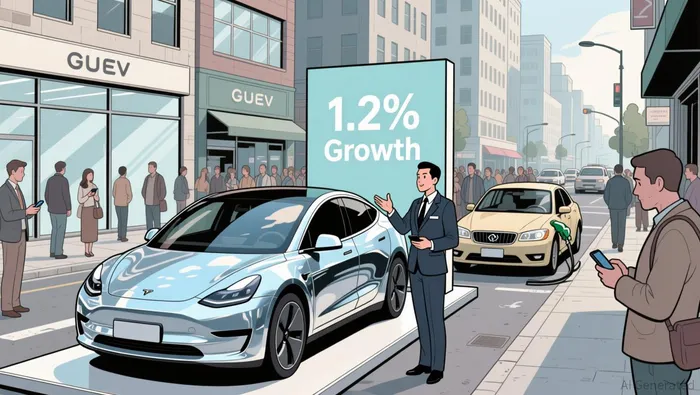
The strategic retreat is a direct response to a market that has simply not materialized. The optimistic growth assumptions of the policy boom have been invalidated by stark demand numbers. For General Motors, the drop was severe: its EV sales dipped after the end of federal tax credits, with deliveries falling 43% in the fourth quarter of 2025. This wasn't an isolated stumble; it mirrored a broader industry freeze. The entire U.S. EV market grew a mere 1.2% in 2025, a figure that underscores the fragility of the segment once policy support was removed.
This weak demand is the core reason behind the massive writedowns. The $6 billion charge announced last week brings GM's total EV-related write-offs to $7.6 billion. These are not minor adjustments but the financial reckoning for a strategy built on a million EVs per year by 2025-a target the company is now abandoning. The charge itself, with most of it tied to contract cancellations and settlements with suppliers, is the direct cost of unwinding a supply chain for a volume of vehicles that consumers never bought.
The bottom line is a brutal market reality check. Automakers had invested billions, including GM's $35 billion bet, based on the expectation that policy would force demand. Now, with that policy removed and consumer adoption stalling, the industry is facing the true cost of overcapacity. The $7.6 billion total writedown is the price of admitting that the market for EVs, at least in the near term, is not growing fast enough to justify the previous scale of investment. This is the foundation of the reset: a retreat from a policy-driven fantasy to a market-driven truth.
The Strategic Pivot: Optionality vs. Full Retreat
The reset is not a single, uniform retreat. Automakers are responding with distinct strategies, revealing a critical divergence in how they plan to navigate the new, market-driven reality. At the center of this split is a choice between maintaining optionality and making a definitive break.
General Motors is betting on the former. While it has taken a massive $6 billion charge to unwind its EV ambitions, CEO Mary Barra has made clear the company intends to continue to make these models available to consumers. This means GM will retain its broad lineup of roughly a dozen EV models, preserving a foothold in the segment. The strategy is one of deliberate flexibility. By not abandoning its entire EV portfolio, GM keeps the door open for a future policy shift or a sudden surge in demand. It is a calculated pivot to manage risk, ensuring it is not left entirely on the sidelines if the market rebounds.
Ford, by contrast, is making a more aggressive exit. The company's $19.5 billion writedown is not just about scaling back; it is about a fundamental strategic pivot. Ford is killing its second-generation EVs, including the fully electric F-150 Lightning and other planned models. This is a decisive break from its previous full-EV focus. Ford is now shifting to a hybrid and extended-range EV strategy, a move that signals a deeper retreat from the pure-electric future it once envisioned. The company is cutting losses early, as its CEO stated, to shed unprofitable assets and free up capital for a more conservative path.
This divergence is mirrored in other corporate actions. GM's financial reckoning is compounded by a separate $1.1 billion writedown tied to restructuring its China joint venture, adding another layer of complexity to its global strategy. Ford's approach, while costly, appears more streamlined. The bottom line is that GM is attempting a strategic pivot to retain optionality, while Ford is executing a more definitive retreat. One is hedging its bets for a potential future, the other is cutting its losses to survive the present.
Financial Impact and Forward-Looking Catalysts
The $6 billion charge is now a settled fact, recognized in GM's fourth-quarter results. This special item will directly hit reported net income, as the company has acknowledged. However, it will not distort the company's adjusted earnings, a key metric for assessing core operational performance. The charge, combined with a separate $1.1 billion writedown for its China joint venture, brings the total special charges for the quarter to $7.1 billion. This cleanup is a necessary step to reset the financial foundation for the scaled-back strategy.
The market's reaction suggests investors may view this as a necessary, if painful, cleanup. Despite the charge announcement, GM's stock had already gained about 67% in the past 12 months, significantly outperforming the broader market. This rally, which occurred before the full extent of the charge was known, indicates the market was already pricing in a strategic reset and the potential for future profitability once the overhang of stranded costs is cleared. The subsequent 2.2% dip in after-hours trading on the charge news appears to be a short-term reaction to the headline figure, not a fundamental rejection of the new path.
Looking ahead, the financial toll is expected to diminish. GM has stated it expects additional material cash and non-cash charges in 2026, but these will be significantly less than the EV-related charges incurred in 2025. This sets a clear trajectory: the worst of the writedowns is behind the company. The focus now shifts entirely to execution and cash flow.
The primary catalyst for the new strategy's sustainability is twofold. First, GM must successfully execute its scaled-back EV plan, which retains a broad lineup of roughly a dozen models. Second, and more critically, it must demonstrate that this remaining U.S. EV portfolio can generate profit against a backdrop of weaker demand and a market that grew a mere 1.2% in 2025. The company's ability to lower the cost of producing these vehicles, as its CFO has stated, will be the key test. If it can achieve this, the massive 2025 writedowns will have been a costly but effective reset. If not, the financial pressure from a struggling segment will persist, making the new strategy's long-term viability the central question for investors.





Comentarios
Aún no hay comentarios