
Grayscale's IPO: Balancing Public Access and Private Control in the Crypto Era
The Dual-Class Structure: A Tool for Control, Not Just Capital
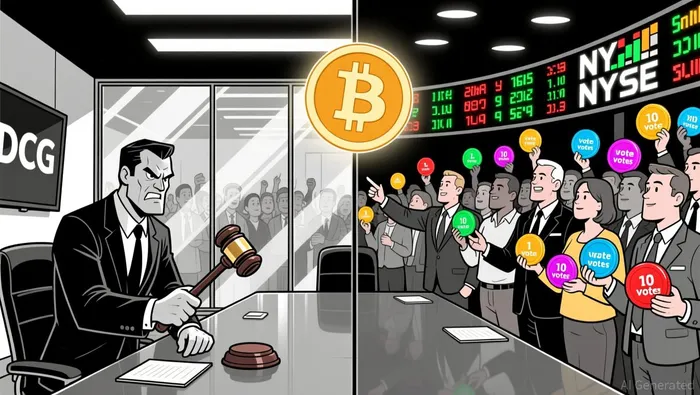
Grayscale's IPO filing reveals a strategic intent to preserve control while accessing public market capital. Class A shares, which will be offered to the public, grant one vote per share and full economic rights, while Class B shares-held entirely by DCG-carry ten votes per share but no economic value according to a report. This design allows DCG to maintain a 10-vote-to-1 voting advantage, ensuring strategic decisions remain under the parent company's influence. According to a report by , this structure mirrors broader trends in crypto IPOs, where firms like Gemini and BitGo are also adopting multi-class share models to balance founder control with public market demands.
However, critics argue that dual-class structures inherently prioritize the interests of controlling shareholders over broader stakeholders. For Grayscale, this means DCG can steer governance decisions-such as product development, regulatory compliance, and executive compensation-without needing consensus from public shareholders. While this may provide stability in a volatile industry, it risks creating a governance gap between institutional investors (who often hold significant stakes in public shares) and retail investors, who may feel disenfranchised by limited voting power.
Institutional Dominance and Retail Displacement
The dual-class structure's implications for investor alignment are further complicated by the broader shift toward institutional dominance in crypto markets. Data from Yellow.com indicates that institutional investors now control 59% of BitcoinBTC-- ownership, with professional trading accounting for 85% of price discovery. This trend has been amplified by the approval of spot Bitcoin ETFs in 2024, which attracted $107 billion in inflows and entrenched traditional financial intermediaries in crypto markets.
For Grayscale, the IPO's structure may exacerbate this imbalance. Institutional investors, already influential in crypto governance, could see their power diluted by the public's limited voting rights. Meanwhile, retail investors-whose participation in U.S. crypto markets dropped by 11% in 2024-face further barriers, including minimum investment requirements and custody fees. A report by AIMA notes that 47% of institutional investors increased their crypto allocations in 2025 due to regulatory clarity, but retail investors remain excluded from sophisticated products like derivatives and institutional-grade custody solutions.
Broader Market Trends: Governance in the Age of Crypto IPOs
Grayscale's IPO is part of a larger wave of crypto firms seeking public listings, including Gemini and BitGo. These companies are leveraging favorable political climates and regulatory advancements-such as the Senate Agriculture Committee's proposed digital assets market structure bill-to align with traditional financial standards. The bill, which classifies major cryptocurrencies as "digital commodities" under the CFTC's jurisdiction, aims to reduce conflicts of interest by requiring crypto firms to segregate operations. Such measures could mitigate governance risks associated with dual-class structures by promoting transparency and accountability.
However, the effectiveness of these frameworks remains untested. For example, the bill's requirement for crypto firms to adopt a "segregated business model" may clash with the centralized control enabled by dual-class shares. This tension highlights a critical challenge: how to balance founder control with the need for inclusive governance in an industry still grappling with regulatory uncertainty.
Conclusion: A Delicate Equilibrium
Grayscale's IPO represents a strategic gamble to secure public market capital while retaining private control. The dual-class structure offers stability in a volatile sector but risks alienating retail investors and institutional stakeholders who prioritize democratic governance. As crypto firms increasingly adopt similar models, the industry must address the long-term implications of concentrated voting power. Regulatory frameworks like the Senate Agriculture Committee's bill may provide a path forward, but their success will depend on balancing innovation with investor protection.
For now, Grayscale's IPO serves as a case study in the evolving dynamics of crypto governance. Whether it strengthens institutional alignment or widens the gap between public and private interests will depend on how the company navigates the delicate balance between control and access in the years ahead.






Comentarios
Aún no hay comentarios