
Can Grayscale's GLINK ETF Spark a Chainlink Bull Run Amid a Challenging Altcoin Market?
The crypto market in Q4 2025 has been defined by stark contrasts: BitcoinBTC-- ETFs like BlackRock's IBIT faced record outflows amid macroeconomic uncertainty, while Grayscale's newly launched GLINKLINK-- ETF-tied to ChainlinkLINK-- (LINK)-showed resilience, even as the broader altcoin sector struggled. This divergence raises a critical question: Can GLINK, by offering institutional-grade exposure to Chainlink's infrastructure, catalyze a bull run for LINKLINK-- in a market where most altcoins are underperforming?
Institutional Adoption and On-Chain Signals: A Contrarian Play
Chainlink's on-chain activity in Q4 2025 suggests a quiet but significant accumulation phase. Whale wallets withdrew $10.2 million in LINK from Binance, signaling confidence in the token's long-term value. Simultaneously, wallet distribution expanded by 27% year-over-year, reflecting broader adoption across decentralized applications and infrastructure. These trends align with a deflationary dynamic: reduced exchange reserves and increased staking volume (now 45 million LINK staked) have tightened liquidity, creating a structural tailwind for price.
Grayscale's GLINK ETF, launched on December 2, 2025, capitalized on this momentum. Unlike traditional crypto ETFs, GLINK incorporates staking rewards, offering investors a yield-driven incentive to hold LINK. This feature distinguishes it from Bitcoin ETFs, which lack such income streams. Analysts project $500 million to $1 billion in inflows over the coming quarters, potentially pushing LINK toward a $20 billion market cap. Crucially, GLINK's launch coincided with a 7% price spike in LINK, suggesting immediate demand from institutional and retail investors seeking regulated exposure to blockchain infrastructure.
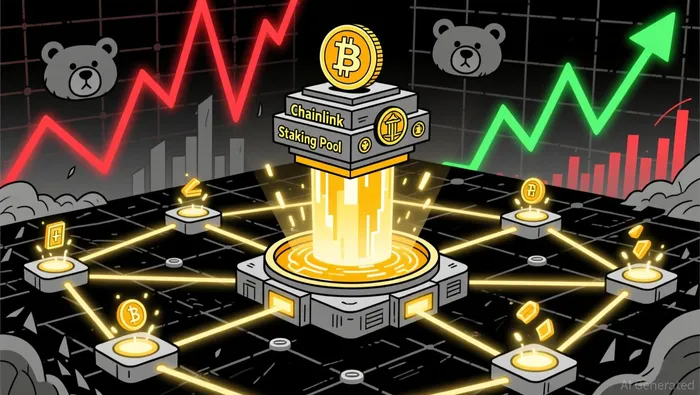
Divergence From Bitcoin ETFs: A Bear Market Contrarian
While Bitcoin ETFs like IBIT and GBTC faced a $3.79 billion outflow in November 2025, GLINK's inflows remained stable or positive. This divergence highlights a key insight: institutional capital is increasingly differentiating between speculative assets and foundational infrastructure. Chainlink's role in securing $93 billion in cross-chain and DeFi ecosystems positions it as a critical node in the tokenized economy. By contrast, Bitcoin ETFs, despite their $60.8 billion in cumulative inflows since 2024, have struggled with redemptions as macroeconomic risks-such as Fed policy uncertainty-weigh on risk appetite.
The bear market has also exposed structural weaknesses in altcoin ETFs. For instance, Solana and XRP ETFs have underperformed, with SolanaSOL-- ETFs facing $156 million in outflows due to network challenges. Yet GLINK's focus on Chainlink's utility-driven model-versus speculative narratives-may insulate it from such volatility. Whale positions in LINK, though currently showing unrealized losses, could become a catalyst if the ETF drives sustained inflows and reduces selling pressure.
Total Value Secured and Staking: A Foundation for Growth
Chainlink's Total Value Secured (TVS) surged to $93 billion in Q4 2025, underscoring its role as a backbone for DeFi, insurance, and real-world asset tokenization. This growth is not merely speculative; it reflects demand for reliable oracleADA-- services in a maturing blockchain ecosystem. GLINK's staking mechanism further amplifies this value proposition. By locking LINK in staking pools, the ETF reduces circulating supply while generating yield for investors-a dual benefit that could attract capital during periods of market stress.
Moreover, the ETF's structure-converted from Grayscale's existing Chainlink Trust provides immediate liquidity and a proven track record, reducing friction for institutional adoption. This contrasts with newer altcoin ETFs, which face skepticism due to their untested models. For example, XRP ETFs, while outperforming Solana in inflows, rely on aggressive fee strategies rather than intrinsic utility. GLINK's alignment with Chainlink's infrastructure role gives it a more durable edge.
Risks and Realities: A Cautious Bull Case
Despite these positives, GLINK's success hinges on broader market conditions. The crypto bear market has seen LINK decline 39% year-to-date, and the ETF's performance could be constrained if macroeconomic risks persist. Additionally, the altcoin ETF landscape is crowded, with competitors like XRPZ (Franklin Templeton's XRPXRP-- ETF) offering lower fees. However, GLINK's focus on a utility-driven asset-Chainlink's oracle network-positions it as a contrarian play in a market dominated by speculative narratives.
A key test will be the ETF's ability to drive sustained inflows. If GLINK attracts $1 billion in capital, it could inject significant liquidity into the LINK market, potentially triggering a re-rating of the token's value. This scenario assumes that institutional investors view Chainlink as a "must-have" infrastructure asset, akin to how Bitcoin ETFs have redefined institutional exposure to digital assets.
Conclusion: A Contrarian Opportunity in a Bear Market
Grayscale's GLINK ETF represents a unique intersection of on-chain strength, institutional adoption, and infrastructure value. While the broader altcoin market remains bearish, Chainlink's fundamentals-evidenced by whale accumulation, TVS growth, and staking expansion-suggest a potential inflection point. For investors willing to bet against the short-term narrative, GLINK offers a regulated, yield-enhanced vehicle to capitalize on Chainlink's role in the tokenized future.
As the crypto market navigates macroeconomic headwinds, the true test of GLINK's impact will come in the next 6–12 months. If the ETF can drive sustained inflows and reduce selling pressure from whale holders, it may yet sparkSPK-- a bull run for LINK-a rare bright spot in an otherwise challenging altcoin landscape.





Comentarios
Aún no hay comentarios