
Grayscale's GDOG ETF Underperformance and Altcoin ETF Rotation Dynamics: A Structural Analysis of Meme-Asset vs. High-Utility Altcoin Adoption
Structural Challenges of Meme-Asset ETFs: The Case of GDOG
Grayscale's GDOG ETF, launched with a 0% expense ratio for the first three months or until $1 billion in trading volume is reached, initially attracted attention as the first U.S. spot Dogecoin ETF according to reports. Despite DOGE's 170% return between October 2023 and November 2025, the ETF's performance metrics-particularly assets under management (AUM) and trading volume-remain opaque compared to competing altcoin funds. This opacity contrasts sharply with the success of XRP-focused ETFs, such as Canary Capital's XRPC, which generated $276.8 million in net inflows since its launch.
The structural challenges of meme-asset ETFs like GDOG are multifaceted. First, DOGE's lack of intrinsic utility-positioned as a community-driven "meme" coin-limits its appeal to institutional investors prioritizing functional blockchain use cases. Second, DOGE's volatility exacerbates risk profiles, deterring capital inflows during market downturns. 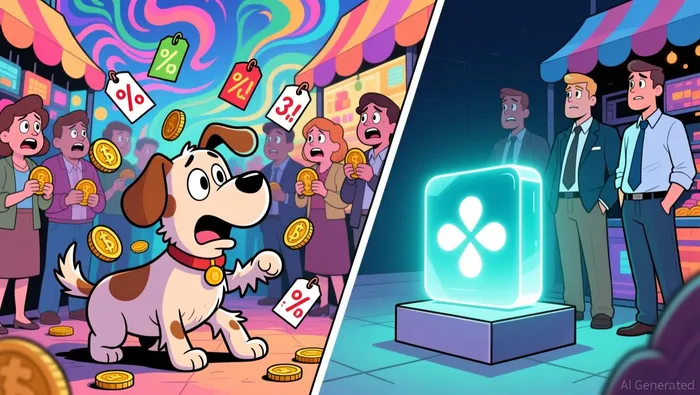 For instance, both DOGEDOGE-- and XRP faced significant declines in late 2025, with DOGE down 80% from its 2021 peak and XRP down 43% from its July 2025 high according to market data. However, XRP ETFs, including GXRP, managed to attract inflows despite the selloff, reflecting stronger investor confidence in their utility and regulatory clarity according to analysis.
High-Utility Altcoins: XRP's Regulatory and Institutional Edge
High-utility altcoins like XRP benefit from a clearer value proposition and regulatory narrative. XRP's role in Ripple's cross-border payment network positions it as a functional asset, attracting institutional interest and sustained inflows. For example, Franklin Templeton's XRPZ ETF recorded $164.04 million in inflows in a single day, while GXRP's launch saw $67 million in AUM on its first day according to reports. These figures highlight the advantages of utility-driven assets in a market increasingly wary of speculative exposure.
Regulatory clarity further amplifies XRP's appeal. Unlike DOGE, which remains unregulated, XRP has navigated legal uncertainties with a more defined path, bolstered by recent court rulings and institutional endorsements. As Czhang Lin of LBank Labs notes, "XRP's regulatory optimism has created a narrative that differentiates it from meme-asset peers, even in a bearish market" according to analysis. This dynamic is critical for ETF adoption, as investors prioritize assets with reduced legal ambiguity.
Altcoin ETF Rotation Dynamics: A Market of Diverging Priorities
The rotation of capital from meme-asset ETFs to high-utility altcoin ETFs reflects broader market trends. Bloomberg analysts project over 100 altcoin ETFs to launch in the next six months, intensifying competition for investor capital. In this environment, funds tied to utility-driven assets like XRP are better positioned to capture inflows, as evidenced by XRPC's $276.8 million in net inflows versus GDOG's lack of comparable data according to reports.
Moreover, the absence of 1940 Act registration for both GDOG and GXRP introduces a shared risk profile, but XRP's utility mitigates this concern. As Grayscale's GXRP ETF transitions to a 0.35% expense ratio after its initial zero-fee period, its ability to retain assets will depend on its alignment with institutional-grade use cases according to financial reports. In contrast, GDOG's reliance on DOGE's cultural appeal may struggle to sustain long-term capital inflows amid shifting market sentiment.
Conclusion: Implications for Investors and the Altcoin ETF Landscape
The underperformance of GDOG relative to high-utility altcoin ETFs underscores a fundamental truth: the crypto investment landscape is increasingly bifurcated between speculative and utility-driven assets. While meme-asset ETFs may capture short-term retail interest, their structural challenges-volatility, regulatory ambiguity, and lack of utility-limit their scalability. Conversely, high-utility altcoins like XRP, supported by institutional backing and functional blockchain applications, are better positioned to attract sustained capital inflows.
For investors, this dynamic suggests a strategic shift toward altcoin ETFs with clear utility and regulatory clarity. As the market matures, the ability of funds like GDOG to compete will hinge on their capacity to address these structural gaps-a challenge that remains unresolved in the current landscape.





Comentarios
Aún no hay comentarios