
Grayscale's Evolving Crypto Product Pipeline and Strategic Positioning in a Regulatory-Driven Market
Grayscale Investments has long been a bellwether for institutional-grade crypto adoption, and its latest updates to the "Assets Under Consideration" list underscore a pivotal shift in the digital asset landscape. As the firm expands its pipeline to include 36 altcoins for Q1 2026-up from 32 in Q4 2025-the strategic focus on tokenization, Decentralized Physical Infrastructure Networks (DePIN), and artificial intelligence (AI) signals a broader alignment with regulatory clarity and institutional demand. This evolution reflects not just Grayscale's operational priorities but also the maturing infrastructure of the crypto market itself, where legislative progress and capital flows are converging to redefine the institutional playbook.
A Watchlist as a Barometer of Institutional Trends
Grayscale's updated asset watchlist, organized into five categories-Smart Contract Platforms, Financials, Consumer & Culture, Artificial Intelligence, and Utilities & Services-reveals a deliberate effort to mirror the diversification of institutional interest. New additions like Tron (TRX) in the Smart Contract category and DoubleZero (2Z) in Utilities & Services highlight the firm's appetite for projects that bridge blockchain innovation with real-world infrastructure. Similarly, the inclusion of Nous Research and Poseidon in AI, alongside ARIA Protocol in Consumer & Culture, underscores a strategic pivot toward sectors where institutional capital is increasingly allocating resources.
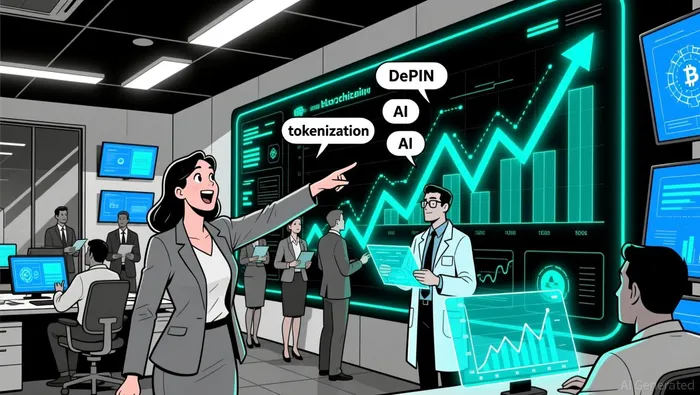
The removal of Prime Intellect from the AI category, meanwhile, suggests a tightening of criteria as Grayscale prioritizes projects with demonstrable utility and regulatory alignment. This curation process, updated every 15 days post-quarter-end, is not merely a product development exercise but a dynamic response to market signals. For instance, the firm's emphasis on DePIN-a category encompassing decentralized networks for physical infrastructure-aligns with growing institutional interest in tokenized assets that generate tangible value, such as satellite data or energy grids.
Regulatory Clarity as a Catalyst for Institutional Adoption
The 2025 regulatory landscape has been a critical enabler of Grayscale's strategic shifts. The U.S. passage of the GENIUS Act, which established federal frameworks for stablecoins, has already accelerated the adoption of smart contract platforms and real-world asset (RWA) tokenization. Simultaneously, the Securities and Exchange Commission's (SEC) approval of generic listing standards for commodity-based exchange-traded products (ETPs) has expanded the universe of investable crypto assets for U.S. institutions. These developments have not only reduced legal ambiguity but also created a fertile ground for Grayscale to evaluate altcoins with clear utility and compliance-ready structures.
Moreover, the anticipated passage of bipartisan crypto market structure legislation in 2026-a key component of Grayscale's 2026 Digital Asset Outlook-promises to further integrate public blockchains with traditional finance. This legislative progress is expected to facilitate on-chain issuance by both startups and established firms, a trend that directly supports Grayscale's focus on tokenization and DePIN projects. As institutional investors seek to hedge against volatility and access yield-generating assets, the firm's pipeline is increasingly positioned to meet these demands with products that align with regulatory guardrails.
Institutional Capital and the New Normal in Crypto Markets
The shift in institutional adoption patterns is equally transformative. According to Grayscale's research, global spot crypto ETPs attracted $87 billion in net inflows since January 2024, driven by a more sustained and methodical buying approach compared to the retail-driven volatility of prior cycles. This trend is amplified by the rise of institutional-grade custody solutions and the emergence of Digital-Asset Treasury (DAT) companies, which treat crypto as a core operating asset. Early adopters like Harvard Management Company and Mubadala have already allocated to crypto ETPs, signaling a normalization of digital assets within institutional portfolios.
In parallel, the tokenization of real-world assets (RWAs)-such as real estate, art, and infrastructure-is gaining traction, supported by regulatory clarity and blockchain-based settlement systems. Grayscale's inclusion of DePIN and AI projects in its watchlist reflects an understanding that institutional investors are no longer merely speculating on crypto's potential but actively integrating it into capital allocation strategies. For example, AI-driven analytics tools are now being deployed to optimize risk management and automate trading, further embedding digital assets into traditional financial workflows.
Strategic Positioning for 2026 and Beyond
Grayscale's evolving pipeline is a testament to its role as both a participant and a catalyst in the institutionalization of crypto. By prioritizing assets that align with regulatory progress and sector-specific innovation, the firm is not only diversifying its product offerings but also reinforcing its position as a bridge between traditional finance and decentralized ecosystems. The inclusion of projects like ARIA Protocol and Nous Research-which leverage AI and decentralized infrastructure-demonstrates a forward-looking approach that anticipates the next phase of institutional demand.
However, the firm's success will hinge on its ability to navigate the delicate balance between innovation and compliance. While inclusion in the "Assets Under Consideration" list does not guarantee product launches, it does indicate a rigorous evaluation process that prioritizes projects with scalable utility and regulatory resilience. As the U.S. and global markets continue to refine their crypto frameworks, Grayscale's strategic alignment with these trends positions it to capitalize on the growing convergence of institutional capital, technological innovation, and regulatory clarity.







Comentarios
Aún no hay comentarios