
Grayscale's Chainlink ETF Filing and Its Implications for the Digital Asset Ecosystem
The digital asset ecosystem is on the cusp of a transformative shift as Grayscale's filing for a spot ChainlinkLINK-- (LINK) ETF with the U.S. Securities and Exchange Commission (SEC) signals a broader institutional embrace of altcoins. This move, which seeks to convert the firm's existing Chainlink Trust into a tradable ETF under the ticker GLNK, is not just a product launch—it's a strategic pivot toward mainstream adoption of decentralized finance (DeFi) infrastructure. The implications are profound, touching on regulatory innovation, institutional capital flows, and the redefinition of crypto's role in global markets.
Regulatory Progress: A New Framework for Altcoin ETFs
Grayscale's filing, submitted on September 5, 2025, is part of a broader regulatory thaw under the Trump administration, which has prioritized clarity for digital assets. The SEC's recent approval of in-kind redemptions for BitcoinBTC-- and EthereumETH-- ETFs has set a precedent, aligning crypto ETFs with traditional commodity structures and reducing operational costs for institutional investors [2]. This shift has created a regulatory pathway for altcoin ETFs, with Grayscale's Chainlink proposal leveraging the same cash-based creation/redemption model as its Bitcoin and Ethereum counterparts [1].
The filing also highlights a potential staking feature, a first for U.S.-listed crypto ETFs. By allowing third-party providers to stake LINK tokens while maintaining custody with CoinbaseCOIN-- Custody Trust Company, the ETF could generate yield for investors—a critical differentiator in a market where volatility often overshadows utility [1]. However, this innovation hinges on regulatory guidance, as the SEC has yet to finalize rules for staking rewards in ETF structures [5].
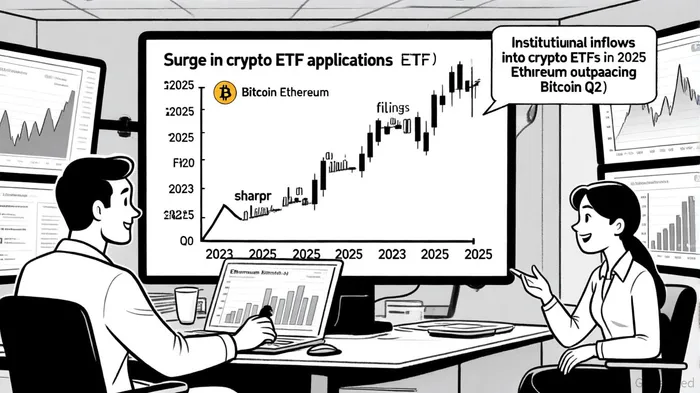
The Trump administration's emphasis on interagency coordination between the SEC and Commodity Futures Trading Commission (CFTC) further reduces ambiguity, potentially accelerating approvals for altcoin ETFs [1]. With over 90 crypto ETF applications under review—including altcoin-focused products from Bitwise, Franklin Templeton, and VanEck—the regulatory landscape is evolving from a “wild west” to a structured framework [6].
Institutional Adoption: Beyond Bitcoin and Ethereum
The institutional appetite for altcoin exposure is no longer speculative. Grayscale's Chainlink ETF filing coincides with a surge in demand for diversified crypto portfolios, driven by the rise of Digital Asset Treasury Companies (DATCOs) and corporate treasuries allocating to DeFi infrastructure [2]. Chainlink, as a decentralized oracleORCL-- network, represents a critical layer of Web3's infrastructure, and its inclusion in a regulated ETF underscores the market's recognition of its utility beyond speculative trading.
James Seyffart, a senior ETF analyst at Bloomberg, has noted that the traditional “altcoin season” is being replaced by a “corporate” altcoin season, where institutional investors prioritize projects with real-world applications [2]. This shift is evident in the growing number of institutional filings for altcoin ETFs, including Grayscale's SolanaSOL--, DogecoinDOGE--, and XRPXRP-- proposals. While inflows into altcoin ETFs are unlikely to match Bitcoin's $10 billion-plus inflows in 2025, they are expected to serve as trading vehicles for capitalizing on sector-specific trends [2].
Grayscale's existing Chainlink Trust, which manages $29 million in assets, provides a proven foundation for the ETF [1]. By converting this trust into a liquid ETF, Grayscale is addressing a key barrier to institutional adoption: the complexity of custodying and managing altcoins. The ETF's structure—mirroring Bitcoin and Ethereum ETFs—ensures familiarity for institutional investors, who can now access Chainlink's price performance without navigating the technicalities of blockchain wallets [4].
Market Implications: A Catalyst for Ecosystem Growth
The approval of Grayscale's Chainlink ETF would have cascading effects on the digital asset ecosystem. First, it would validate DeFi's role in the financial system, encouraging further innovation in oracle networks, smart contracts, and cross-chain interoperability. Second, it would democratize access to altcoins, enabling retail investors to participate in the growth of DeFi infrastructure without the risks of self-custody [5].
Moreover, the ETF's potential staking feature could set a precedent for yield-generating crypto products, bridging the gapGAP-- between traditional fixed-income instruments and blockchain-based returns. This innovation is particularly relevant as the Federal Reserve's tightening cycle enters a plateau, pushing investors toward alternative yield sources [3].
However, challenges remain. The SEC's cautious approach to staking and the ongoing debate over whether crypto assets are commodities or securities could delay approvals. Additionally, competition from Bitwise's parallel Chainlink ETF filing may pressure Grayscale to differentiate its product through yield generation or lower fees [6].
Conclusion: A New Era for Crypto ETFs
Grayscale's Chainlink ETF filing is a microcosm of the broader institutionalization of digital assets. It reflects a regulatory environment maturing to accommodate innovation, an institutional sector seeking diversification, and a market infrastructure evolving to meet these demands. While the road to approval is not without hurdles, the filing marks a pivotal step toward a future where crypto ETFs are not just speculative tools but foundational components of global portfolios.
As the SEC weighs its decision, one thing is clear: the digital asset ecosystem is no longer on the fringes of finance. It is now a core consideration for regulators, institutions, and investors alike.





Comentarios
Aún no hay comentarios