
Grayscale and Bitwise ETFs: Can Institutional Entry Prevent a DOGE Price Crash?
Institutional Adoption: A New Era for Meme Coins
Grayscale and Bitwise have spearheaded the institutionalization of meme coins by securing regulatory approvals for their DOGEDOGE-- and XRPXRP-- ETFs. Grayscale's Dogecoin ETF, approved by the NYSE and NYSE Arca, is set to launch as early as November 24, 2025, following a 20-day SEC review window under Section 8(a) of the Securities Act of 1933 according to reports. This expedited process bypasses the need for explicit SEC endorsement, reflecting broader regulatory clarity. Bitwise, meanwhile, has already launched the Bitwise Solana Staking ETFBSOL-- (BSOL), which amassed $550 million in assets within weeks, while its XRP ETF is poised for a near-term debut according to market analysis.
These developments signal a structural shift. By converting private placement products into publicly traded ETFs, firms like Grayscale are addressing institutional concerns around custody and liquidity. For example, Grayscale's Dogecoin Trust, launched in January 2025, allows investors to gain exposure to DOGE without directly holding the asset, mitigating risks associated with crypto storage. This institutional-grade structure is critical for attracting large-cap investors who previously shunned meme coins due to their volatility and regulatory ambiguity.
Price Floor Dynamics: ETFs as Stabilizers
The core argument for ETFs acting as price floors lies in their ability to institutionalize demand. When ETFs track crypto assets, they attract a broader investor base, including those hesitant to engage with volatile markets directly. This institutional demand can stabilize prices by reducing reliance on retail-driven speculation. For instance, the Bitwise Solana ETF's $57 million first-day inflow demonstrates how regulated products can inject liquidity into altcoins, potentially supporting price floors during downturns.
Historical precedents for BitcoinBTC-- and EthereumETH-- ETFs offer instructive parallels. While Bitcoin ETFs saw $4.2 billion in combined outflows during the 2025 downturn, altcoin ETFs like those for SolanaSOL-- and XRP attracted inflows, suggesting a capital rotation toward assets with clearer regulatory pathways according to market analysis. This trend implies that DOGE ETFs, if approved, could similarly attract institutional capital, reducing the risk of a freefall.
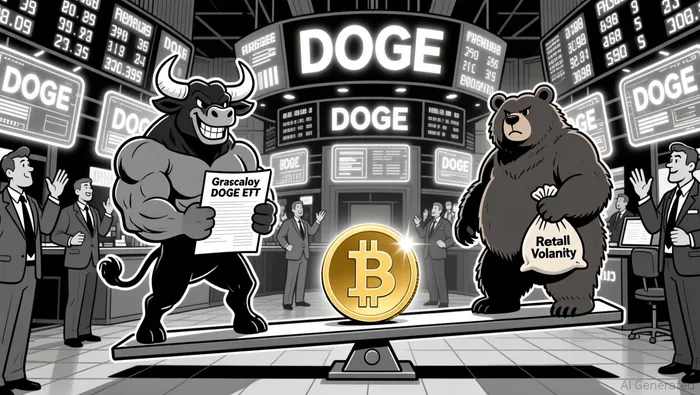
However, the effectiveness of ETFs as crash preventers depends on market conditions. DOGE's recent price action-trading at $0.1543 and near the bottom of its long-term price channel-highlights the fragility of its fundamentals. While ETFs may provide short-term liquidity, they cannot counteract macroeconomic headwinds, such as Bitcoin's death cross or risk-off flows.
Regulatory Clarity and Market Legitimacy
The SEC's recent stance has been instrumental in enabling this shift. By allowing firms to list crypto ETFs under Section 8(a), the agency has reduced regulatory friction, enabling Grayscale and Bitwise to bypass the 19b-4 exchange rule process. This approach, coupled with DOGE's classification as a commodity rather than a security according to market analysis, has minimized legal hurdles. Bloomberg analyst James Seyffart estimates a 90% approval chance for Grayscale's Dogecoin ETF according to market forecasts, underscoring growing institutional confidence.
Yet, regulatory clarity alone is not a panacea. The October 2025 market crash, which liquidated $19 billion in leveraged positions, revealed the risks of shallow liquidity and high leverage. While ETFs offer tax efficiency and in-kind creation/redemption mechanisms according to financial reports, they cannot eliminate systemic risks inherent to the crypto market.
Conclusion: A Cautious Optimism
Grayscale and Bitwise ETFs represent a significant step toward mainstream adoption for meme coins. By institutionalizing DOGE and XRP, these products could stabilize prices through increased liquidity and diversified investor bases. However, their ability to prevent a crash hinges on broader market dynamics. While ETFs may act as temporary price floors, they cannot insulate DOGE from macroeconomic volatility or structural weaknesses in its underlying network.
For investors, the key takeaway is that institutional adoption is a double-edged sword. It brings legitimacy and liquidity but also exposes meme coins to the same risks that plague traditional markets. As the November 2025 launch dates approach, the true test will be whether these ETFs can transform DOGE from a speculative meme into a resilient asset.





Comentarios
Aún no hay comentarios