
Grayscale's 2026 Crypto Expansion: Unlocking Institutional Demand in Altcoins
Grayscale Investments, the largest digital asset manager in the United States, is poised to redefine institutional-grade exposure to altcoins in 2026. With a strategic focus on tokenization platforms, decentralized infrastructure, and artificial intelligence (AI), the firm has expanded its "Assets Under Consideration" list to include 36 altcoins across five sectors. This move, coupled with regulatory progress and the registration of statutory trusts for assets like BNBBNB-- and Hyperliquid (HYPE), signals a pivotal shift in how institutional capital will flow into the crypto ecosystem. For investors, this represents a unique window to capitalize on newly sanctioned ETFs and rebalanced portfolios that prioritize real-world utility and scalability.
A Strategic Rebalancing Toward Institutional-Grade Altcoins
Grayscale's Q1 2026 rebalancing process has added 36 altcoins to its evaluation pipeline, emphasizing projects with clear use cases in decentralized infrastructure and AI. Notable inclusions include Tron (TRX) in the Smart Contract category, ARIA Protocol (ARIAIP) in Consumer & Culture, and DoubleZero (2Z) in Utilities & Services. The AI segment, in particular, has seen the addition of Nous Research and Poseidon, reflecting Grayscale's alignment with the growing institutional interest in AI-driven blockchain networks.
This rebalancing is not arbitrary. Grayscale's quarterly review process, which updates its asset list 15 days after quarter-end, ensures that its portfolio remains attuned to emerging trends such as Decentralized Physical Infrastructure Networks (DePIN) and tokenized intellectual property. By prioritizing projects with tangible infrastructure value-such as Tron's blockchain for decentralized applications or DoubleZero's DePIN solutions-Grayscale is effectively curating a basket of altcoins that align with institutional risk-return profiles.
Regulatory Tailwinds: Delaware Trusts and SEC Streamlining
The firm's recent registration of statutory trusts for BNB and HYPE in Delaware marks a critical step toward launching exchange-traded funds (ETFs) for these assets. While these registrations do not immediately translate to approved ETFs, they signal Grayscale's intent to navigate the evolving regulatory landscape. The SEC's recent approval of generic listing standards has further streamlined the process for asset-specific ETFs, reducing bureaucratic hurdles and accelerating time-to-market for products like the proposed Grayscale Bittensor Trust (GTAO).
This regulatory progress is particularly significant for Bittensor (TAO), a decentralized AI platform that incentivizes machine learning model development through its native token. Grayscale's filing for a TAOTAO-- ETP underscores the growing institutional appetite for AI-focused crypto projects, a sector that has historically been underrepresented in traditional investment vehicles.
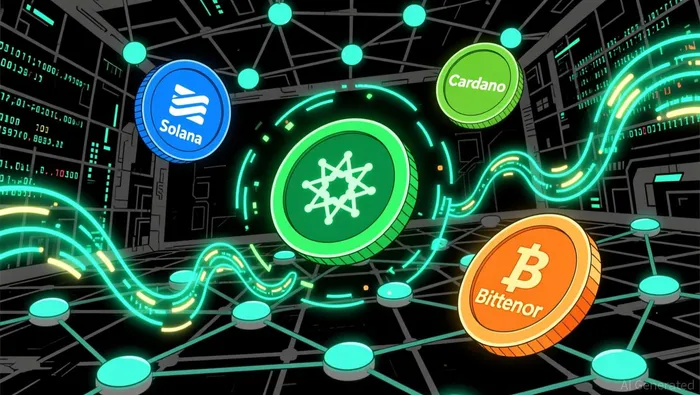
Spotlight on Institutional-Grade Altcoins: SolanaSOL--, CardanoADA--, and Bittensor
Three altcoins stand out in Grayscale's 2026 expansion: Solana (SOL), Cardano (ADA), and Bittensor (TAO).
- Solana (SOL): As a high-throughput smart contract platform, Solana has become a cornerstone of Grayscale's Smart Contract Fund, accounting for 30.31% of the fund's holdings. Its institutional appeal stems from its ability to support decentralized finance (DeFi) and Web3 applications at scale, a trait that has driven demand following the 2024 ETF approvals.
- Cardano (ADA): Grayscale's inclusion of ADAADA-- in its Q1 2026 list reflects its growing institutional traction. ADA's recent 7.3% 24-hour price surge and its role as a proof-of-stake platform with a focus on sustainability position it as a compelling addition to diversified crypto portfolios.
- Bittensor (TAO): The decentralized AI platform's recent halving event increased token scarcity, attracting institutional interest. Grayscale's proposed ETP for TAO aims to provide regulated access to a project that bridges blockchain and machine learning, a niche with significant long-term potential.
Strategic Entry Points for Investors
For investors seeking to capitalize on Grayscale's 2026 expansion, the firm's rebalancing and regulatory progress create three key entry points:
- Pre-ETF Launch Opportunities: The registration of trusts for BNB and HYPE suggests that Grayscale is preparing for ETF approvals in early 2026. Investors can position themselves ahead of these launches by allocating to the underlying assets, which are likely to see increased liquidity and price discovery as institutional demand builds.
- Sector-Specific ETFs: Grayscale's focus on AI and DePIN projects opens the door for sector-specific ETFs, such as the proposed BittensorTAO-- Trust. These products will allow investors to gain exposure to high-growth, utility-driven altcoins without the complexities of direct crypto ownership.
- Rebalanced Portfolios: The inclusion of 36 altcoins in Grayscale's Q1 2026 list means that investors can diversify across sectors like Smart Contract Platforms (SOL, ADA) and AI (TAO) while leveraging the firm's institutional-grade custody and compliance infrastructure.
Conclusion: A New Era for Institutional Crypto Exposure
Grayscale's 2026 expansion is more than a product update-it's a structural shift in how institutional capital will engage with altcoins. By rebalancing its portfolio to include projects with real-world utility, navigating regulatory hurdles, and pioneering AI-focused ETFs, the firm is creating a blueprint for institutional-grade crypto exposure. For investors, this represents a rare opportunity to align with assets like Solana, Cardano, and Bittensor at a time when regulatory clarity and market demand are converging.
As the SEC's generic listing standards reduce friction for new ETFs and Delaware's trust registrations pave the way for approvals, the window for strategic entry is narrowing. Investors who act now-leveraging Grayscale's curated altcoin list and regulatory progress-will be well-positioned to capitalize on the next phase of crypto's institutional adoption.







Comentarios
Aún no hay comentarios