
The Graph's Horizon Upgrade and Its Implications for GRT Value and Data Infrastructure Dominance
The Graph's Horizon Upgrade, launched in 2025, represents a paradigm shift in blockchain data infrastructure. By reimagining its architecture as a modular, multi-service platform, the protocol has laid the groundwork for a self-reinforcing flywheel of network effects and fee-driven token scarcity. This analysis explores how Horizon's design not only addresses scalability and economic sustainability but also positions GRTGRT-- as a cornerstone asset in the evolving decentralized data ecosystem.
A Modular Architecture for Scalability and Specialization
Horizon's core innovation lies in its separation of indexing, storage, and query execution into distinct service classes. Traditionally, Indexers redundantly indexed the same subgraphs, creating inefficiencies. Horizon replaces this model with a consensus-driven indexing layer, where Indexers validate outputs through deterministic replay or zero-knowledge proofs, sealing subgraph data as verifiable artifacts. This sealed data is then stored by specialized providers, decoupling compute from availability and reducing operational costs.
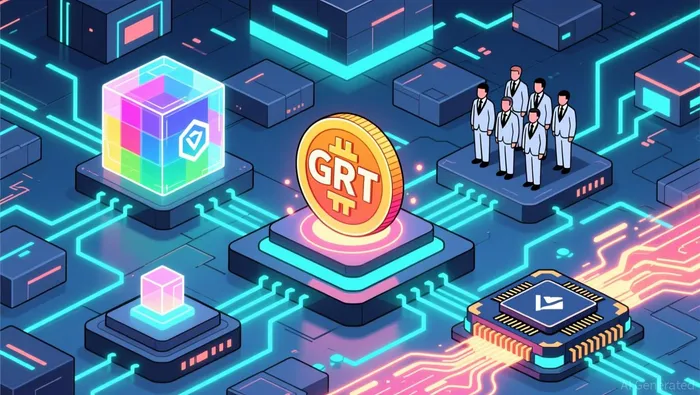
This modular approach enables a "query-first economy," where competition shifts from redundant indexing to optimizing query performance. As stated in the migration guide, Indexers who fail to adopt Horizon will lose access to rewards and query fees, creating a strong incentive for rapid adoption. The testnet's success in unifying Subgraphs, Substreams, and Token API under a single protocol layer further validates this architecture's potential to support diverse data services.
Fee-Driven Scarcity and Network Effects
Horizon's architectural changes directly impact GRT's token economics. By introducing a unified payments system and core staking protocols, the upgrade enhances the token's utility as a medium for accessing and securing data services. As more developers build on the platform-evidenced by a 7.6% quarter-over-quarter increase in active subgraphs to 15,087 in Q3 2025-query fees and token burns rise, creating scarcity.
The protocol's economic model further amplifies this effect. GRT issuance is now directed toward funding innovation across services, creating a feedback loop where increased utility drives demand for the token. For instance, the integration of TRON and the launch of the Amp Enterprise Database signal Horizon's expansion into institutional-grade data solutions, broadening GRT's use cases. Meanwhile, cross-chain functionality via ChainlinkLINK-- CCIP, slated for Q1 2026, will enable staking and delegation across multiple chains, further diversifying GRT's utility.
Network Effects and Long-Term Value Accrual
Horizon's multi-service architecture fosters a flywheel of network effects. As more developers deploy data services-ranging from real-time analytics to token APIs-the platform's value proposition for Indexers, storage providers, and end users grows. This is already evident in the protocol's multichain adoption: Base surpassed EthereumETH-- Mainnet in query volume for the first time in Q3 2025, reflecting Horizon's ability to scale beyond legacy chains.
The economic environment also supports this trajectory. While broader crypto markets face volatility, structural demand from spot ETFs and digital asset treasuries, and stablecoin growth (which reached $280B in market cap) underscores the maturation of blockchain infrastructure. The Graph's focus on fee-driven scarcity aligns with these trends, positioning GRT as a deflationary asset in a sector increasingly valued by institutional investors.
Challenges and Considerations
Despite its promise, Horizon's success hinges on execution. Query volume declined 15.9% quarter-over-quarter in Q3 2025, raising questions about short-term demand. However, this dip may reflect broader market conditions rather than Horizon's efficacy, as the protocol's testnet and migration roadmap remain on track. Additionally, macroeconomic factors-such as elevated U.S. tariffs and immigration-driven consumer spending shifts- could indirectly affect crypto adoption. Yet, The Graph's focus on enterprise and multichain use cases provides insulation from such volatility.
Conclusion
The Graph's Horizon Upgrade is more than a technical overhaul-it is a strategic repositioning toward a future where data infrastructure is modular, permissionless, and economically sustainable. By creating a flywheel of network effects and fee-driven scarcity, Horizon ensures that GRT's value accrues to participants while enabling the protocol to dominate the blockchain data landscape. For investors, this represents a compelling opportunity to bet on a foundational layer of Web3, where innovation and utility are inextricably linked.







Comentarios
Aún no hay comentarios