
The Graph (GRT): A Bear Market Bargain or a Long-Term Growth Play?
The cryptocurrency market in late 2025 is mired in a bearish funk, with the Fear & Greed Index hovering at 15 (Extreme Fear) and 83% of altcoins trading below their 200-day moving averages. Amid this gloom, The Graph (GRT) stands at a crossroads: Is it a discounted asset in a bear market, or a foundational piece of the Web3 infrastructure poised for long-term growth? To answer this, we must dissect its on-chain fundamentals, divergent price forecasts, and alignment with broader decentralized trends.
Bearish Factors: A Market in Retreat
The immediate outlook for GRTGRT-- is clouded by macroeconomic headwinds. With a current price of $0.0365 and a market cap of $386–$392 million, GRT has underperformed relative to the broader market. Analysts project a bearish range of $0.0346–$0.0355 for December 2025, reflecting weak demand and lingering uncertainty. The token's 3% annual inflation rate, coupled with supply unlocks from Edge & Node (8% over five years), exacerbates downward pressure according to market analysis. Meanwhile, technical indicators show a prolonged downtrend, with the 50-day and 200-day moving averages diverging.
Market sentiment remains a critical drag. Over 80% of participants expect a continued downturn, and GRT's price volatility-swings between $0.01389 and $0.45 in forecasts-underscores its speculative nature. This volatility is compounded by the token's utility-driven model: while on-chain activity remains robust (3,000+ subgraphs, 200+ indexers), demand for query fees has not yet translated into sustained price appreciation.
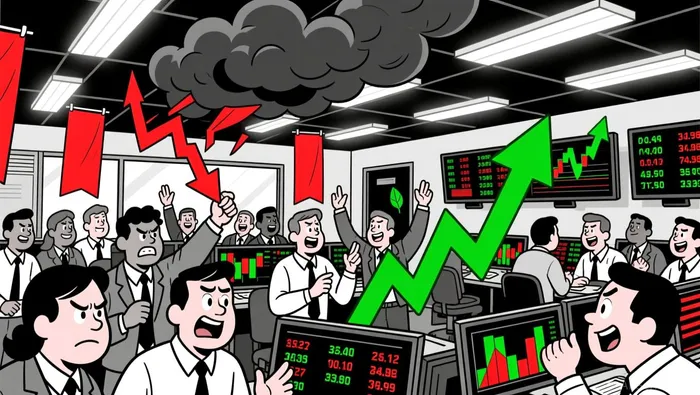
Bullish Fundamentals: The Infrastructure Play
Contrarians argue that GRT's value proposition lies in its role as the "Google of Web3." The network's decentralized indexing protocol powers critical dApps like UniswapUNI--, AaveAAVE--, and Synthetix, with over 2,000 curators and 200 indexers maintaining its infrastructure. Recent upgrades aim to align incentives and reduce sell pressure-a move reminiscent of past testnet participation cycles that drove price spikes.
Moreover, strategic partnerships are expanding GRT's utility. Integration with Chainlink CCIP enables cross-chain staking and liquidity expansion, potentially boosting demand on layer 2s like ArbitrumARB-- and Base. Enterprise collaborations signal real-world adoption, including TRON's $25 billion daily volume and DTCC-compliant Substreams. These developments counterbalance supply-side pressures and position GRT as a linchpin in the data layer of Web3.
Divergent Predictions: A Tale of Two Scenarios
Price forecasts for GRT in 2025 are starkly divided. On the bullish end, some analysts project a surge to $0.45–$0.85 or even $1.00 according to market analysis, driven by accelerated Web3 adoption and improved governance. A neutral scenario anticipates consolidation around $0.06–$0.07 according to projections, while bearish forecasts warn of a potential drop to $0.01389 by 2035 according to market reports.
This divergence reflects the dual nature of GRT's value proposition: it is both a utility token and a speculative asset. Short-term bearishness is justified by macroeconomic risks and inflationary pressures, but long-term optimismOP-- hinges on the token's ability to capture value as decentralized data indexing becomes a standard in Web3.
Strategic Entry: A Contrarian Thesis
For investors with a multi-year horizon, GRT's current valuation may represent a compelling entry point. At $0.0365, the token trades well below its historical highs and is priced for a worst-case scenario. If Web3 adoption accelerates-driven by enterprise use cases, cross-chain interoperability, or regulatory clarity-GRT could see a re-rating. Historical precedents show that infrastructure tokens often outperform during growth cycles.
However, caution is warranted. The token's inflationary model and unlocking schedules pose risks, and regulatory uncertainty could delay adoption. A strategic approach would involve dollar-cost averaging into GRT while monitoring on-chain metrics (query volume, node activity) and macroeconomic shifts.
Conclusion: Balancing Risk and Reward
The Graph (GRT) embodies the tension between bear market pessimism and long-term optimism. While current fundamentals suggest it is a bear market bargain, its potential as a growth play depends on the trajectory of Web3 adoption. Investors must weigh the risks of short-term volatility against the rewards of positioning in a critical infrastructure layer. For those with a contrarian mindset and a multi-year outlook, GRT's undervaluation may offer a unique opportunity-but only if they are prepared to weather the storm.






Comentarios
Aún no hay comentarios