
Granular Exposure in European Equities: Capitalizing on Sectoral and Regional Divergence Amid Macroeconomic Uncertainty
The Case for Granular Exposure
European equities are no longer a monolith. Amid macroeconomic uncertainty—driven by trade tensions, inflationary pressures, and policy shifts—the region's markets have fractured into distinct narratives. Investors who adopt a granular approach, targeting specific sectors and regions, can capitalize on this divergence. According to a report by the International Monetary Fund (IMF), , , but with stark regional disparities[1]. Meanwhile, the (ECB) has flagged heightened volatility from U.S. tariff announcements, . Yet, this volatility has created opportunities for those willing to dig deeper.
Sectoral Divergence: Winners and Losers
The sectoral landscape in Europe is a tale of two extremes. Defensive sectors like utilities, financials, and telecoms have outperformed, . , for instance, . Conversely, the automotive sector has faltered, .
Investors should prioritize sectors aligned with European policy priorities. The and Competitiveness Compass initiative are turbocharging demand for semiconductors and energy infrastructure[2]. Companies like Nexans, a leader in high-voltage cabling for offshore wind projects, are prime examples of firms benefiting from this structural shift[1]. Similarly, defense stocks—Saab, Rheinmetall, and Leonardo—are operating at near-war-time capacity, .
Regional Divergence: Where to Allocate
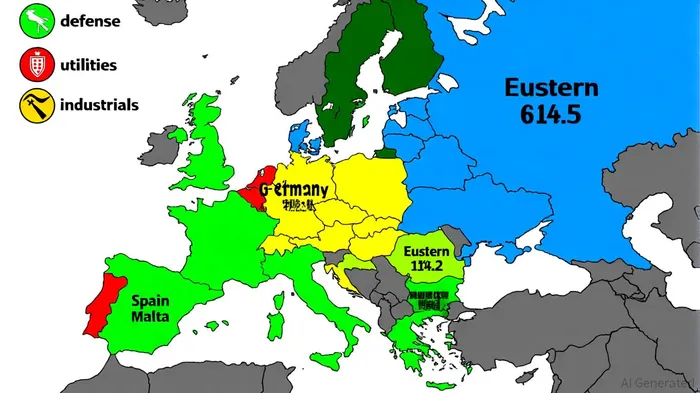
Regional performance in Europe is equally fragmented. Malta and Spain are shining stars, . In contrast, , . Southern Europe's outperformance is partly due to its decoupling from U.S. tariff risks, as noted by Goldman Sachs[2].
For investors, this means tilting toward Southern Europe and defense-heavy economies. , , . Countries like Italy and Norway, , offer compelling entry points. Meanwhile, Eastern Europe's lower correlation with U.S. markets (0.16 in 2023 vs. .
Strategies for Navigating Uncertainty
To harness this divergence, investors should adopt a dual strategy:
1. Sectoral Selectivity: Overweight industrials, utilities, and defense while underweighting cyclical sectors like automotive. Diversify within sectors—for example, pairing high-growth tech firms with stable utilities to balance risk[1].
2. Regional Precision: Allocate to Southern Europe and defense-focused economies. Consider ETFs like the (WDEF) for targeted exposure[6].
Moreover, . . As fiscal stimulus and geopolitical rearmament drive earnings growth, patient investors can capitalize on a re-rating of European indices.
Conclusion
European equities are no longer a side bet. The region's sectoral and regional divergence, amplified by macroeconomic uncertainty, demands a granular approach. By focusing on policy-driven sectors and high-growth regions, investors can navigate volatility and unlock value in a market poised for structural transformation. As the ECB and EU governments recalibrate their strategies, the time to act is now—before the next wave of re-rating catches the unprepared.







Comentarios
Aún no hay comentarios