
Gran Tierra Energy's Strategic Prepayment Agreement and Capital Structure Optimization
A Prepayment Agreement to Bolster Liquidity
Gran Tierra's agreement involves an initial advance of $150 million and a potential additional $50 million, contingent on production targets. Payments will be fulfilled through scheduled deliveries of Ecuadorian crude oil, effectively converting future production into immediate cash flow. According to a Finimize report, this structure allows the company to "lock in liquidity without issuing new shares," reducing refinancing risks and preserving shareholder equity.
The prepayment also necessitated adjustments to Gran Tierra's Colombian reserve-based credit facility. The borrowing base was reduced from $75 million to $60 million, while covenants were revised to align with the new prepayment terms, as noted in a Stocktitan announcement. These changes, though seemingly restrictive, signal a strategic reallocation of resources. By securing a larger portion of its funding through prepayments tied to physical assets (crude oil), Gran TierraGTE-- mitigates exposure to traditional debt markets, where interest rates remain elevated.
Capital Structure Metrics: A Mixed Picture
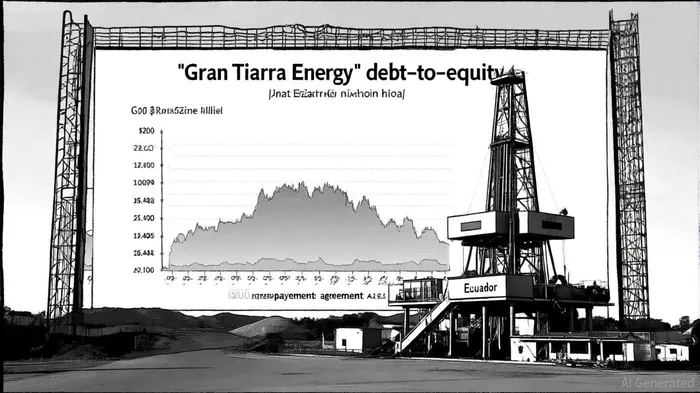
Gran Tierra's balance sheet has long been characterized by high leverage. As of the latest available data, its debt-to-equity ratio stands at 196.5%, with an interest coverage ratio of 0.8-indicating that earnings barely cover interest obligations, according to SimplyWall St. For context, the company's Q2 2025 debt-to-equity ratio was 2.02, and its interest coverage ratio was 0.70, per TipRanks. These metrics highlight a precarious financial position, exacerbated by the energy sector's cyclical nature.
However, the prepayment agreement offers a potential turning point. By converting future production into upfront cash, Gran Tierra can reduce its reliance on high-cost debt. The $200 million infusion will likely be used to strengthen its balance sheet, fund operational expenses, and potentially repay higher-interest obligations. Analysts at SimplyWall St note that this strategy could "improve confidence among shareholders and bondholders" by demonstrating the company's ability to secure non-dilutive financing.
Risk-Adjusted Returns in a High-Volatility Environment
The energy sector's inherent volatility demands a careful balance between risk and reward. Gran Tierra's prepayment agreement introduces both opportunities and challenges. On the one hand, the company gains immediate liquidity and reduces refinancing uncertainty. On the other, it commits to delivering a fixed volume of crude oil, exposing it to production risks if output falls short of expectations.
Despite these risks, analysts project that the agreement could enhance risk-adjusted returns. Marketscreener reports that the prepayment has already driven a pre-market rally in GTE shares, reflecting investor optimism. The company's focus on Colombia and Ecuador-regions with relatively stable production profiles-further mitigates execution risks. Additionally, by avoiding equity issuance, Gran Tierra preserves its ownership structure, which is critical for maintaining investor trust in a sector prone to capital calls.
Conclusion: A Strategic Pivot for Long-Term Resilience
Gran Tierra Energy's prepayment agreement represents a strategic pivot in a challenging market. By leveraging its physical assets to secure liquidity, the company addresses immediate financial pressures while positioning itself for long-term stability. While its debt metrics remain concerning, the reduction in refinancing risks and the avoidance of equity dilution suggest a more sustainable capital structure.
For investors, the key question is whether Gran Tierra can maintain production levels sufficient to meet its prepayment obligations. If successful, the company could emerge as a case study in creative financing within the energy sector. In a world where volatility is the norm, Gran Tierra's approach offers a compelling blend of pragmatism and innovation.





Comentarios
Aún no hay comentarios