
Grab's System Glitch and Operational Risks in a Competitive Southeast Asian Market
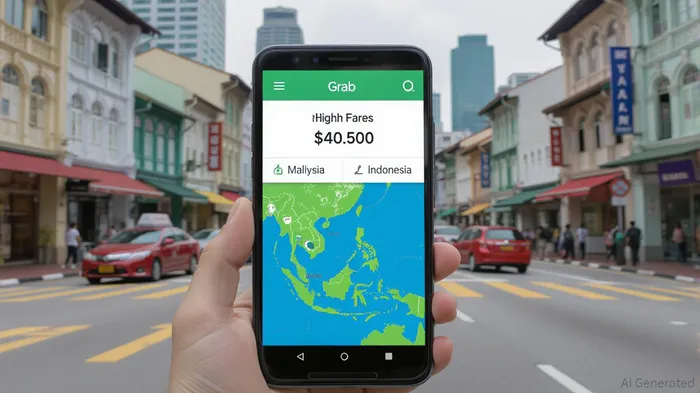
In the summer of 2025, Grab Holdings Inc. faced a public relations and operational crisis that tested the resilience of its digital ecosystem. On August 20, users in Singapore and Malaysia encountered a system glitch that caused ride fares to spike to over $1,000 for short trips—a viral incident that exposed vulnerabilities in the company's technological infrastructure. While Grab swiftly resolved the issue and issued apologies, the event raised critical questions about the long-term sustainability of its business model in a fiercely competitive market. For investors, the incident underscores a broader tension: Can a hyperconnected digital platform like Grab balance rapid growth with operational stability in an environment where technical failures can erode user trust and market share?
The August 2025 Glitch: A Symptom of Deeper Risks
The August glitch was not an isolated event. Over the past three years, Grab has experienced recurring system outages, including a prolonged app malfunction in April 2025 that disrupted services across Singapore, Malaysia, Thailand, and the Philippines. These incidents highlight systemic challenges in managing a platform that integrates ride-hailing, food delivery, digital payments, and financial services. The August glitch, in particular, revealed weaknesses in Grab's ability to handle real-time pricing algorithms and user experience safeguards. While the company claimed no users were charged for the erroneous fares, the reputational damage was immediate. Social media was flooded with memes and complaints, and the incident became a case study in how technical errors can amplify public scrutiny for a company transitioning from a high-growth startup to a mature, profit-focused entity.
Historically, Grab's operational risks have been compounded by its reliance on a decentralized network of driver-partners and its aggressive expansion into financial services. For example, the company's membership program, GrabUnlimited, faced scalability issues in 2023–2024 due to a legacy architecture that struggled with concurrency and idempotency. Engineers were forced to manually resolve corrupted membership states, a problem that required a costly migration to Temporal, an open-source workflow engine. While this migration reduced production incidents by 80%, it also exposed the fragility of Grab's tech stack—a concern for investors evaluating its ability to sustain profitability.
Financial Implications: Profitability vs. Structural Vulnerabilities
Grab's Q2 2025 earnings report—$819 million in revenue and $20 million in profit—marked a milestone in its journey toward sustainability. However, these figures mask underlying risks. The company's forward EBITDA margin of ~14% and $7.6 billion in liquidity provide a buffer for innovation and expansion, but its high price-to-earnings (P/E) ratio raises concerns about overvaluation. Analysts note that Grab's profitability is still heavily dependent on driver and customer incentives, which are costly to maintain and vulnerable to competitive pressures.
The Southeast Asian market, where Grab operates in eight countries, is becoming increasingly crowded. Rivals like Gojek in Indonesia and Shopee Food in Vietnam are leveraging hyperlocal strategies to erode Grab's market share. Meanwhile, Grab's foray into digital banking via GrabPay and its recent $1.5 billion convertible note issuance signal a pivot toward financial services—a sector where regulatory scrutiny and technological precision are paramount. A single glitch in this domain could have far graver consequences than a ride-hailing error, potentially triggering regulatory penalties or loss of user trust in financial transactions.
Strategic Resilience: Innovation or Overreach?
Grab's response to operational risks has been twofold: technological modernization and strategic diversification. The migration to Temporal for its membership system is a testament to the company's engineering capabilities, but it also reflects a reactive approach to problem-solving. Investors must ask whether Grab's innovation pipeline—such as AI-driven logistics and expanded financial services—can offset the costs of recurring outages. For instance, the company's 45% year-over-year growth in advertising revenue and 31% increase in active advertisers suggest a maturing ecosystem, but these gains are contingent on maintaining user engagement and trust.
A critical test will be Grab's ability to navigate regulatory shifts in Southeast Asia. The digital banking sector is evolving rapidly, with new entrants and stricter compliance requirements. Grab's recent expansion of GrabFin, which saw a 44% growth in loan disbursements to $721 million in Q2 2025, demonstrates its ambition to become a financial services powerhouse. However, this expansion requires significant capital and carries risks of regulatory pushback or technological failure.
Investment Implications: Balancing Growth and Stability
For long-term investors, Grab presents a paradox: a dominant player in a high-growth region with a history of operational missteps. The company's Q2 2025 profitability is a positive signal, but its P/E ratio of ~35x (as of August 2025) suggests that the market is pricing in aggressive future growth. This valuation is justified if Grab can sustain its EBITDA margin and expand its financial services division, but it becomes precarious if technical glitches or regulatory hurdles disrupt its trajectory.
Key metrics to monitor include:
1. EBITDA Margin Stability: Can Grab maintain its ~14% margin amid rising competition and incentive costs?
2. System Uptime: How frequently do outages occur, and what is the cost of reputational damage?
3. Regulatory Compliance: Will Grab's digital banking initiatives face delays or penalties in Southeast Asia?
Conclusion: A Calculated Bet on Southeast Asia's Digital Future
Grab's August 2025 glitch is a reminder that even the most dominant platforms are not immune to operational risks. However, the company's ability to pivot—whether through technological upgrades, strategic diversification, or regulatory engagement—will determine its long-term viability. For investors, the key is to assess whether Grab's management can transform these vulnerabilities into strengths. If the company can stabilize its core operations while expanding into high-margin financial services, it could cement its position as Southeast Asia's digital infrastructure leader. But if technical and reputational risks persist, the high P/E ratio may become a liability.
In a market where the margin between innovation and instability is razor-thin, Grab's next moves will be critical. For now, the company's Q2 2025 results and $7.6 billion liquidity cushion offer a buffer—but not a guarantee. Investors must weigh the potential rewards of Southeast Asia's digital boom against the risks of a platform still learning to walk the tightrope of scale.







Comentarios
Aún no hay comentarios