
Grab Holdings' Growth Prospects and Valuation Justification: Re-Rating Potential in Southeast Asia's Digital Economy
The recent upgrade of GrabGRAB-- Holdings' (GRAB) price target by Morgan Stanley to $5.70 for 2025 has reignited investor interest in Southeast Asia's leading super app. This re-rating potential is underpinned by a confluence of factors: Grab's strategic expansion into financial services, the rapid maturation of the region's digital economy, and structural tailwinds from trade agreements like the ASEAN Digital Economy Framework Agreement (DEFA) and the Regional Comprehensive Economic Partnership (RCEP).
Morgan Stanley's Rationale: A Catalyst for Re-Rating
Morgan Stanley's upgraded price target reflects confidence in Grab's ability to accelerate top-line growth through market penetration and ecosystem diversification. According to a Fintech News report, the firm highlights Grab's expanding revenue streams from ride-hailing, food delivery, and digital payments as key drivers. This optimism is echoed by broader Wall Street sentiment, with 11 analysts assigning a "Moderate Buy" rating and an average price target of $5.82, according to the NextSprints guide. JPMorgan and Barclays have similarly raised their targets to $5.60 and $6.50, respectively, underscoring a consensus that Grab's strategic initiatives-such as hyper-localized features and fintech expansion-are unlocking long-term value, as noted by the Fintech News report.
Southeast Asia's Digital Economy: A $1 Trillion Opportunity
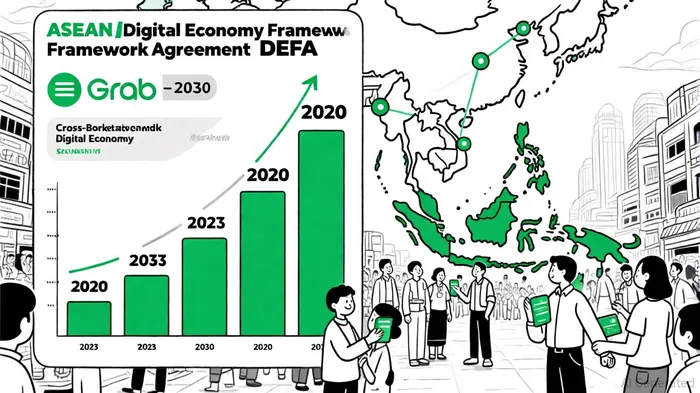
Southeast Asia's digital economy is projected to grow from $330–363 billion in 2025 to $1 trillion by 2030, according to Market Research Southeast Asia. This transformation is being fueled by digital trade agreements like DEFA and RCEP, which harmonize cross-border data flows and reduce transaction costs, a dynamic described in the NextSprints guide. For Grab, this creates a fertile ground for scaling its super app ecosystem. The company has evolved from a ride-hailing platform into a diversified entity offering food delivery, grocery services, and financial solutions. By 2025, Grab's fintech segment-already accounting for 30% of revenue-is expected to rise to 45%, driven by a 54% year-over-year revenue increase in its loan portfolio and a 56% growth in total loan disbursements, according to Tech Collective SEA reports (see Tech Collective SEA coverage).
Grab's strategic acquisitions, including a regional neobank and Chope (a restaurant booking platform), further solidify its position as a digital infrastructure provider. Its financial services division now includes digital banking, insurance, and lending tailored for gig workers and SMEs, aligning with the region's push for financial inclusion, as noted by Tech Collective SEA. Meanwhile, AI-driven operational efficiencies-such as a 15% cost reduction and 22% improvement in user retention-highlight Grab's ability to balance growth with profitability, the NextSprints guide explains.
Financial Performance: A Turnaround Story
Grab's Q1 2025 results underscore its financial resilience. Revenue grew 18% year-on-year to SGD $773 million, with a net profit of SGD $10 million-a stark contrast to the SGD $115 million loss in Q1 2024, as reported by Fintech News. Adjusted EBITDA reached SGD $106 million, reflecting disciplined cost management. The company's Q2 2025 performance was even more impressive: a 23% revenue increase and its first-ever profitable quarter, according to a Growth Shuttle analysis. These metrics, coupled with SGD $6.2 billion in cash liquidity, position Grab to fund strategic acquisitions and technological innovation, including partnerships with autonomous driving firms, a point highlighted by Fintech News.
However, challenges persist. The fintech segment reported a SGD $30 million loss in Q1 2025, attributed to increased credit provisioning, as Fintech News noted. While non-performing loans remain within acceptable risk parameters, high compliance costs and regulatory scrutiny could temper short-term margins.
Valuation Justification: A Super App for the Future
Grab's valuation must be viewed through the lens of its long-term vision: becoming the operating system for Southeast Asian commerce. With 46 million monthly transacting users in Q2 2025 and a 40% increase in country-specific features planned for 2025 (per the NextSprints guide), the company is capitalizing on the region's mobile-first adoption (88.9% of internet users access the web via smartphones in 2023), as reported by Market Research Southeast Asia. Its advertising revenue, now at an annualized run rate of $236 million, further diversifies income streams, according to Growth Shuttle.
The upgraded price targets from Morgan Stanley and peers suggest that the market is beginning to price in Grab's potential to dominate the digital economy. At $5.70, the stock implies a 2025 enterprise value of approximately $18 billion, a discount to the $25–30 billion range implied by Southeast Asia's digital economy projections. This gap represents re-rating potential, particularly as Grab's fintech and e-commerce segments mature.
Conclusion
Grab Holdings' re-rating potential is anchored in its strategic alignment with Southeast Asia's digital transformation. Morgan Stanley's upgraded price target, combined with the region's $1 trillion digital economy opportunity, provides a compelling case for investors. While near-term challenges in fintech profitability exist, Grab's financial discipline, ecosystem diversification, and regulatory tailwinds position it as a long-term winner in a market poised for exponential growth.





Comentarios
Aún no hay comentarios