
GPIQ vs. QYLD: Navigating Momentum and AI Investing in 2025
In the rapidly evolving AI ETF landscape, momentum investing has become a double-edged sword. While artificial intelligence and high-tech innovation drive market rallies, structural inefficiencies in product design can erode returns. The Global X AI ETF (GPIQ) and the Invesco NextGrowth ETF (QYLD) exemplify this dichotomy, with GPIQ leveraging adaptive strategies to outperform QYLD's rigid framework in 2025.
Strategic Foundations: Flexibility vs. Tradition
GPIQ's core strength lies in its hybrid approach to AI and momentum investing. By combining exposure to AI-related equities with a flexible covered call strategy, GPIQ adjusts its Nasdaq-100 equity sleeve between 25% and 75% based on implied volatility and market conditions[3]. This adaptability allows it to capture monthly premium income while retaining uncapped upside during rallies-a critical advantage in 2025's volatile environment. In contrast, QYLD adheres to a traditional covered call model, systematically writing one-month at-the-money calls on the Nasdaq-100 Index[4]. While this approach historically generated steady yields during downturns, it has struggled in 2025's bull market, where QYLD's fixed exposure limited participation in equity gains[3].
Performance Analysis: A Tale of Two Returns
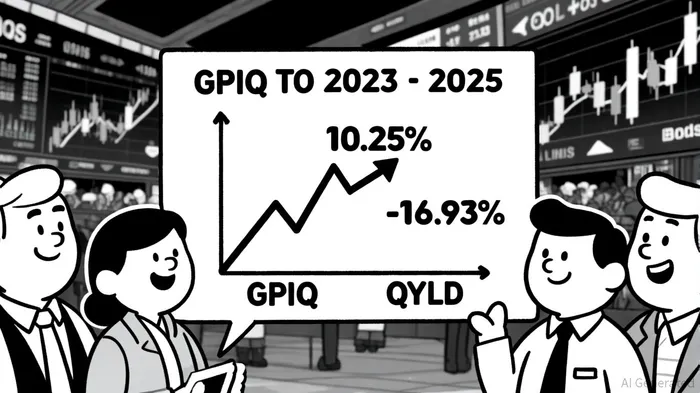
The divergence in strategies has led to stark performance outcomes. As of October 2025, GPIQ delivered a 10.25% total return, driven by 3.43% share price appreciation and a 6.82% yield[3]. This outpaces QYLD's -16.93% return over the same period, underscoring the risks of a rigid strategy in a rising market. Cost efficiency further amplifies GPIQ's edge: its 0.29% expense ratio is half QYLD's 0.60%, reducing drag on investor returns[4]. For income-focused investors, GPIQ's higher dividend yield and tax-advantaged distributions-partially qualifying under Section 1256 treatment-offer additional benefits[3].
Structural Challenges and Market Exposure
QYLD's structural limitations extend beyond performance. Its portfolio is heavily concentrated in the Nasdaq-100's top 10 holdings, which account for 53.97% of assets[5]. While this aligns with AI-driven momentum, it exposes the fund to sector-specific risks. For instance, QYLD's 10.08% allocation to NVIDIA-a key AI enabler-could amplify gains in a bull market but magnify losses during corrections[5]. GPIQ, meanwhile, mitigates concentration risk through its tactical overwrite range, which dynamically adjusts exposure to balance income generation and growth potential[3].
The Road Ahead: Momentum Investing in 2025
The AI ETF space remains a high-stakes arena for momentum investors. GPIQ's success highlights the importance of structural agility: its ability to adapt to volatility while maintaining growth exposure positions it as a compelling choice for 2025. QYLD, despite its 12-year track record, faces an uphill battle to regain relevance without strategic overhauls. As noted by critics, QYLD's underperformance in a bull market-coupled with its higher costs-raises questions about its long-term viability[2].
For investors seeking to capitalize on AI-driven momentum, GPIQ's lower costs, tax efficiency, and adaptive strategy offer a more robust framework. However, both ETFs remain heavily reliant on the Nasdaq-100's top tech stocks, a concentration that could backfire if market dynamics shift. Diversification and active management will be key to sustaining returns in this high-growth, high-risk sector.







Comentarios
Aún no hay comentarios