
GPIF's ESG Resilience: Navigating the Global Retreat with Strategic Allocation
The global ESG investment landscape is in flux. Record outflows from sustainable funds in early 2025—driven by geopolitical shifts, regulatory fragmentation, and sector underperformance—have fueled skepticism about the viability of ESG strategies. Yet, Japan's Government Pension Investment Fund (GPIF), the world's largest pension fund with ¥220 trillion in assets, is doubling down on its ESG commitment. This move underscores a critical truth: while short-term volatility may dominate headlines, GPIF's institutional credibility, data-driven governance, and alignment with structural trends position it as a beacon of resilience in an uncertain era. For investors, its strategy offers a roadmap to outperform in the long run.
GPIF's Institutional Credibility: A Pillar of ESG Integrity
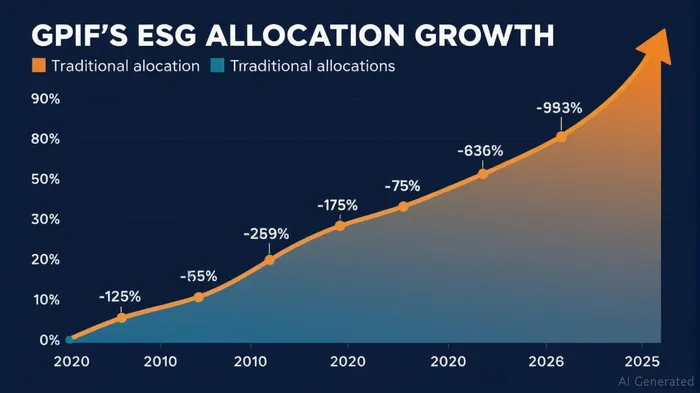
GPIF's ESG pivot is not a fleeting trend but a deliberate evolution of its risk-mitigation ethos. Since 2024, the fund has embedded sustainability across all asset classes—equities, bonds, real estate, and alternatives—through rigorous frameworks like ESG integration and climate-risk analysis. Its policy emphasizes reducing long-term financial risks while securing returns, aligning with net-zero goals without sacrificing market stability. Crucially, GPIF avoids "impact washing," prioritizing investments that balance profit and planetary stewardship. This approach has earned it the trust of global investors, even as others retreat.
Navigating the Global Retreat: Why GPIF's Timing is Strategic
The first quarter of 2025 saw record $8.6 billion in outflows from global sustainable funds, with Europe's historic redemptions and U.S. political headwinds exacerbating the decline. Yet GPIF's strategy defies this trend. By focusing on data-driven governance—enhanced ESG data systems, workforce training, and transparent stakeholder reporting—the fund mitigates risks inherent in less mature ESG markets. Its emphasis on climate resilience, biodiversity, and emerging technologies like green hydrogen positions it to capitalize on long-term structural shifts.
Consider the numbers: despite Q1's outflows, sustainable funds have outperformed traditional ones since 2018, growing $100 to $136 versus $131 for conventional assets. GPIF's policy ensures it captures this upside, even as shorter-term investors flee volatility. As geopolitical tensions (e.g., U.S. climate policy rollbacks) create regulatory uncertainty, GPIF's alignment with EU and Chinese ESG standards—such as China's 2024 voluntary reporting framework—future-proofs its portfolio.
Actionable Sectors: Hydrogen and Electricity Transition
While GPIF's direct hydrogen partnerships are not explicitly detailed, its focus on clean energy infrastructure aligns with industry trends. For instance, corporate giants like ExxonMobil's $4.9 billion acquisition of Denbury—a CO₂ pipeline firm enabling blue hydrogen—highlight the sector's growth potential. Investors can mirror GPIF's strategy by targeting:
- Green Hydrogen Producers: Companies like Plug PowerPLUG-- (NASDAQ: PLUG) or Nel ASA (OSE: NEL) developing electrolyzers for renewable hydrogen.
- Grid Modernization: Utilities investing in smart grids and storage (e.g., NextEra EnergyNEE-- (NEE)), critical to electrifying industries.
- ESG-Linked Bonds: Green bonds and transition finance instruments, which saw deepening markets in 2024 as EU standards boosted transparency.
The Risk-Mitigation Edge: Why GPIF's Approach Works
GPIF's success hinges on its ability to blend activism with pragmatism. By engaging with companies on ESG governance and exercising voting rights, it pushes for accountability without ideological rigidity. This contrasts sharply with passive ESG funds that underperformed in Q1 2025. Meanwhile, its allocation to climate-resilient sectors—like solar (up to $500 billion in 2024) and EVs (20% of global car sales)—ensures diversification against sector-specific risks.
Investment Advice: Emulate GPIF's Long-Term Vision
The retreat in ESG flows is a temporary storm, not a permanent drought. Investors should:
- Focus on Themes, Not Labels: Avoid funds with vague ESG claims. Instead, target companies with science-based emissions targets and real-world projects (e.g., green hydrogen partnerships).
- Prioritize Governance: Seek firms like GPIF that invest in data infrastructure and transparent reporting to avoid greenwashing.
- Hedge with Transition Technologies: Allocate to sectors GPIF emphasizes—hydrogen, carbon capture, and circular economy plays—where long-term demand is clear.
Conclusion: Resilience Through Alignment
GPIF's ESG journey illustrates that sustainability is not a fad but a financial imperative. Its integration of risk management, thematic focus, and global regulatory alignment offers a replicable model. While short-term volatility will persist, investors who follow GPIF's lead—prioritizing data, diversification, and long-term structural trends—will thrive. The question isn't whether ESG is here to stay, but whether you'll be positioned to capitalize on it.







Comentarios
Aún no hay comentarios