
GovXcellence Philippines 2026: Strategic Infrastructure Investment in Public-Sector Tech Ecosystems
The Philippines is undergoing a seismic shift in governance and economic development, driven by a bold digital transformation agenda. By 2026, the country's public-sector tech ecosystem will be a cornerstone of its global competitiveness, with strategic infrastructure investments unlocking unprecedented opportunities for innovation, inclusion, and economic growth. For investors, this represents a unique window to capitalize on a nation redefining its digital future.
The Foundation: Government-Led Digital Infrastructure
At the heart of this transformation is the Philippines Digital Infrastructure Project, a $288 million initiative approved in October 2024 to expand a national fiber optic backbone according to World Bank data. This project is not just about connectivity-it's about democratizing access to digital services. By targeting rural schools, health facilities, and geographically isolated areas (GIDAs), the government aims to bridge the digital divide for over 20 million Filipinos as research shows. According to a report by the World Bank, this initiative is projected to reduce the cost of fixed broadband as a percentage of GNI per capita from 11.3% in 2022 to 8.5% by 2026 according to World Bank projections, a critical step toward making digital inclusion a reality.
The Department of Information and Communications Technology (DICT) has further cemented its role as the architect of this transformation. Its eGovernment Masterplan (eGMP), launched in December 2024, outlines a blueprint for digitizing public services according to DICT's official announcement. From expanding free public Wi-Fi access (now over 19,000 sites nationwide as data shows) to deploying digital transformation centers (DTCs), the DICT is creating a seamless, integrated digital environment. These efforts are particularly impactful in provinces like Bulacan, where internet speeds and coverage have seen measurable improvements as reported.
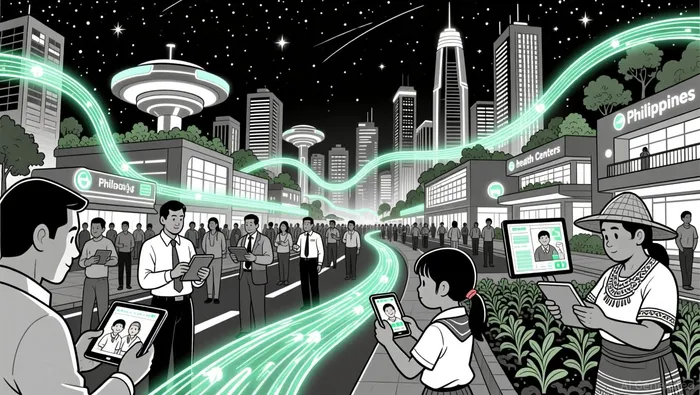
Economic Impact: A $150 Billion Digital Economy by 2030
The economic implications of these investments are staggering. The Philippines' digital economy, valued at $35.4 billion in 2023 according to trade data (8.4% of GDP), is on a trajectory to reach $150 billion in gross merchandise value by 2030 as forecasted. This growth is fueled by digital-enabling infrastructure, including telecommunication services and professional business services. The Second Digital Transformation Development Policy Loan, approved in November 2024, is modernizing archaic policies like the 1931 Radio Control Law to foster competition in the broadband sector according to World Bank reports. These reforms are expected to increase fixed broadband subscriptions per 100 people from 7.9 in 2022 to 35.0 by 2026 as projections indicate, a 343% surge that will catalyze demand for digital services.
Private-sector collaboration is equally vital. The Philippine Startup Development Programme and initiatives like Tech4ED and Project SPARK are upskilling micro, small, and medium enterprises (MSMEs) in digital marketing and e-commerce as initiatives show. By integrating MSMEs into the digital value chain, the government is fostering innovation-led development aligned with the Philippine Development Plan according to trade reports.
Case Studies: Proven Success in Digital Payments and E-Governance
Concrete outcomes validate the efficacy of these initiatives. The Paleng-QR PH digital payment program, adopted by 132 local government units (LGUs) as of September 2024 as video reports show, is a standout example. In La Paz, Abra, the program-branded as "Paleng-QR PH Plus"-has streamlined transactions in public markets and transportation, reducing cash-handling risks and long queues as observed. An academic study on Ozamiz City's public mall further highlights the program's scalability, showing high vendor adoption rates according to research.
Similarly, the eLGU system has digitized local government services, enabling residents to access permits and clearances online as initiatives show. The eGov PH Super App, consolidating these services into a single platform, enhances transparency and efficiency as trade reports indicate. These tools are especially transformative in GIDAs, where DTCs and free Wi-Fi programs are bridging infrastructure gaps as documented.
Global Partnerships and Policy Alignment
The Philippines is not building in isolation. The DICT has signed memoranda of understanding (MoUs) with Estonia, Japan, and other nations to exchange insights on e-governance and cybersecurity as initiatives show. Collaborations with the International Telecommunication Union (ITU) and ASEAN ensure alignment with global standards, including the ASEAN Digital Masterplan as partnerships indicate. These partnerships position the Philippines as a digital leader in Southeast Asia and a key player in global policy-making.
Investment Opportunities: A Call to Action
For investors, the Philippines offers a compelling mix of strategic infrastructure projects and a rapidly expanding digital economy. The World Bank's Digital Infrastructure Project and the Digital Transformation Development Policy Loan are just the beginning as reports show. Private-sector players can capitalize on opportunities in broadband infrastructure, AI-driven agriculture solutions, and fintech innovations like Paleng-QR PH as analysis suggests.
The government's Cloud First Policy and national broadband plan are addressing rural connectivity challenges as trade data indicates, creating a fertile ground for tech startups and infrastructure providers. With the digital economy projected to contribute 9.4% to GDP by 2026 according to trade forecasts, the ROI for early-stage investments is substantial.
Conclusion
The Philippines' digital transformation is not a fleeting trend but a foundational shift in governance and economic strategy. By 2026, strategic infrastructure investments will have laid the groundwork for a resilient, inclusive, and globally competitive public-sector tech ecosystem. For investors, the message is clear: the time to act is now.







Comentarios
Aún no hay comentarios