
U.S. Government Support and Its Impact on Intel's Strategic Rebound
The semiconductor industry has become a battleground for geopolitical influence, with nations pouring billions into domestic manufacturing to secure technological sovereignty. At the center of this contest is IntelINTC--, a once-dominant chipmaker now seeking a strategic rebound underpinned by unprecedented U.S. government support. The CHIPS and Science Act of 2022, coupled with targeted subsidies and tax incentives, has positioned Intel to reclaim a pivotal role in the global supply chain. This analysis examines how these geopolitical tailwinds, combined with Intel's industry positioning, are reshaping the company's trajectory—and what this means for investors.
U.S. Government Support: A Catalyst for Intel's Resurgence
The Biden-Harris administration has allocated up to $7.86 billion in direct funding to Intel under the CHIPS Act, alongside a 25% investment tax credit, to accelerate its manufacturing and advanced packaging projects in Arizona, New Mexico, Ohio, and Oregon[1]. This funding is part of a broader $52.7 billion federal package aimed at revitalizing U.S. semiconductor production[2]. Intel's $100 billion private investment plan, supported by these incentives, is expected to create tens of thousands of jobs and reduce reliance on foreign manufacturing hubs, particularly in Asia[3].
This support extends beyond the CHIPS Act. Intel previously secured a $3 billion contract for the Secure Enclave program, which focuses on producing leading-edge semiconductors for U.S. government use[4]. These initiatives reflect a strategic alignment between Intel's capabilities and national security priorities, as the U.S. seeks to counter China's growing influence in critical technologies.
Geopolitical Tailwinds: Redefining Supply Chain Resilience
The CHIPS Act is not merely an economic stimulus but a geopolitical countermeasure. By incentivizing domestic production, the U.S. aims to mitigate risks from global supply chain disruptions and reduce dependence on Taiwan, where TSMC—the world's largest foundry—produces most of the world's advanced chips[5]. Intel's expansion in the U.S. is thus framed as a national security imperative, with the company's fabs serving as a buffer against geopolitical volatility.
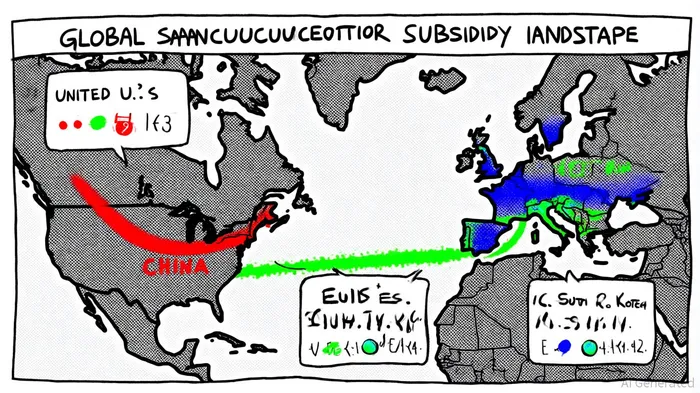
This strategy mirrors a global “chip war,” as nations like China, South Korea, and the EU launch their own subsidy-driven programs. China, for instance, has allocated $48 billion for its third phase of chip fund, while South Korea announced a $19 billion package in 2024[6]. The EU's €3.3 billion Chips Act aims to double its manufacturing capacity[7]. In this context, Intel's U.S.-first approach positions it as a key player in a fragmented but fiercely competitive landscape.
Industry Positioning: Intel vs. TSMC vs. Samsung
Intel's resurgence must be evaluated against its fiercest rivals. TSMC, with over 60% of the global foundry market share, leads in advanced process nodes (e.g., 2nm and 1.6nm) and packaging technologies like CoWoS, which are critical for AI and high-performance computing (HPC) chips[8]. Samsung, meanwhile, is advancing its Gate-All-Around (GAA) transistor technology in its 3nm process and expanding its global footprint[9].
Intel's strategy diverges: it is leveraging U.S. government support to prioritize domestic manufacturing and partnerships, such as its collaboration with Nvidia to develop AI chips[10]. While TSMC and Samsung focus on global scale and technological edge, Intel's alignment with national security goals gives it a unique advantage in accessing federal contracts and subsidies. However, this approach also exposes it to political risks, as policy shifts could alter the funding landscape.
Investment Implications: Balancing Opportunity and Risk
For investors, Intel's strategic rebound hinges on its ability to execute its $100 billion investment plan and capitalize on U.S. policy tailwinds. The company's access to federal funding reduces capital expenditure risks, while its partnerships with firms like Nvidia open new revenue streams. However, challenges remain: TSMC's technological lead and Samsung's aggressive expansion could erode Intel's market share in the long term.
Moreover, the global subsidy race introduces uncertainty. If the U.S. fails to maintain its funding pace relative to China or South Korea, Intel's competitive edge could diminish. Investors must also weigh geopolitical risks, such as trade tensions or regulatory changes, which could disrupt supply chains or alter subsidy eligibility.
Conclusion: A Nation's Champion in a Global Race
Intel's strategic rebound is inextricably tied to U.S. government support and the broader geopolitical contest for semiconductor dominance. While the CHIPS Act provides a critical lifeline, the company's success will depend on its ability to innovate, scale, and navigate a rapidly shifting global landscape. For investors, this represents both an opportunity—a bet on a national champion—and a risk, as the semiconductor industry's future remains as volatile as it is vital.





Comentarios
Aún no hay comentarios