
The U.S. Government's Strategic Stake in Intel: A New Era for Semiconductor Geopolitics and Investment Opportunities
The U.S. government's reported interest in taking a direct equity stake in Intel CorporationINTC-- marks a pivotal shift in how geopolitical strategy and industrial policy intersect with capital markets. This move, if finalized, would not only inject billions into a struggling chipmaker but also signal a broader reimagining of how the U.S. secures its technological edge in an era of intensifying global competition. For investors, the implications are twofold: a reevaluation of tech equity valuations in the context of state intervention and a recalibration of capital reallocation strategies to align with national security imperatives.
Geopolitical Leverage and the Reshaping of Tech Valuation
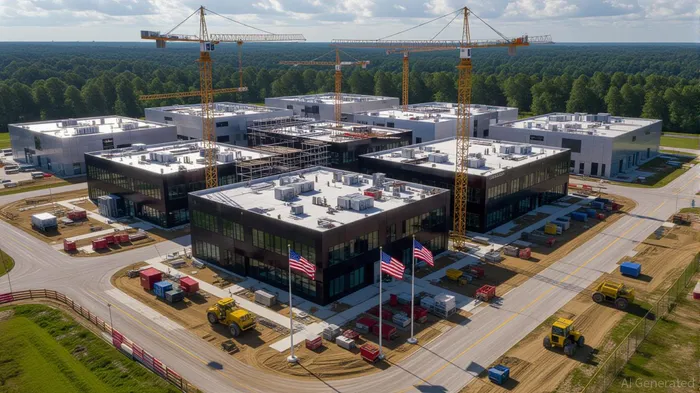
The Trump administration's engagement with IntelINTC-- is rooted in a simple yet profound premise: semiconductors are no longer just commodities—they are geopolitical weapons. By securing a stake in Intel, the U.S. aims to counter China's growing influence in the global chip supply chain, which has long relied on Taiwanese and South Korean manufacturers. Intel's Ohio factory, delayed but still central to the administration's vision, represents a physical and symbolic commitment to reshoring critical production.
This intervention reflects a broader trend of governments weaponizing capital. The U.S. has already taken a 15% cut of NvidiaNVDA-- and AMD's AI chip sales to China and injected $400 million into rare-earth producer MP MaterialsMP--. These moves are not about market efficiency but about ensuring that strategic assets remain under U.S. control. For investors, this means valuing tech companies through a dual lens: traditional financial metrics and the geopolitical utility of their operations.
Capital Reallocation and the New Industrial Policy
The potential stake in Intel is a departure from the CHIPS and Science Act's grant-based approach, which allocated $8.5 billion in subsidies. Instead, it signals a shift toward equity partnerships, where the government becomes a co-owner of critical infrastructure. This model offers both advantages and risks. On one hand, it provides Intel with stable, long-term capital to accelerate its Ohio project and compete with TSMCTSM-- and Samsung. On the other, it introduces political constraints—government stakeholders may demand operational controls to align with national security goals, potentially limiting Intel's flexibility in global markets.
For capital allocators, this creates a new calculus. The U.S. government's involvement could attract risk-averse investors seeking “safe” tech plays, but it also raises questions about corporate governance. Will Intel's board prioritize shareholder returns or government mandates? How will this affect R&D spending or international partnerships? These uncertainties could lead to a bifurcation in the semiconductor sector: state-backed “national champions” like Intel and more agile, privately held firms that avoid political entanglements.
Strategic Investment Opportunities
The Intel deal underscores a broader reallocation of capital toward sectors deemed vital to national security. Investors should consider three angles:
Direct Exposure to Government-Backed Tech: Companies like Intel, now with a potential government stake, may see reduced volatility as their operations become quasi-public assets. However, their valuations could become decoupled from traditional metrics like EBITDA or revenue growth, instead reflecting geopolitical risk premiums.
Indirect Beneficiaries: Firms supplying materials, equipment, or services to Intel's Ohio project (e.g., ASMLASML--, Lam Research) could see a surge in demand. A reveals its resilience amid sector-wide volatility, suggesting a potential tailwind from U.S. manufacturing expansion.
Geopolitical Hedging: As the U.S. and China vie for dominance, investors might hedge by diversifying across regions. For example, Japanese and European chipmakers, less entangled in U.S.-China tensions, could offer alternative growth avenues.
Risks and Cautionary Notes
While the government stake could stabilize Intel's finances, it does not address the company's core challenges: its lag in advanced chip manufacturing and its struggle to attract foundry customers. A shows a decline, raising questions about its ability to innovate without sustained investment. Additionally, the political nature of the deal introduces execution risks. If the administration imposes unrealistic timelines or operational mandates, the Ohio project could face further delays, eroding investor confidence.
Conclusion: A New Paradigm for Tech Investment
The U.S. government's potential stake in Intel is not an isolated event but a harbinger of a new era in tech investment. As nations increasingly treat technology as a strategic asset, investors must adapt to a landscape where capital flows are shaped as much by geopolitics as by market forces. For those willing to navigate the complexities, this shift offers opportunities—both in supporting the next generation of U.S. manufacturing and in identifying undervalued players in a fragmented, high-stakes sector.
In the coming months, the key will be to monitor how the administration balances its dual goals: fostering innovation and maintaining control. For now, the Intel deal serves as a case study in how capital and power are converging in the 21st century.





Comentarios
Aún no hay comentarios